Lulla TeamWe review current pediatric literature and synthesise it into accessible language for parents.
When your newborn won't sleep: what to check, in order
It's 23:00, your newborn has been awake for an hour and a half, and you're on your phone looking for what to do. Most of the articles you find explain one cause — the one the author happens to know — and apply it to every child. If it isn't your cause, you lose a week.
This page does something else: it gets you to your probable cause in a few minutes. Three questions that cut out most of the possible causes, then a table that links the exact symptom you can see to the page that solves it. Plus three things the other infant sleep guides skip: the middle-of-the-night wakings, the physical causes and the room.
The three questions that decide everything
1. Is this actually a problem?
Add up how much your infant slept in the last 24 hours, daytime plus night, and compare it with the range for their age. If the total is inside the range, they sleep the night in one stretch and wake up cheerful in the morning, you don't have a sleep problem — you have a schedule problem: they sleep enough, just not when you need them to, and the fix is to shift the times. If the total is inside the range but the night keeps breaking up, you do have a sleep problem, and you go on to the next question.
The ranges, in short: 0–2 months 14–17 h per 24 hours, 3 months 13–16 h, 4–11 months 12–15 h, 12–24 months 11–14 h. These are wide ranges, not targets, and the differences between two healthy children of the same age are large. The exact range for their month, together with the model day, is on the age page:
Newborn · 1 month · 2 months · 3 months · 4 months · 5 months · 6 months · 7 months · 8 months · 9 months · 10 months · 11 months · 12 months · 13 months · 14 months · 15 months · 16 months · 17 months · 18 months · 19 months · 20 months · 21 months · 22 months · 23 months · 24 months
2. Won't fall asleep, or falls asleep and then wakes?
These are two different problems, with different causes, and almost all the bad advice comes from mixing them up. If it takes more than 30 minutes to fall asleep, you look at how long they were awake and at what time you put them down. If they fall asleep in three minutes but wake four times, you look at how they fell asleep — at the conditions they go looking for again at 1 in the morning. And the advice you hear most often, “keep them up longer, so they're properly tired”, solves neither of them and can make both worse: a child kept past their window takes longer to fall asleep and wakes more often.
3. For how long?
Three bad nights are not a pattern. Children have bad nights for no reason at all: a busier day, a blocked nose that clears, an afternoon at their grandparents'. A pattern means one or two weeks in the same direction. This rule decides whether you get to change something or only to wait — and it's the one most often broken, because by the third night nobody has any patience left.
The clock tells you the cause
The time they wake up is the cheapest piece of diagnostic information you have, and the one least often used as such. Four patterns, with four different causes:
- More than 30 minutes to fall asleep. Most often the wake window: too long and they're overtired, too short and they simply aren't sleepy. The range for each month tells you which way you got it wrong.
- Wakes 40–50 minutes after falling asleep. That's the end of the first sleep cycle. Every child wakes briefly at the switch between cycles; the question is whether they can get back to sleep on their own. That ability builds over the course of the first year — it isn't a switch they either have or don't. If they fell asleep in your arms, they go looking for your arms. In many children this also changes on its own, with age; a sleep training method only speeds up the change.
- Wakes in the middle of the night, at roughly the same time every night. A clock, not hunger. Real hunger doesn't run on a schedule. The section below gives you the test that separates the two.
- Wakes between 4 and 6 in the morning. Check this one in both directions, because they look identical. Either they've banked enough sleep that they can't fall back asleep — bedtime too early, too much daytime sleep. Or, more often, the opposite: they were awake too long before bedtime, and the last hour of sleep, the most fragile one, is the first to break. The causes and the four-step plan.
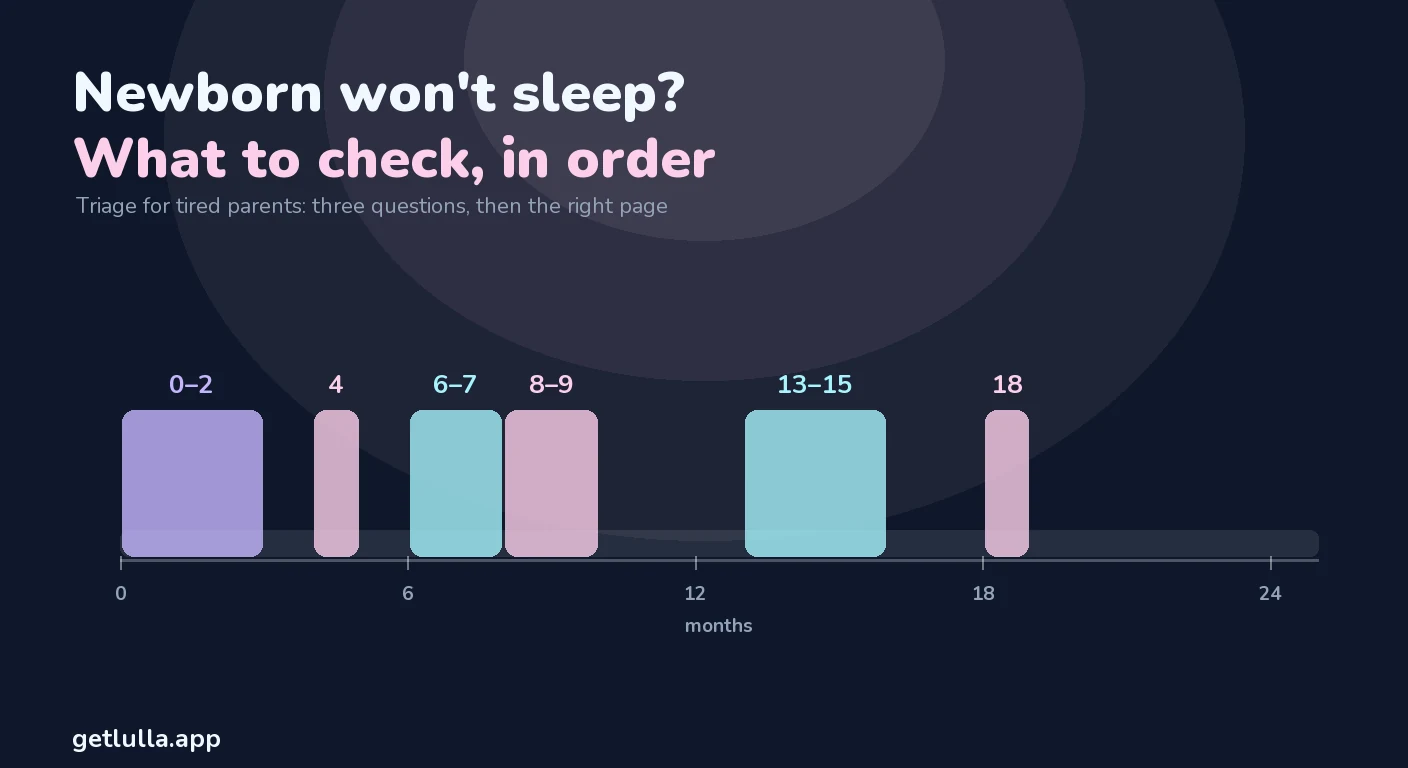
Sleep regressions: the 6 windows where sleep breaks on its own
Before you go looking for what you did wrong, look at the age. From birth to the second birthday there are six windows where sleep comes apart because of development — twelve months out of twenty-five. During one, don't add naps, and if you want to change the way they fall asleep, don't start on the worst nights; but keep checking bedtime and the wake window, because a regression on top of a schedule that was already wrong looks far worse than it is. The one change that almost always helps is an earlier bedtime.
- 0–2 months: there is no day/night rhythm yet, and sleep is scattered across the day as much as across the night. What's normal at this age.
- 4 months:the 4-month sleep regression — not a phase that passes and leaves sleep exactly as it was. At this age the structure of sleep matures for good; what passes are the bad nights, not the change.
- 6–7 months: the run-up to the drop from three naps to two — the third nap is still there at 6 months and goes at around 7. What the day looks like in this stretch.
- 8–9 months: they pull up to standing in the crib and separation anxiety arrives. What happens at 8 months.
- 13–15 months:the drop from two naps to one, the longest transition of the first two years. It usually starts here, but in some children it stretches toward 18 months.
- 18 months: more opposition than inability — they can fall asleep, they just want to be the one who decides. Not all of it is defiance, though: separation anxiety is still high at this age, so the firm limit comes with staying beside them. The chain of requests and what to do with it.
Your symptom, the page that solves it
Find the row that looks most like what you're seeing. If two of them fit, start with the one you can test tonight: the first rows ask you to change the clock, the last ones ask for a plan that runs a few nights.
| What you see | Probable cause | Where the answer is |
|---|---|---|
| Fights it for 30–40 minutes in the crib, evening after evening | Wrong wake window | Wake windows by age |
| Cries, arches their back and rubs their eyes before every sleep | Overtiredness | The tired signs |
| Falls asleep only in your arms, at the breast or with a bottle | Sleep association | How they learn to fall asleep on their own |
| Naps 30 minutes and wakes up crying | Short nap at the end of one cycle | How many naps and how long each one lasts |
| Screams an hour after falling asleep, doesn't recognize you | Night terror | Night terror, nightmare or bedtime fear |
| Wakes at 5 in the morning and won't go back to sleep | Sleep pressure used up | Early waking |
| Started suddenly three or four days ago, around 4 months | Sleep regression | The 4-month regression |
| At 14 months, refuses the morning nap and crashes at 17:00 | The 2 → 1 nap transition | Moving to a single nap |
| The evening looks different every day | No routine | The evening routine |
| You simply want the schedule for their month | — | The age-by-age schedule, with PDF |
The middle-of-the-night wakings
Between 23:00 and 4 in the morning is the stretch that gets written about least, even though that's where most nights are lost. There's only one practical question: is it real hunger or is it habit?
Before that, one thing that isn't up for negotiation: where they sleep stays the same at three in the morning as at seven in the evening — on their back, on a firm flat surface, in their own empty crib, in your room. If you feed them or rock them at night, do it only for as long as you're sure you'll stay awake, and put them in the crib before you fall asleep yourself. Falling asleep together on a couch or in an armchair is the highest-risk situation of the whole night.
Three criteria that tell them apart, and all three can be checked in a single night:
- How much they actually eat. Real hunger means a full feed, with swallowing, not two minutes of sucking and done. If they fall asleep halfway through, food isn't what woke them.
- What they do right afterward. If they fall back asleep within a few minutes and stay asleep, it was a real need. If they stay awake and cheerful, the need was a different one.
- What time it happens. Real hunger varies from one night to the next. A waking that lands at 1:40 every night isn't hunger, it's a clock — usually the end of a cycle the child can't yet get through on their own.
Under 6 months, waking to feed is normal and isn't something you “fix”. Over 6 months, if all three criteria point to “habit”, you're dealing with the same cause as the 40-minute waking, not with hunger.
When it's something physical, not the schedule
Sometimes you did nothing wrong. What tells a physical cause apart from a schedule one comes down to three things together: it started suddenly, from one night to the next; there is a second symptom — a blocked nose, changed stools, irritated skin, a fever, pulling at an ear; and it doesn't respond to any adjustment of the timings. When you have all three, stop fiddling with the schedule.
Two causes, though, get far more blame than they deserve, and both of them cost you weeks if you believe them:
- Teething. A 2025 study filmed the sleep of 849 infants, night after night for four weeks, and compared the nights on which parents reported teething with all the others. More than half the parents said their baby was sleeping badly because of teeth — the recordings showed no difference. An older cohort study, much smaller, didn't find the link either. Teething explains one bad evening, not three bad weeks.
- Reflux. The joint guideline of the North American and European societies for pediatric gastroenterology explicitly recommends not giving acid-suppressing medication for crying and fussing in otherwise healthy infants, and unsettled sleep doesn't appear in any recommendation as a reason to start such treatment. If one has been suggested so that your baby will sleep, it's worth asking again. When there is forceful vomiting, refusal to feed or growth that stalls, that's a different conversation, and it belongs with your doctor.
The room, in two minutes
It's the check with the best payoff for the least effort, and you only do it once. Four things:
- Real darkness. Not “half-dark”. If you can see your hand clearly a foot from your eyes, there is too much light for the last part of the night.
- 61–68 °F (16–20 °C), the range recommended by The Lullaby Trust. Too warm is more often the problem than too cold, and a child who is wrapped too warmly wakes up without being able to say why. Feel the back of their neck, not their hands — hands are cold even on a child who is sweating.
- An empty crib. No pillows, loose blankets, bumpers or soft toys before 12 months, and on their back for every sleep. That's the safe-sleep rule, not a preference.
- Sound, if you use it. The phone or machine outside the crib, with the cable kept away from your baby, where they can't grab it. White noise: how loud and how long.
The red flags
These don't get solved with a schedule. Tell your pediatrician if you see any of them. The first one won't wait until tomorrow:
- Hard to wake or floppy, with no muscle tone: call 911 or go to the ER. That isn't a sleep sign, it's a sign of illness. The same goes if they fall straight back to sleep after you've woken them, or if they're under three months old and have a temperature of 38 °C (100.4 °F) or higher, even if they otherwise seem fine. If they're eating visibly less or suddenly sleeping far more than usual, but they wake up when you wake them, call the doctor the same day; what to check instead of hours.
- Snoring on most nights, mouth breathing, or breathing with visible effort. The American Academy of Pediatrics practice guideline asks the doctor to ask about snoring at routine visits — the guideline covers children over one year, and the reason is that parents almost never raise the subject themselves. Tell them, if they don't ask you. In a newborn, short pauses followed by faster breathing are normal; what gets flagged is constant snoring and visible effort.
- Poor weight gain, persistent vomiting, blood in the stool or severe eczema. These get assessed on their own, regardless of sleep — you don't wait to see whether the nights sort themselves out.
- Total sleep much lower than usual, for weeks on end, together with daytime irritability. Not one night — a pattern that runs for weeks. Compare your baby with themselves, not just with the range: in a newborn, a total below the range is common and, if they're feeding, wetting diapers and growing, it isn't a sign of illness.
- Inconsolable crying, very different from their normal. Especially if it starts suddenly, after weeks of being fine.
What to do tonight, in 15 minutes
If you got here with your child in your arms and have no time for a two-week plan, do just this:
- Turn off everything stimulating: screens, white light, play, visitors. The lights go down half an hour beforehand, not in the last minute.
- 20 minutes of settling in a dark room, without trying to get them to sleep. The aim is to bring the agitation down, not to win the fight.
- Tomorrow evening, put them down 30 minutes earlier than today — and hold that time for three or four days before you decide whether it worked. If they're overtired, an earlier bedtime is the only thing that works fast.
- Don't change the method tonight. A new settling method is something you choose ahead of time, during the day, together with the other parent, not at 23:00 with your child in your arms.
How Lulla helps
The triage above asks for one thing memory can't give you: what actually happened over the last two weeks. What time they woke each time, how many times they woke at night, how much they banked over 24 hours. In Lulla, every sleep has a start and an end time, and you log the awakenings in the sheet that comes up after the sleep. In History, sleeps are grouped by day, and you see the awakenings when you tap a sleep. The day's total appears on the Home screen, under “Today's sleep,” and below it, next to the average for the past week, you see the range of hours for your child's age — which is exactly the set of figures the first and third questions in this guide ask for. And if there are two of you, sharing means you both see the same night, not two versions of it.
Worth remembering: the 24-hour sleep ranges this article points to are those of the National Sleep Foundation, with the transition at 3 months smoothed by us to 13–16 hours. The American Academy of Sleep Medicine, whose recommendation has been endorsed by the American Academy of Pediatrics, gives 12–16 hours at 4–12 months and makes no recommendations below 4 months. The article is for information, not medical advice. For any concern about your child's sleep, breathing or growth, your pediatrician is still the first place to go — they have the full history.
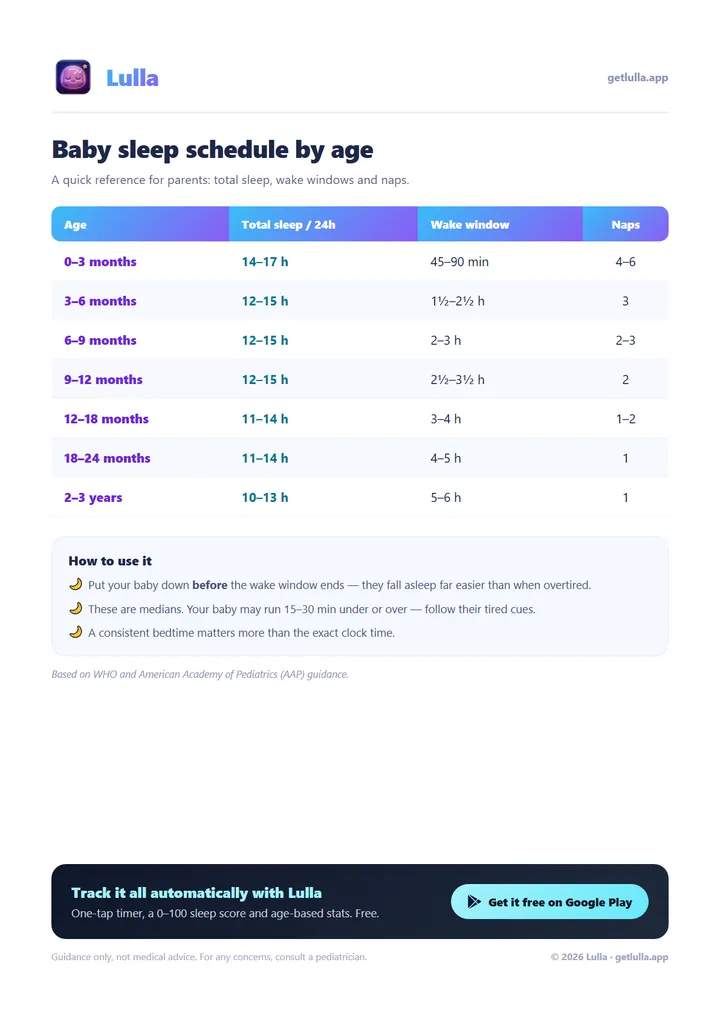
Your baby's sleep schedule, by age
Your baby's sleep schedule, by age
One table with everything that matters: total sleep per 24h, wake windows and number of naps, from newborn to age 3. Total sleep follows the National Sleep Foundation recommendations.
Sources and references
This article draws on official guidelines and peer-reviewed studies. Verify the sources directly:
- Iglowstein I, Jenni OG, Molinari L, Largo RH. Sleep duration from infancy to adolescence: reference values and generational trends. Pediatrics. 2003;111(2):302–307.
- Galland BC, Taylor BJ, Elder DE, Herbison P. Normal sleep patterns in infants and children: a systematic review of observational studies. Sleep Medicine Reviews. 2012;16(3):213–222.
- Paruthi S, Brooks LJ, D’Ambrosio C, Hall WA, Kotagal S, et al. Recommended Amount of Sleep for Pediatric Populations: A Consensus Statement of the American Academy of Sleep Medicine. J Clin Sleep Med. 2016;12(6):785–786.
- Moon RY, Carlin RF, Hand I; AAP Task Force on Sudden Infant Death Syndrome and the Committee on Fetus and Newborn. Sleep-Related Infant Deaths: Updated 2022 Recommendations for Reducing Infant Deaths in the Sleep Environment. Pediatrics. 2022;150(1):e2022057990.
- Marcus CL, Brooks LJ, Draper KA, Gozal D, Halbower AC, et al. Diagnosis and Management of Childhood Obstructive Sleep Apnea Syndrome. Pediatrics. 2012;130(3):576–584.
- Kahn M, Lucchini M, Oster E, Thakur S, Waugh M, Barnett N. Does Teething Disrupt Infant Sleep? A Longitudinal Auto-Videosomnography Study. J Pediatr. 2025;279:114461.
- Wake M, Hesketh K, Lucas J. Teething and tooth eruption in infants: a cohort study. Pediatrics. 2000;106(6):1374–1379.
- Rosen R, Vandenplas Y, Singendonk M, Cabana M, Di Lorenzo C, et al. Pediatric Gastroesophageal Reflux Clinical Practice Guidelines: Joint Recommendations of the North American Society for Pediatric Gastroenterology, Hepatology, and Nutrition (NASPGHAN) and the European Society for Pediatric Gastroenterology, Hepatology, and Nutrition (ESPGHAN). J Pediatr Gastroenterol Nutr. 2018;66(3):516–554.
- The Lullaby Trust. Your baby’s room temperature: the recommended room temperature for babies is 16–20°C.
- Hirshkowitz M, Whiton K, Albert SM, Alessi C, Bruni O, et al. National Sleep Foundation’s sleep time duration recommendations: methodology and results summary. Sleep Health. 2015;1(1):40–43.
📖 Read also:
- Wake windows by age: the full chart from newborn to 2 years
- How many naps by age: the full chart and the 4 nap drops
- Baby waking up at 5 AM? Why it happens and what to do
- Sleep training methods: Ferber, cry it out, the chair and what studies show
Or check out the complete baby sleep guide — all 7 articles condensed in one place.