Lulla TeamWe review current pediatric literature and synthesise it into accessible language for parents. All recommendations follow WHO and AAP guidelines.
How to build the perfect sleep routine for your baby

A well-established sleep routine is the most powerful tool you have as a parent. It's not about rigidity — it's about predictability. Babies feel safe when they know what comes next.
Why does the routine matter?
In a study of 10,085 mothers across 14 countries, babies with a nightly routine fell asleep in about 18 minutes on average, against 24 without one, and spent 19 minutes awake at night instead of 67 (Mindell et al., Sleep, 2015). That is an association, not proof of cause — but a separate study by the same team, in which a routine was deliberately introduced, found significant reductions in time to fall asleep and in night wakings (Mindell et al., Sleep, 2009). Their bodies learn to produce melatonin at the same time every evening.
The ideal routine in 4 steps
1. Warm bath (6:30 pm) — Not for hygiene, but for the thermal signal. Warm water raises body temperature, and the subsequent cooling triggers drowsiness. 10 minutes is enough.
2. Light massage (6:45 pm) — 5 minutes of massage with lavender (if tolerated) calms the nervous system. Slow movements, from head to feet.
3. Story or song (7:00 pm) — Your voice is the best falling-asleep tool. It doesn't matter what you read — it's the rhythm and soothing tone that count. In Lulla you have 120 personalized stories featuring your baby's name.
4. Bedtime (7:15-7:30 pm) — Put baby in the crib drowsy but awake. That teaches them to fall asleep on their own — the most important sleep skill.
Common mistakes
- Routine too long (over 45 min) — baby gets overstimulated
- Screens in the last 2 hours — blue light blocks melatonin
- Changing the routine on weekends — consistency is key
- Skipping the routine when you're tired — that's exactly when it matters most
How Lulla helps you
Set the bedtime in Lulla and you'll get an automatic reminder. Track your consistency with the Sleep Score — the "Rhythm" component shows how steady your bedtime is. Goal: under 30 minutes of variation.
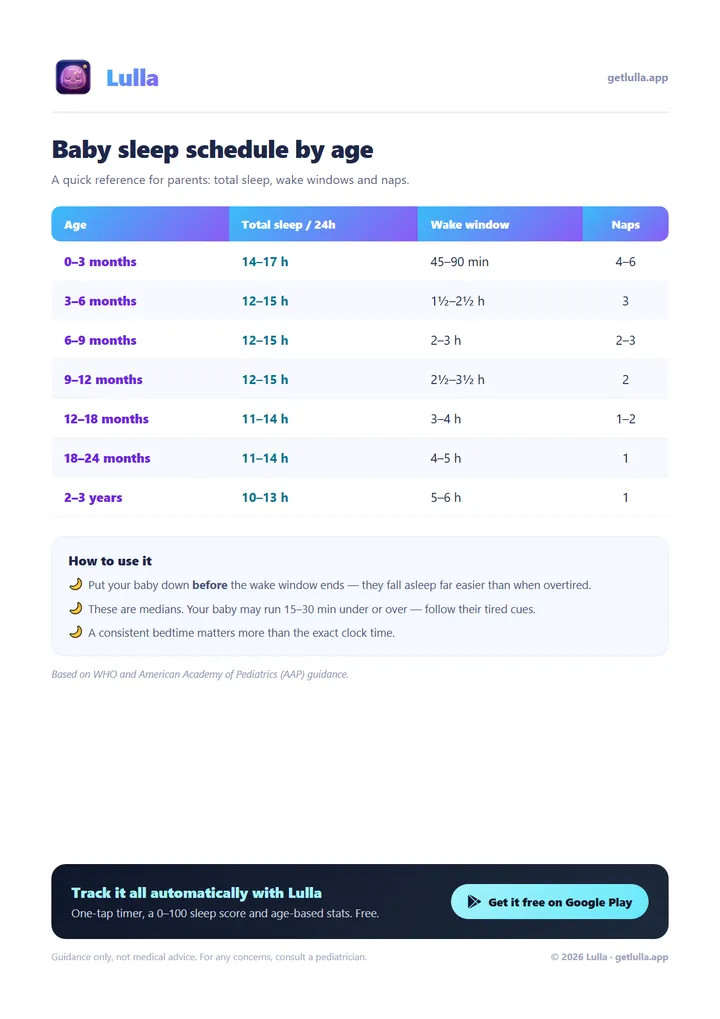
Your baby's sleep schedule, by age
Your baby's sleep schedule, by age
One chart with everything that matters: total sleep per 24h, wake windows and number of naps, from newborn to age 3. Based on WHO and AAP guidance.
Sources and references
This article draws on official guidelines and peer-reviewed studies. Verify the sources directly:
- Mindell JA, Telofski LS, Wiegand B, Kurtz ES (2009). A nightly bedtime routine: Impact on sleep in young children and maternal mood. Sleep, 32(5), 599–606.
- Mindell JA, Li AM, Sadeh A, Kwon R, Goh DYT (2015). Bedtime routines for young children: A dose-dependent association with sleep outcomes. Sleep, 38(5), 717–722.
- American Academy of Pediatrics — Healthy Sleep Habits (HealthyChildren.org)
- National Sleep Foundation — Bedtime Routines for Children
📖 Read also:
- How many hours should your baby sleep? Age-by-age guide
- The 4-month sleep regression: what it is and how to get through it
- White noise vs. natural sounds: which works better?
Or check out the complete baby sleep guide — all 7 articles condensed in one place.