Lulla TeamWe review current pediatric literature and synthesise it into accessible language for parents. All recommendations follow WHO and AAP guidelines.
From 2 naps to 1: when it happens and how to do it without chaos

At 14 months they lie awake for 40 minutes in the crib at the morning nap, then fall asleep at 5:00 PM and wake up at 9:30 PM full of energy. Nothing is broken and you haven't done anything wrong. They're moving from two naps to one — the longest sleep transition of the first two years.
When it happens
Usually between 13 and 18 months. The benchmarks we use on our age pages show exactly that: at 13, 14 and 15 months you see one or two naps, and from 16 months a single one.
The window is wide because the differences between children are big, and that's the norm, not the exception. The Zurich longitudinal study followed 493 children precisely so it could draw percentiles — that is, show how wide the normal range is at each age. A meta-analysis of 34 studies finds an average of 11.9 hours of sleep per 24 hours in toddlers, with a normal range from 9.9 to 13.8 hours. Almost four hours of difference between two equally healthy children.
The American Academy of Sleep Medicine recommends 11-14 hours per 24 hours for 1-2 year olds, daytime naps included. If yours lands inside that range and wakes up rested, the number of naps matters less than the total.
The 5 signs it's time
- They fight the morning nap. They lie awake 20-30 minutes in the crib, even though you know they're tired.
- If they nap in the morning, they refuse the afternoon nap. Or the other way round — but they no longer do both.
- To fit both naps in, bedtime drifts past 9:00 PM.
- They start waking early or during the night, even though they used to sleep well. Waking at 5 AM often has this cause.
- They skip a nap four or more times a week, entirely on their own.
The rule that matters most: the signs have to last one to two weeks, not two days. A child who refuses a nap three days in a row because they're teething isn't ready for the transition; they're just a child who's teething.
How to make the switch, step by step
Don't cut the morning nap overnight. You move it.
- Push it 15-30 minutes later every 3-4 days. From 9:30 to 9:45 AM, then 10:15, then 10:45.
- Target: asleep between 12:00 and 12:30 PM. That's where the single nap settles, and that's where it stays for years.
- Move lunch to before the nap, not after. A hungry child won't sleep for two hours.
- Earlier bedtime, for the whole stretch. 6:30-7:00 PM isn't excessive in these weeks. Night sleep makes up for what was lost during the day.
- Mixed days are allowed. If they slept 40 minutes and they're a wreck by 4:00 PM, give them a short nap and put them to bed late that evening. You haven't broken anything.
The middle weeks
The part nobody tells you: the transition takes between two and six weeks, and in the middle of it the schedule looks chaotic. Two naps on Monday, one on Tuesday, a dreadful day on Wednesday. It's normal and it passes.
For reference, at 16-17 months our benchmarks show wake windows of 4-5 hours. That means a child who wakes at 7:00 AM can make it to 12:00 without falling apart — but only once the transition has settled, not on day one.
Three mistakes that drag the transition out
- You do it at the same time as something else. A new daycare, a house move, a new sibling, teeth. Pick a boring stretch.
- You leave bedtime unchanged. This is the most common one. The child loses 45 minutes of daytime sleep and nobody gives it back — that's how they end up overtired, and the tiredness signs turn into false energy in the evening.
- You give up after three days. The first days are the worst of the whole transition. If you go back to two naps every time it gets hard, you stay stuck for months.
How Lulla helps
This transition is won with data, not impressions — because the days are so different that memory misleads you. Log every nap in Lulla and check in the stats whether the 24-hour total really dropped or only moved. And if there are two of you, share the tracking: in these weeks it matters enormously that you both see the same schedule.
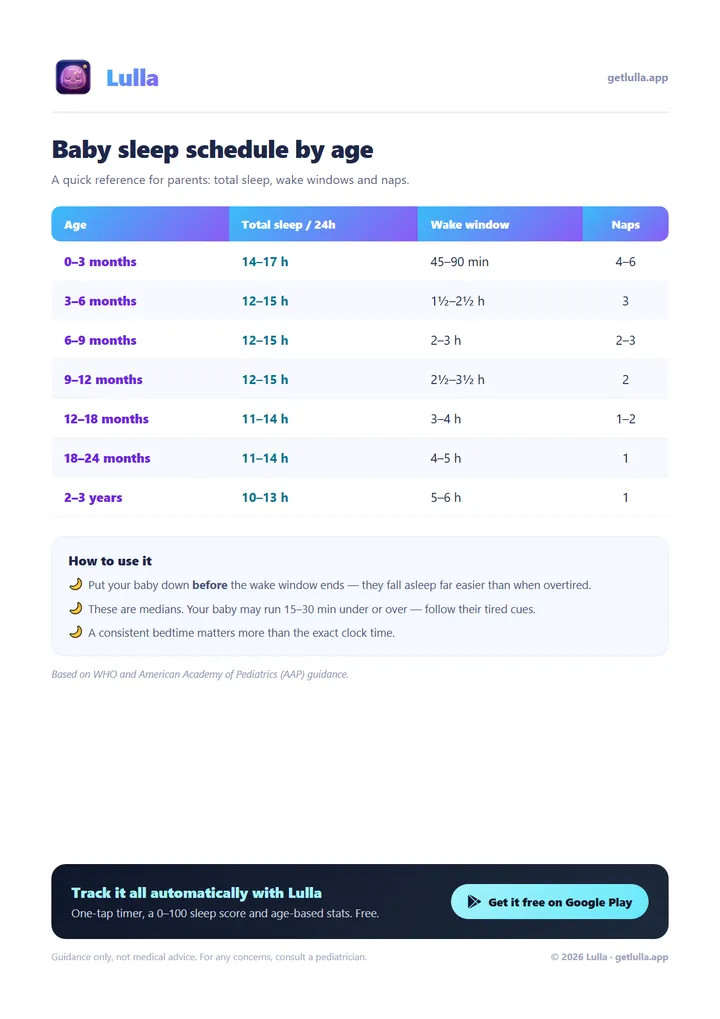
Your baby's sleep schedule, by age
Your baby's sleep schedule, by age
One chart with everything that matters: total sleep per 24h, wake windows and number of naps, from newborn to age 3. Based on WHO and AAP guidance.
Sources and references
This article draws on official guidelines and peer-reviewed studies. Verify the sources directly:
- Iglowstein I, Jenni OG, Molinari L, Largo RH. Sleep duration from infancy to adolescence: reference values and generational trends. Pediatrics. 2003;111(2):302–307.
- Galland BC, Taylor BJ, Elder DE, Herbison P. Normal sleep patterns in infants and children: a systematic review of observational studies. Sleep Medicine Reviews. 2012;16(3):213–222.
- Paruthi S, Brooks LJ, D’Ambrosio C, Hall WA, Kotagal S, et al. Recommended Amount of Sleep for Pediatric Populations: A Consensus Statement of the American Academy of Sleep Medicine. J Clin Sleep Med. 2016;12(6):785–786.
📖 Read also:
- Baby tiredness signs: how to read them before the crying starts
- Baby waking up at 5 AM? Why it happens and what to do
- How to build the perfect sleep routine for your baby
Or check out the complete baby sleep guide — all 7 articles condensed in one place.