Lulla TeamWe review current pediatric literature and synthesise it into accessible language for parents.
The 4 month sleep regression — and the other 7 ages
They were sleeping six hours straight. For three nights now they have been waking every two. You haven't changed a thing — not the time, not the routine, not the room. They're four months old.
That's the one sleep regression that really earns the name. The other seven ages people search “regression” for are different things filed under the same label, and the difference isn't academic: at some of them you have to change the schedule, at others you have to do exactly the opposite and leave it alone. This guide separates them, using the same reference figures our age pages run on.
What actually happens at 4 months
In the first few months, a baby has essentially two states of sleep — one active, one quiet — plus stretches that don't clearly resemble either. At around three to four months, sleep reorganizes into the stages an adult has, with clear transitions between them. A home polysomnographic study followed 15 infants at 3, 6, 9, 12, 18 and 24 months. It can't pin down the month the reorganization happens — the first recording is at 3 months, the next at 6 — but it does show what happens from there on: REM sleep declines steadily, and the lighter stages increase.
There's only one practical consequence. After the change, your child surfaces between cycles several times a night, almost awake. If they know how to get themselves back to sleep, you don't hear it. If they don't, they call you — every single time.
You can see it in the figures too: at 4 months, the number of naps drops from four to three or four, the wake window grows from 1 h 15 – 1 h 45 to 1 h 30 – 2 h, and the night lengthens from 9–10 hours to 10–11. The schedule that worked at three months simply can't work at four.
It's the only one of them that isn't a phase. The bad nights pass; the reorganization of sleep doesn't run backwards — it's a step in the brain's maturing, not a stretch your child comes out of. It doesn't stop there, either: sleep goes on maturing for another two years or so, with REM declining gradually that whole time. Which is why “let it pass on its own” has a specific meaning here: the bad nights pass, the surfacing between cycles doesn't. What comes with age, in many children even without any method, is getting back to sleep on their own afterward.
The signs, in the order they usually arrive
Not all of them show up in every child, but the pattern is recognizable:
- Daytime naps shorten to 30–40 minutes. They end at the first surfacing between cycles, before the second one links on to it. This is usually the first sign, and it shows up a few days ahead of the nights.
- Night wakings become regular, not random. Every two hours, then every hour and a half — not at a different time each night.
- They fight bedtime even though they're clearly tired. They thrash around in the crib at the very time they used to fall asleep in three minutes.
- They ask for something back that they no longer needed. Your arms, nursing, rocking — the conditions they used to fall asleep in a month ago.
- They're awake and sociable at three in the morning. No crying; they smile, they babble, they want to play. It's the most confusing sign and it is normal.
What is not a sign of regression: a fever, a stuffy nose, a change in their stools, irritated skin. If any of those turn up, the cause is probably physical, and the schedule is not to blame.
“Regression” is one word for three different things
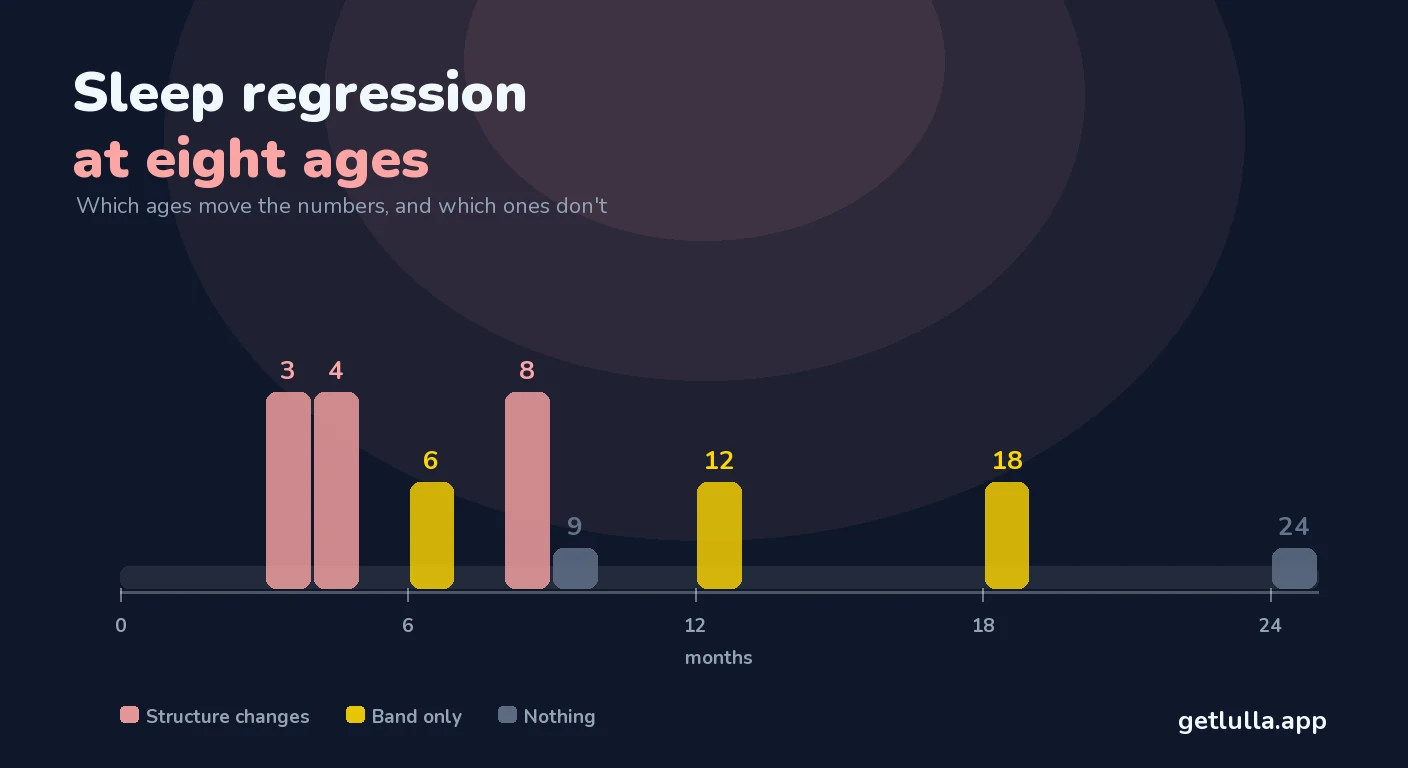
We took the eight ages parents search “regression” for and compared each one with the month before it, in the reference figures. The result splits the list into three — and not in the way you would expect.
1. The schedule has fallen behind — 3, 4 and 8 months
Here it's the structure that changes: the number of naps in the reference ranges drops, and the wake window band moves along with it. At 3 months a nap disappears from the model day itself. At 4 months the range opens up, 4 → 3–4, and the fourth nap actually goes at around 5 months; at 8 months it closes the other way, 2–3 → 2, after the model day had already moved to two naps, at 7 months. Your child hasn't broken; their schedule has expired. If you hold on to the old one, what you get is an overtired child on top of a biological change — which is exactly the nights you're describing. What works: you move the schedule, you don't defend it.
2. Only the band moves — 6, 12 and 18 months
The number of naps in the reference range stays the same, but the three ages don't ask for the same thing. At 6 and at 18 months the wake window widens by half an hour, and only at the top end: your child can stay awake longer, they don't have to. At 12 months no window moves at all — what drops is the total sleep needed over 24 hours, from 12–15 hours to 11–14, and there the adjustment runs the other way: you take sleep away, usually daytime sleep, you don't add awake time. What works: you adjust gradually and leave the rest alone. Two clarifications. At 6 months the figures don't move, but this month is the start of the switch from three naps to two — the third nap leaves the model day at around 7 months, so you adjust the window and let the transition settle at its own pace, without cutting anything. At 18 months the band is the only thing moving in the figures; what moves in real life is their will — you widen the window and then you stop, and the rest gets handled with a few limits, clear ones, always the same.
3. Nothing moves — 9 months and 2 years
At these ages the reference figures are identical to the month before. If sleep has fallen apart anyway, the cause isn't in the schedule — it's in your child: they pull up to standing and practice all night, they miss you when you leave the room, or they have discovered that they can ask for one more story. What works: you start from that cause, not from the clock. Do check the clock once, though — it may have drifted on its own over the past few weeks, and at 10 months the bottom end of the wake window goes up anyway, from 2 h 30 to 3 h, so a nine-month-old who is already at the top of the band asks for it a month early. But if the schedule is fine, don't change it just to be doing something: at these ages that is the most common mistake.
So do the “12 month” and “2 year” sleep regressions exist or not?
The question deserves a straight answer, because both have an established name and neither one is a regression in the sense the 4-month one is.
At 12 months something real does happen, but it's arithmetic, not neurology: the total needed drops from 12–15 to 11–14 hours, the first drop since month 4. If you hold on to the old schedule, the surplus goes into daytime sleep and the night thins out — it looks exactly like a regression, but it's a schedule left carrying half an hour too much. At 2 years, not even that: the ranges are identical to the month before. What changes at that age is the child — language, imagination, testing the limits — not how much sleep they need.
None of which means it doesn't hurt. It only means the answer is a different one: at 12 months you adjust, at 2 years you hold the limit.
The table, age by age
Each row leads to that month's page, with the full day's schedule. “What it's called” is the term that age gets searched under, not a verdict that it is a regression. “What moves” shows the single most important change from the month before, not all of them. And one clarification that changes what you can read out of the table: those bands aren't measurements of your child, they are the published recommendations for wide age brackets, split up by us month by month. So they have a resolution of one month. “Nothing” means that at this resolution we don't see a difference — not that nothing is happening in your child.
| Age | What it's called | What moves | What to do |
|---|---|---|---|
| 3 months | 3 month sleep regression | 4–5 → 4 naps | Move the schedule |
| 4 months | 4 month sleep regression | 4 → 3–4 naps | Move the schedule |
| 6 months | 6 month sleep regression | 2 h–2 h 30 → 2 h–3 h | Adjust gradually |
| 8 months | 8 month sleep regression | 2–3 → 2 naps | Move the schedule |
| 9 months | 9 month sleep regression | Nothing | Leave the schedule alone |
| 12 months | 12 month sleep regression | 12–15 h → 11–14 h | Adjust gradually |
| 18 months | 18 month sleep regression | 4 h–5 h → 4 h–5 h 30 | Adjust gradually |
| 2 years | 2 year sleep regression | Nothing | Leave the schedule alone |
8 and 9 months are two different things, even though they get searched the same way. At 8 months they settle onto two naps and the window lengthens — that is, the schedule really does change. “For good” would be overstating it: this arrangement holds until around 13 months. At 9 months the figures are identical to the month before: what is left is the behavioral part, the pulling up to standing and the separation anxiety. So the same “8 to 10 month sleep regression” asks for different things in month 8 and in month 9.
Two more things that are hard to see from a single row. At 3 months the schedule moves, the child doesn't change — and almost nobody searches for it: that is where a nap disappears from the model day and the window grows, which is exactly the schedule pattern of month 4, a month earlier. What's missing is the part that makes month 4 a regression: the change in the architecture of sleep. And the “12 month sleep regression” isn't really at 12 months: what happens at that age is that the total sleep needed drops, and from 13 months on comes the drop from two naps to one, which in some children stretches toward 18 months — the longest transition of the first two years. Plenty of people file both of them under “the one-year regression”.
How long it lasts
“Two to six weeks” is the figure that circulates, and it's worth saying where it comes from: not from a study. “Sleep regression” isn't a term from the medical literature — the phrase doesn't appear in any title or abstract indexed in PubMed — so nobody has ever timed how long it lasts, not at ten days and not at eight weeks. What can be checked runs the other way: overall, night wakings decrease over the first half of the year, they don't increase, and the fastest consolidation of sleep happens between month 1 and month 4. A worsening that stretches on for months is therefore not the usual pattern — but how long it lasts in your child is something nobody can tell you in advance.
For the 4-month one, though, the question is badly put. There you aren't waiting for a phase to pass — you're waiting for a child to learn a new skill in a world that changed underneath them. What passes are the terrible nights. The surfacing between cycles stays for good; what changes, gradually, is how often they get themselves back to sleep without you finding out. In a study that filmed babies at night, at 12 months half of the children still needed a parent to fall back asleep.
How to tell a regression from something else
Three signs together, and all three have to be true:
- It started suddenly, from one night to the next, rather than degrading gradually. A slow decline is almost always a schedule that has fallen behind, not a regression.
- There is no second symptom. No fever, no stuffy nose, no change in their stools, no irritated skin. If there is one, the cause is probably physical and it doesn't get fixed with the clock.
- It matches something in that month. If the nights broke at an age that isn't in the table above, look first at the nap transitions: at 13–15 months the drop from two naps to one begins, and that alone explains most of the “regressions at a year and a bit”. A “regression” at 17, at 20 or at 22 months is in no table at all — not in ours, and not in the list of ages that everyone repeats. And, to be exact: “sleep regression” isn't a term from the medical literature, so no age on any of those lists is “scientifically confirmed”. What can be checked is whether the reference figures move at that age or not.
If one of the three doesn't fit, the three-question triage gets you to the real cause faster than any article about regressions.
What works and what makes it worse
- Keep the routine, exactly the same, even if it feels pointless. In the weeks when nothing is working, the one thing that stays predictable for your child is the order of the evening's steps. The routine works through repetition and through keeping the same order, not through how elaborate it is.
- Put them down earlier, not later — with one exception. When a child is running a sleep deficit, and a child in a regression usually is, a bedtime 20–30 minutes earlier is the adjustment that asks for the least and changes the most. The exception is the child who is already banking above the top end of the 24-hour range — at 12 months, for instance, where the total needed itself drops: there the extra sleep you offer doesn't turn into sleep, it turns into hours awake in bed.
- Don't cut daytime sleep. “So they'll be more tired this evening” is the advice that most often drags a regression out: what you get is an overtired child, who takes longer to fall asleep and wakes more often.
- Don't start new habits that you'll have to undo. Rocking them all the way to sleep, a bottle at every waking, moving them into your bed — they all work tonight and they all become next month's problem. If you use them to get through a week, use them deliberately and briefly.
- Don't change something every evening. Give a change three or four days before you judge it. Otherwise, a week from now, you have no way of knowing what helped.
When to start sleep training, and when not to
The 4-month regression is both the point at which the ability to fall asleep alone becomes useful and the worst week in which to teach it. The two don't contradict each other — what settles it is the order you do them in.
In the middle of the worst nights you start nothing new. You wait for the peak to settle, and you take their age into account: from 4 months you can put them in the crib drowsy but awake, but none of the guidelines we read recommends controlled crying or extinction before 6 months. Sleep training methods and what the studies showed about each one have a guide of their own.
At the other ages in the table, there is no proven rule. In fact, the largest randomized trials of the methods included babies aged 6–8 months, and in one from Israel, in children aged 9–18 months, those with a lot of separation anxiety responded better with the parent staying in the room than with timed checks. If you want to try a method, choose one you can stick with.
How Lulla helps
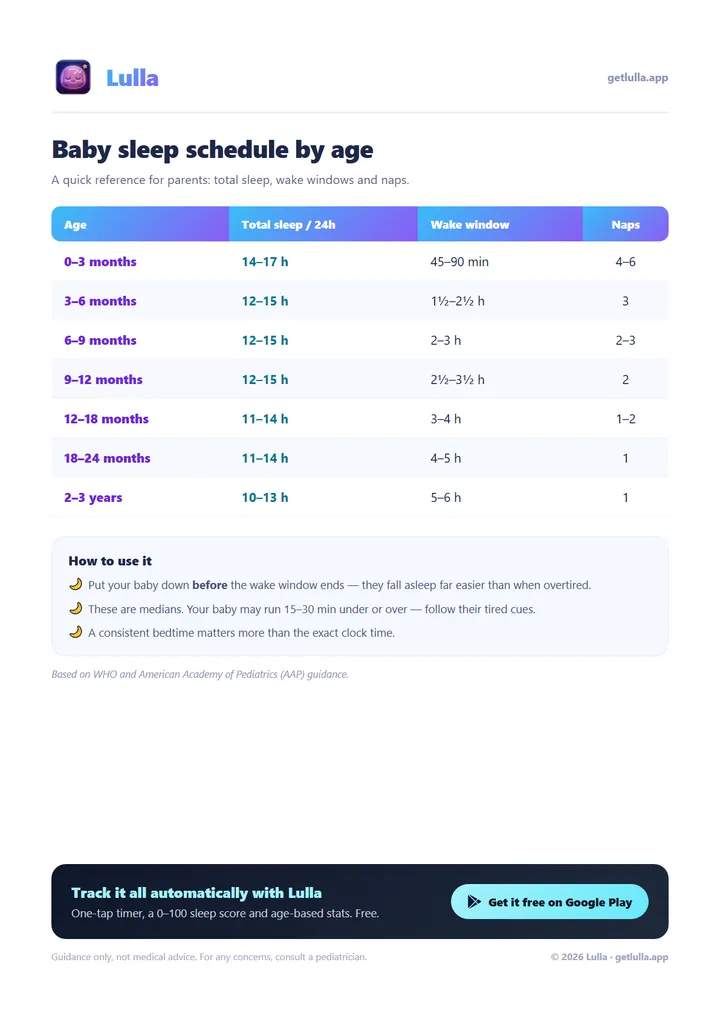
A regression is recognized by comparison, not from memory: this week against the ones before it. Lulla records every sleep and shows you what the nights looked like two weeks ago, when everything was working — what time they fell asleep, how many times they woke, how much they banked over 24 hours. That is how you see whether something broke suddenly or whether the schedule has been drifting for a month, which is a completely different problem. The sleep score drops for a while; that is normal, and it coming back up is the first sign that you're out. If you want the figures on paper, the free PDF by age pulls together total sleep, the wake window and the number of naps by age group, and each month's page has the full model day, with times.
Worth remembering: the 24-hour sleep range this article points to (12–15 hours at 4–11 months, 11–14 hours at 1–2 years) is the National Sleep Foundation's. The American Academy of Sleep Medicine, whose recommendation is endorsed by the American Academy of Pediatrics, gives 12–16 hours at 4–12 months and makes no recommendations for babies under 4 months. The night-sleep bands, the wake windows and the number of naps, month by month, are Lulla's reference figures, interpolated between the published brackets so that there can be a page for every month — not recommendations from these organizations. The article is for information, not medical advice. For any concern about your child's sleep, breathing or growth, your pediatrician is still the first place to go — they have the full history.
Your baby's sleep schedule, by age
Your baby's sleep schedule, by age
One table with everything that matters: total sleep per 24h, wake windows and number of naps, from newborn to age 3. Total sleep follows the National Sleep Foundation recommendations.
Sources and references
This article draws on official guidelines and peer-reviewed studies. Verify the sources directly:
- Louis J, Cannard C, Bastuji H, Challamel MJ. Sleep ontogenesis revisited: a longitudinal 24-hour home polygraphic study on 15 normal infants during the first two years of life. Sleep. 1997;20(5):323–333.
- Iglowstein I, Jenni OG, Molinari L, Largo RH. Sleep duration from infancy to adolescence: reference values and generational trends. Pediatrics. 2003;111(2):302–307.
- Galland BC, Taylor BJ, Elder DE, Herbison P. Normal sleep patterns in infants and children: a systematic review of observational studies. Sleep Medicine Reviews. 2012;16(3):213–222.
- Paruthi S, Brooks LJ, D’Ambrosio C, Hall WA, Kotagal S, et al. Recommended Amount of Sleep for Pediatric Populations: A Consensus Statement of the American Academy of Sleep Medicine. J Clin Sleep Med. 2016;12(6):785–786.
- Hirshkowitz M, Whiton K, Albert SM, Alessi C, Bruni O, et al. National Sleep Foundation’s sleep time duration recommendations: methodology and results summary. Sleep Health. 2015;1(1):40–43.
- Dias CC, Figueiredo B, Rocha M, Field T. Reference values and changes in infant sleep-wake behaviour during the first 12 months of life: a systematic review. J Sleep Res. 2018;27(5):e12654.
- Henderson JM, France KG, Owens JL, Blampied NM. Sleeping through the night: the consolidation of self-regulated sleep across the first year of life. Pediatrics. 2010;126(5):e1081–e1087.
📖 Read also:
- When your newborn won't sleep: what to check, in order
- Wake windows by age: the full chart from newborn to 2 years
- Sleep training methods: Ferber, cry it out, the chair and what studies show
- From 2 naps to 1: when it happens and how to do it without chaos
Or check out the complete baby sleep guide — all 7 articles condensed in one place.