Lulla TeamWe review current pediatric literature and synthesise it into accessible language for parents. All recommendations follow WHO and AAP guidelines.
Baby waking up at 5 AM? Why it happens and what to do
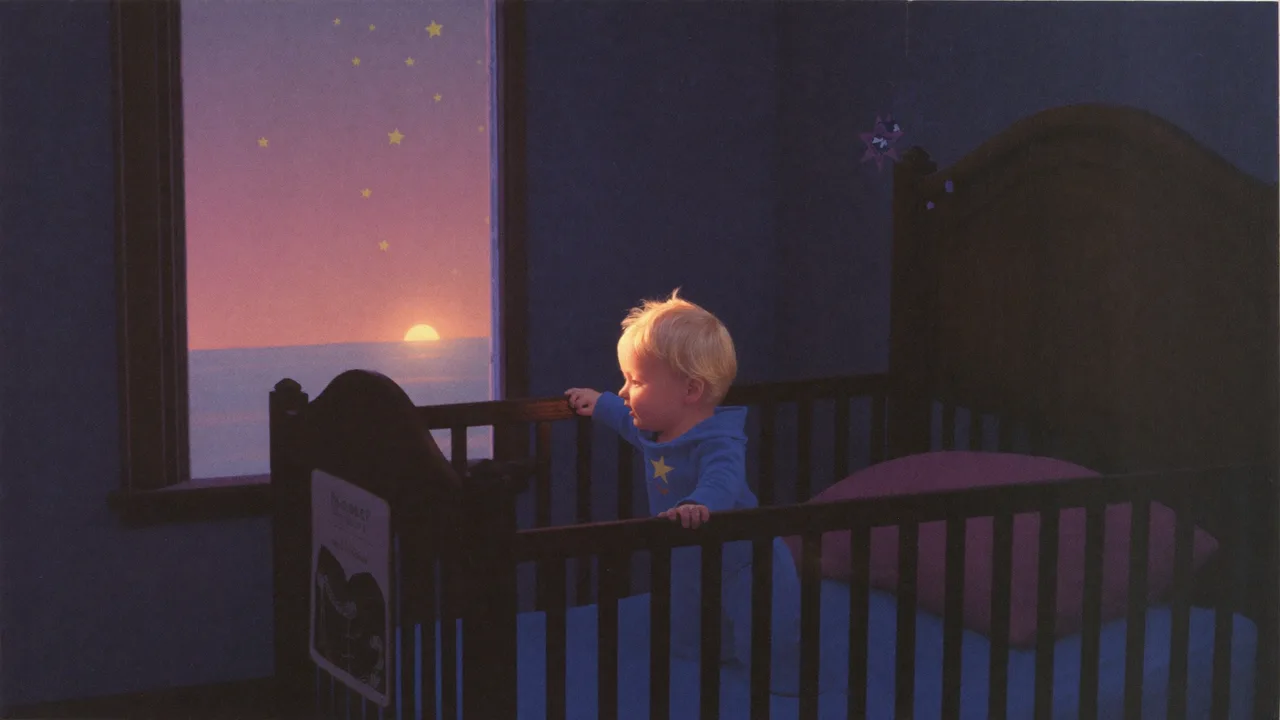
It's 5:07 AM and your baby is awake — fully awake, ready to play. If this scene repeats day after day, you're not alone: early waking is one of the most common (and most exhausting) sleep problems. The good news: in most cases it can be fixed.
What "early waking" actually means
We talk about early waking when a baby wakes before 6:00 AM and won't go back to sleep, even though they haven't completed their sleep needs. The difference from a night waking: after 4-5 AM, sleep pressure is almost used up, so falling back asleep is much harder than at 1 AM.
Why the last hour of sleep is the most fragile
Towards morning, your baby comes out of deep sleep and spends more and more time in light sleep. At the same time, melatonin naturally declines and cortisol starts to rise. The result: between 4:30 and 6:00, any stimulus — a ray of light, a garbage truck, hunger — can turn a normal micro-waking into a definitive one.
The 5 most common causes
1. Bedtime too late (the overtiredness paradox)
Counterintuitive but real: a baby put to bed too late wakes up earlier, not later. Overtiredness raises cortisol, and cortisol fragments precisely the last part of the night. If your baby falls asleep after 8:30 PM and wakes at 5, try a bedtime 30-60 minutes earlier — it sounds illogical, but it works surprisingly often.
2. Light
After 4 AM, even weak light (dawn through the blinds, a night light) suppresses the remaining melatonin. The golden rule: the room so dark that you can't see your hand 30 cm from your face. Blackout curtains are the most cost-effective investment against early wakings — especially in summer.
3. Morning noises
Birds, neighbours, pipes, the garbage truck — the city wakes up exactly during the fragile sleep window. Continuous white noise until the desired wake time masks these sounds.
4. Unbalanced daytime sleep
Too much daytime sleep (above the age requirement) or a late nap (after 4:30-5:00 PM in older babies) "steals" from the night's sleep pressure. Check the 24-hour total against the age-based recommendations and move the last nap earlier.
5. Hunger
In babies under 6 months, the 5 AM waking may simply be real hunger. The telltale sign: they feed eagerly and fall right back asleep afterwards. In that case there's nothing to fix — it's a phase that passes on its own.
The 4-step plan to push wake-up time later
- Treat any waking before 6:00 as a night waking — lights off, minimal interaction, monotone voice, no leaving the room. If at 5:15 your baby gets milk + lights + play, their internal clock learns: "the day starts at 5:15".
- Blackout + white noise until the target wake time.
- Adjust bedtime — earlier if they're overtired, in 15-minute steps.
- Stay consistent for 1-2 weeks. The circadian rhythm doesn't shift in 2 days. Log the times and judge the trend, not one isolated morning.
When it's just... their chronotype
Some children are simply early birds. If your baby wakes at 5:30-6:00 happy and rested and has completed their 24-hour sleep needs, you don't have a problem to fix — you have a little lark. Shift their bedtime and routine so the family schedule aligns with their rhythm, not the other way around.
How Lulla helps
To fix early wakings you need data, not impressions. Lulla shows you in the stats the real wake-up time, day by day, and the correlation with the previous evening's bedtime. After a week you'll see immediately whether an earlier bedtime pushes the morning later. The bedtime reminder keeps you consistent, and the tiredness signs tell you when to start the evening routine.
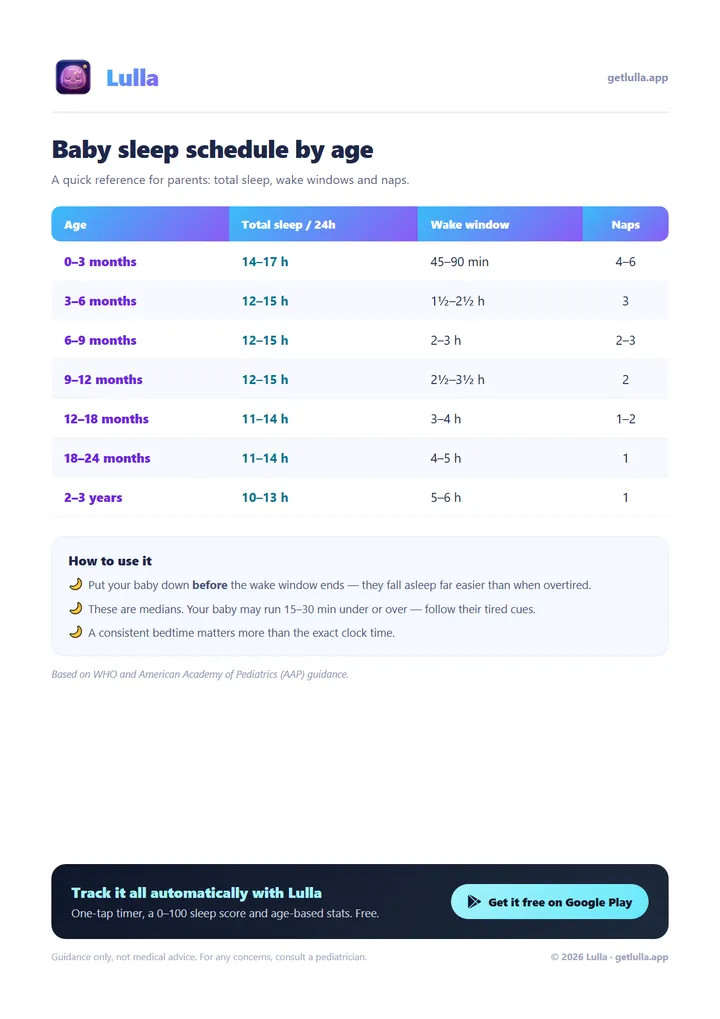
Your baby's sleep schedule, by age
Sources and references
This article draws on official guidelines and peer-reviewed studies. Verify the sources directly:
- American Academy of Pediatrics — Healthy Sleep Habits for Babies (HealthyChildren.org)
- National Sleep Foundation — Baby Sleep Hub: Early Morning Wakings and Sleep Pressure
- Mindell JA, Li AM, Sadeh A, Kwon R, Goh DYT (2015). Bedtime routines for young children: A dose-dependent association with sleep outcomes. Sleep, 38(5), 717–722.
- Galland BC, Taylor BJ, Elder DE, Herbison P (2012). Normal sleep patterns in infants and children: A systematic review. Sleep Medicine Reviews, 16(3), 213–222.
- World Health Organization (2019). Guidelines on physical activity, sedentary behaviour and sleep for children under 5 years of age.
📖 Read also:
- How to build the perfect sleep routine for your baby
- How many hours should your baby sleep? Age-by-age guide
- Baby tiredness signs: how to read them before the crying starts
Or check out the complete baby sleep guide — all 7 articles condensed in one place.