Lulla TeamWe review current pediatric literature and synthesise it into accessible language for parents.
Toddler night terrors vs. nightmares: how to tell them apart
It's 10:40 PM. They went down at 8:00 PM and were asleep in ten minutes. Now they're sitting bolt upright, screaming with their eyes open, drenched in sweat, heart pounding. You say their name and they look straight through you. You pick them up and they fight harder. After five minutes it stops on its own, they roll onto one side and sleep on as if nothing had happened. In the morning they remember nothing.
Another night, at 5 in the morning: crying, calling for you, reaching out with both arms, settled in thirty seconds once you hold them. And a third, in the evening, before falling asleep: they tell you there's something in the closet.
These are three different things that make the same sound, and all three are just as bad to live through. The good news is that you don't need any test to tell them apart: the clock does it for you. This page gives you the criterion, the figure nobody mentions, and the only cause genuinely worth looking for when the episodes keep coming back.
The clock tells them apart
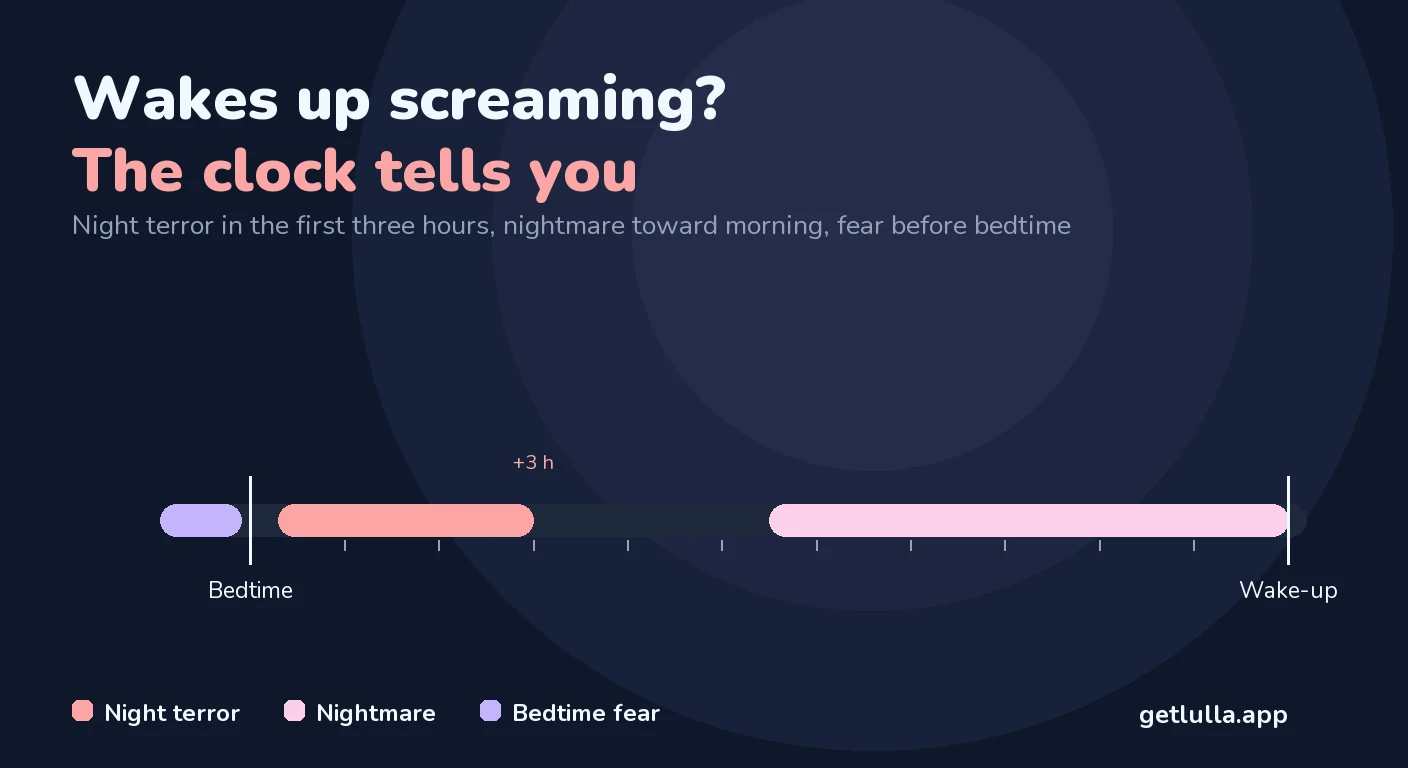
Sleep isn't uniform. Deep sleep dominates the first part of the night and is hard to come out of — that's where the night terror comes from, filed in the literature under sleep terrors, which the 2020 review places at the exit from stages three and four of non-REM sleep. The nightmare is the other half: a REM-sleep parasomnia, and REM sleep piles up toward the second part of the night. That is where the whole difference comes from: the same child, two mechanisms, two moments of the night.
| Night terror | Nightmare | Bedtime fear | |
|---|---|---|---|
| When | In the first three hours after falling asleep | In the second part of the night, toward morning | Before falling asleep, while they're awake |
| Do they recognize you? | No. Their eyes are open and they look straight through you | Yes, completely. They call you by name | Yes, and they negotiate |
| Does comforting help? | No. It usually makes it worse and drags it out | Yes, immediately | Yes, as long as the limit holds |
| In the morning | Remembers nothing | Remembers it and can tell you about it | Remembers it |
Leung's 2020 clinical review describes the episode exactly like that: it happens in the first three hours of the night, at the exit from deep sleep. The child is hard to wake and hard to comfort, with a racing heart, fast breathing, sweating and dilated pupils. In the morning, complete amnesia. If they tell you the next day what they dreamed, it wasn't a night terror.
One limitation of the table, for the ages on this site: under two years the last row tells you nothing, because the child can't tell you what they dreamed, or that they didn't dream. Until then you work with the first three rows, and the most reliable is the third: if your presence calms them, they were awake; if it makes things worse, they weren't.
Three things don't belong in any of the three columns, so you don't waste time looking for them here. Waking 40–50 minutes after falling asleep, with no screaming and no panic, is the end of the first sleep cycle — that's a different conversation. A waking that lands at the same time every single night, with the child awake and cheerful, is a clock, not a fright; the test that separates it from hunger is in the triage guide. And waking between 4 and 6 in the morning, with the child fully awake and not going back to sleep, falls in the same part of the night as a nightmare, but isn't one: it's an early waking, with causes and a plan of its own.
The figure that contradicts almost everything you'll find by searching
If you search for “night terrors”, you'll read everywhere that it's a preschooler's problem: it starts at around 4 years, peaks at 5–7 and most children are done with it by the end of adolescence. Leung's review says exactly that — between 1 and 6.5% of children aged 1–12, with the peak between 5 and 7 years.
Two cohorts that followed real children, from the very beginning, say something else entirely. The Quebec longitudinal study, published by Petit and colleagues in 2015, followed 1,940 children and asked the mothers every year. Peak prevalence of night terrors came at a year and a half: 34.4% of children (confidence interval 32.3–36.5%). A study of 390 pairs of twins, published in 2008, found 36.9% at 18 months and 19.7% at 30 months — half, in a single year.
34% against 6.5% is not a rounding difference. They are two different things, measured under the same name. The cohorts ask the mother whether the child wakes up screaming — and at 18 months confusional arousals are ordinary, and impossible for a parent to tell apart from a night terror proper. The clinical review counts diagnosed children, against criteria, usually referred to a specialist because the episodes were frequent or violent.
There is one more figure, from the same Quebec cohort, that overturns the second half of the expectation as well. A study of 987 children, followed from 5 months to 6 years, measured how often they had nightmares: between 1.3 and 3.9%. The authors title their conclusion exactly that way — less frequent than previously thought. In the age range we are talking about, the thing you are afraid of is the rare one, and the common one is the waking out of deep sleep, which looks far worse than it is.
The consequence for you is twofold. What you are seeing is very common — one child in three, in two different samples, at the age you are probably at right now. And it is almost certainly not the condition you read about: it is the same machinery, an incomplete arousal out of deep sleep, in a milder form, which fades on its own as sleep gets organized. On one condition, though, which we state here and come back to at the end: that the episodes are rare and short. When they are frequent and violent, this statistic no longer covers you.
One note of honesty you won't find in the summaries that cite this study: the Quebec cohort starts measuring at 18 months. So 18 months is also the earliest point measured, not only the peak. We can't rule out that it is even more common earlier — only that at the first age measured in a large cohort it is already at its maximum, and falls from there. And one more, in the same direction: the two cohorts don't confirm each other independently. They are different samples — 1,940 children and 390 pairs of twins respectively — but both followed in Quebec, by teams with five authors in common and with the same method: the question put to the mother.
What it actually is, at your child's age
Under 12 months, in babies: almost certainly something else
Neither of the two cohorts measures under 18 months, so the figures above say nothing about the first year — and absence of data is not evidence of absence. What we do know is that at this age there are far more common explanations for a child who wakes up screaming, and all of them can be checked within a week. One thing has to be said plainly, though: in a baby, “night terror” is not a label you get to apply yourself and then simply wait out. If the episodes keep coming back despite schedule adjustments, you stop looking in articles — you tell your pediatrician what they look like.
- Wake window overshot. Past their limit, a child doesn't just take longer to fall asleep — they also wake up more agitated. The range for their month shows you how long they should be staying awake.
- The end of a sleep cycle. At the end of each cycle the child surfaces for a few seconds, and if they don't yet know how to carry on alone, they wake all the way up. How many naps and how long each one lasts.
- The reorganization at 4 months. The bad nights pass; the structure of sleep doesn't. What changes and at what ages.
- A physical cause. You recognize it by three signs that have to appear together — the triad is in the triage guide.
12–23 months, the 1-year-olds: this is where it's most common
This is where the peak of the two cohorts falls, with one caveat: both measured at 18 months, not month by month, so for 12–17 months we have no figure at all. What development brings in this stretch is something else: between 13 and 15 months, in some children closer to 18, comes the move from two naps to one, the longest transition of the first two years, and at 18 months the autonomy regression lands on top of it, with evenings up for negotiation. A child who has just lost a nap and hasn't made it up at bedtime has exactly the kind of debt that makes wakings out of deep sleep more likely.
The third thing in the table also starts here, and it has nothing to do with the first two: at around 22 months bedtime fear sets in — in the evening, before falling asleep, with the child awake. The 22-month page says why it shows up and what helps. And what helps there is the exact opposite of what helps with a night terror: with bedtime fear you take the feeling seriously, with a night terror there is nothing to take seriously, because they aren't awake. If at the same age they wake up screaming, don't recognize you and remember nothing in the morning, you are in the first column, not the third.
Bedtime, the wake window and the number of naps for their month are on the age page:
Newborn · 1 month · 2 months · 3 months · 4 months · 5 months · 6 months · 7 months · 8 months · 9 months · 10 months · 11 months · 12 months · 13 months · 14 months · 15 months · 16 months · 17 months · 18 months · 19 months · 20 months · 21 months · 22 months · 23 months · 24 months
Over 24 months, from 2 years up: it falls, it doesn't rise
Between 18 and 30 months prevalence halves, from 36.9% to 19.7%. If you have the impression that it is getting worse after two years, most likely the episodes haven't multiplied — they have become more spectacular: the child stands up, talks incoherently and moves around the bed, things they couldn't do at 14 months. Same mechanism, different body.
Only one thing doesn't fall, and it comes from the same Quebec study: up to a third of the children who had night terrors in the early years went on, later in childhood, to walk in their sleep, and sleepwalking peaks at 10 years. The authors call them two faces of the same mechanism. That is not a reason to worry now — it's a reason not to be surprised later, and not to put off the ordinary safety things: a gate at the stairs, the door and the windows shut, nothing to walk into on the way.
What to do during a night terror episode
Three situations, three answers, and one of them is counterintuitive.
- Night terror: don't wake them. But only if they don't recognize you and don't react to you — that is the one criterion in the table that works at any age. A child who looks for you, turns toward you or settles in your arms is awake, and that child you comfort: move on to the next point. For a night terror the 2020 review is explicit — attempts to interrupt the episode should be avoided. What you do is stay beside them and make sure they don't get hurt: nothing hard nearby, the door shut if there are stairs in the house. Don't restrain them, don't splash them with water, don't question them in the morning — they have nothing to tell you, and the question itself frightens them. It passes on its own, usually within a few minutes.
- Nightmare: you go in, you comfort, you stay. Here the child is awake, recognizes you and needs exactly what they are asking for. The next day you can talk about the dream, if they want to.
- Bedtime fear: you are there, but the routine doesn't change. The child is awake and can genuinely be calmed, but the evening limit stays where it was. How you respond, how far the room check goes and which night light helps — it is all on the 22-month page.
What doesn't work for any of them: changing the way they fall asleep on that particular night. A child in the middle of an episode learns nothing, and a night terror is not a falling-asleep problem and can't be “trained”.
The only cause worth looking for: breathing
When the episodes come back week after week, the question that changes something isn't about dreams. It is about how the child breathes in their sleep.
A study published in Pediatrics in 2003 investigated 84 children with repeated night terrors — 79 of them sleepwalking as well — compared with 36 children without parasomnias. 61% of them — 51 out of 84 — had another sleep disorder as well, and in 49 cases that was disordered breathing in sleep. Of those 51, 45 were treated: 43 of the ones with disordered breathing, by surgery on the tonsils and/or adenoids — not with a drug — plus the 2 with restless legs syndrome. In all 45, the parasomnia disappeared. In the 6 left untreated, it persisted. Not one of the 36 children in the control group had a parasomnia.
The limitations matter and we state them: this is a clinical sample, older children referred to a specialist precisely because the episodes were severe — none of them had entered puberty yet, so they were not babies. You can't transfer the 61% figure to a one-year-old who has had two episodes, and you can't transfer the treatment either: whether and when anything gets operated on in a small child is a conversation your doctor has with you, not an article. What you can transfer is the direction: if the episodes keep coming back, listen to how they breathe when they sleep. Snoring on most nights, mouth breathing, or pauses followed by a noisy breath are things to tell your pediatrician — and worth telling even if they don't ask.
What brings the number of night terror episodes down: sleep debt
Sleep deprivation can predispose to night terrors — that is how the 2020 review puts it, and that is where it gets its sleep-hygiene recommendation from. And sleep debt builds up out of exactly the things you can change:
- Bedtime 30 minutes earlier, held for three or four days before you judge it. In an overtired child it is the fastest change there is, and the reason is the wake window, not their willpower.
- The daytime nap protected. A day without the lunchtime nap, at 15 months, gets paid for at night. The signs you see beforehand.
- A constant wake-up time. A schedule that shifts by an hour every day makes deep sleep more fragmented. The model day for every month.
There is one more widely recommended technique, scheduled awakening: if the episodes land at the same time, you wake them gently about half an hour beforehand, a few nights in a row. It's worth knowing. It's also worth knowing how thin the evidence behind it is: a 2023 systematic review gathered the whole literature on behavioral treatments for non-REM parasomnias — 72 papers, of which 68% case reports and 21% case series, and more on adults (44) than on children (32). Scheduled awakening appears in 9 of them. The authors say that “some evidence” supports it, and that the study designs limit what can be claimed. The evidence doesn't rest on controlled trials: nearly nine out of ten papers gathered by the review are case reports or case series. It is the best idea in a thin literature.
When a night terror is no longer a phase
The triage guide has the general list of warning signs. Here are only the specific ones, and each has a reason. On any one of them, tell your pediatrician — you don't wait to see whether the nights pass:
- Snoring on most nights, pauses followed by a noisy breath, mouth breathing. The reason is in the study above: disordered breathing in sleep appears to trigger the wakings out of deep sleep — the authors frame it as a hypothesis, starting from the fact that treating it stopped the episodes.
- Movements that are identical from one episode to the next, repeated several times in the same night. The classic night terror is a disorganized episode, in which the child talks, but incoherently. If it repeats identically, like a recorded sequence, it no longer fits that description — describe to your doctor exactly what they do and how long it lasts or, more simply, show them a video from your phone. The same if you see identical episodes during the day too, with the child awake: what happens outside sleep is not a night terror, and you mention it.
- Episodes that begin after a blow to the head, or that come with a fever. These two you don't leave until tomorrow. A blow to the head followed by something new in sleep gets shown to a doctor the same day; the same for a child with a fever who, after the episode, doesn't settle and doesn't seem like themselves.
- A real risk of injury — gets out of bed, hits the furniture, reaches the stairs.
- Daytime sleepiness in a child who seems to be sleeping enough hours at night.
- Frequent and violent episodes, week after week. The 2020 review says that usually nothing medical is needed, but it puts the threshold exactly here: frequent and severe episodes, or ones that show during the day — tiredness, sleepiness, an unhappy child. You don't have to tick any of the signs above in order to ask, and you lose nothing if it turns out to be nothing.
How Lulla helps
This whole page rests on a single piece of information that memory can't supply: at what time. After a week of write-down-the-time-and-the-length you can see whether the episodes cluster in the first hours after bedtime or toward morning — which is exactly the criterion from the first table — and whether they come after days with a short nap. Lulla notes the times and works out the totals on its own, and if there are two of you, you both see the same night, not two versions of it. It is also the first question anyone will ask you.
To keep in mind: this article is informational, not medical advice, and the figures quoted come from the studies in the source list, each with its own limitations. For any concern about your child's sleep, breathing or development, your pediatrician remains the first port of call — they know the full history.
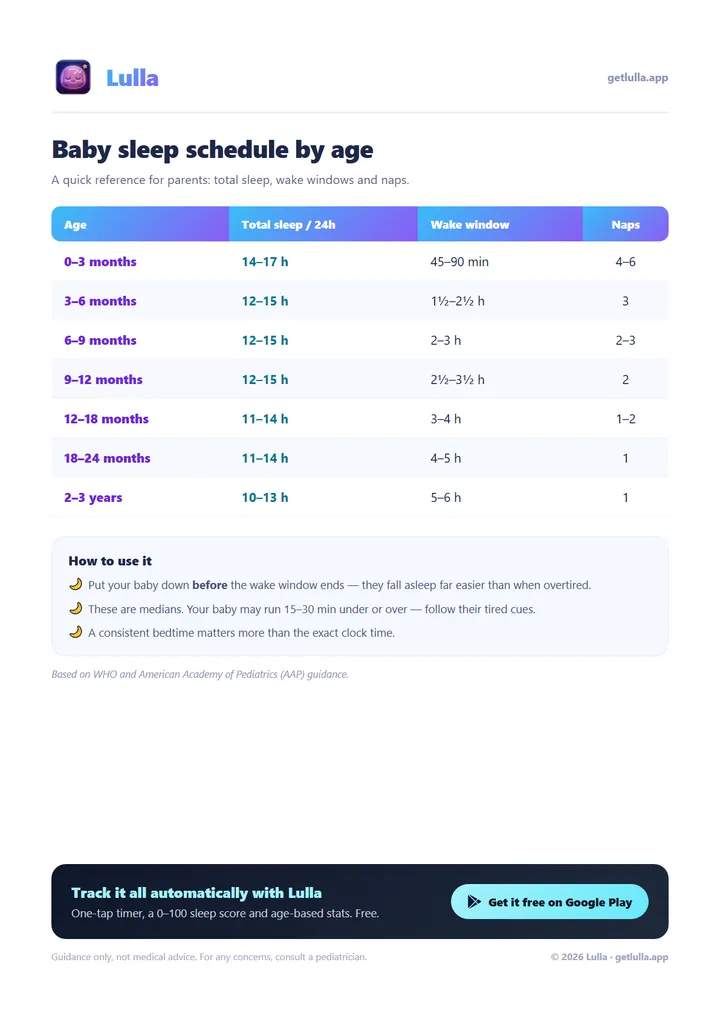
Your baby's sleep schedule, by age
Your baby's sleep schedule, by age
One table with everything that matters: total sleep per 24h, wake windows and number of naps, from newborn to age 3. Total sleep follows the National Sleep Foundation recommendations.
Sources and references
This article draws on official guidelines and peer-reviewed studies. Verify the sources directly:
- Petit D, Pennestri MH, Paquet J, Desautels A, Zadra A, et al. Childhood Sleepwalking and Sleep Terrors: A Longitudinal Study of Prevalence and Familial Aggregation. JAMA Pediatrics. 2015;169(7):653–658.
- Nguyen BH, Pérusse D, Paquet J, Petit D, Boivin M, et al. Sleep terrors in children: a prospective study of twins. Pediatrics. 2008;122(6):e1164–e1167.
- Leung AKC, Leung AAM, Wong AHC, Hon KL. Sleep Terrors: An Updated Review. Current Pediatric Reviews. 2020;16(3):176–182.
- Guilleminault C, Palombini L, Pelayo R, Chervin RD. Sleepwalking and sleep terrors in prepubertal children: what triggers them? Pediatrics. 2003;111(1):e17–e25.
- Mundt JM, Schuiling MD, Warlick C, Dietch JR, Wescott AB, et al. Behavioral and psychological treatments for NREM parasomnias: A systematic review. Sleep Medicine. 2023;111:36–53.
- Marcus CL, Brooks LJ, Draper KA, Gozal D, Halbower AC, et al. Diagnosis and Management of Childhood Obstructive Sleep Apnea Syndrome. Pediatrics. 2012;130(3):576–584.
- Simard V, Nielsen TA, Tremblay RE, Boivin M, Montplaisir JY. Longitudinal study of bad dreams in preschool-aged children: prevalence, demographic correlates, risk and protective factors. Sleep. 2008;31(1):62–70.
- Stefani A, Högl B. Nightmare Disorder and Isolated Sleep Paralysis. Neurotherapeutics. 2021;18(1):100–106.
📖 Read also:
- When your newborn won't sleep: what to check, in order
- Wake windows by age: the full chart from newborn to 2 years
- The 4 month sleep regression — and the other 7 ages
- Baby waking up at 5 AM? Why it happens and what to do
Or check out the complete baby sleep guide — all 7 articles condensed in one place.