Lulla TeamWe review current pediatric literature and synthesise it into accessible language for parents. All recommendations follow WHO and AAP guidelines.
Baby tiredness signs: how to read them before the crying starts
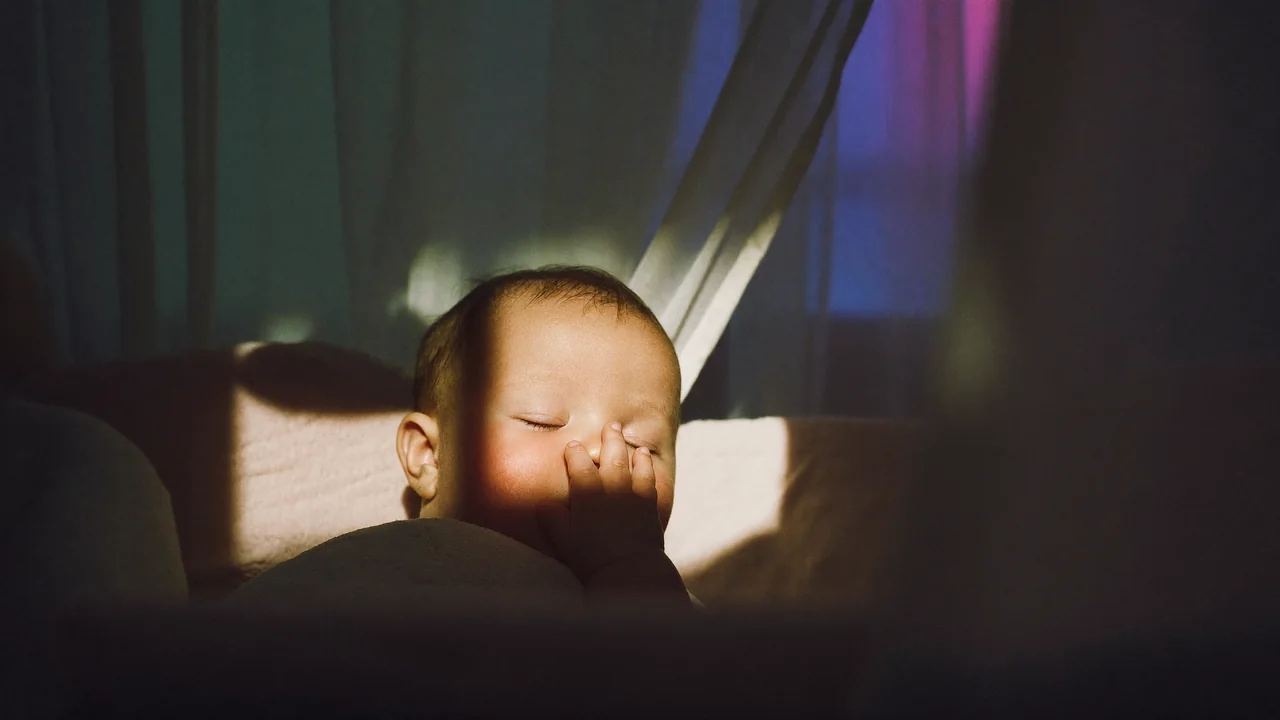
The most common myth about baby sleep: "they cry when they're tired". In reality, crying is the last stage — your baby has been tired for at least 10-15 minutes already. And an overtired baby falls asleep much harder than one caught at the right moment.
The 3 stages of tiredness
Tiredness in a baby doesn't appear out of nowhere. It moves through three distinct phases, each with its own signs. Learn to spot them in order:
Stage 1 — Subtle signs (the window of opportunity)
This is the golden moment. Your baby is calm but starts to "disconnect":
- Blank stare — eyes fixed on one spot, no longer tracking you
- Slower movements — the pace of play drops
- Loss of interest — turns away from a toy, no longer reacts to smiles
- Heavy eyelids — a small blink that lasts longer than usual
- Sudden quiet if they were babbling
Action: start the bedtime routine NOW. You have 5-10 minutes before Stage 2.
Stage 2 — Moderate signs (alarm)
Your baby is telling you clearly "I'm tired":
- Rubbing eyes or ears with the palms
- Yawning — the first yawn is the moment many parents finally notice
- Hiccups or soft whimpers
- Mild fussiness — squirming in your arms, no longer settling
- Reaching for your hand or the bottle insistently
Action: you're already late. Put them in the crib quickly, with no extra stimulation.
Stage 3 — Overtired (emergency mode)
Cortisol has taken the place of melatonin. Now it gets hard:
- Crying that's hard to soothe
- Hyperactive resistance — arching the back, refusing the crib
- Overreaction to stimuli — any sound or light sets them off
- Sudden laughter followed by crying — a chaotic nervous system
- A "second wind" — they seem suddenly awake and cheerful (it's an illusion, it's cortisol)
Action: you need 20-30 min of deep calming (rocking in arms, white noise, darkness) before the crib. Plus, expect sleep to be shorter and more restless.
Why you shouldn't wait for the yawn
Pediatric studies show that babies put to sleep in Stage 1 fall asleep on average in 5-8 minutes and sleep complete cycles. Those put down in Stage 3 (after crying) need 20-45 minutes to fall asleep and sleep short, broken cycles.
The difference doesn't come from "willpower" or "personality". It comes from chemistry — cortisol (the stress hormone) blocks natural sleep onset. The longer you wait, the more cortisol your baby has in their system.
Wake windows by age
How long can your baby stay awake before they enter Stage 1? Here's the rough guide:
- 0-1 month: 45-60 minutes
- 1-3 months: 60-90 minutes
- 3-6 months: 1.5-2.5 hours
- 6-9 months: 2-3 hours
- 9-12 months: 2.5-3.5 hours
- 12-18 months: 3-4 hours (usually 1 daytime nap)
- 18-24 months: 4-5 hours
- 2-3 years: 5-6 hours
These values are medians. Your baby may be 15-30 min below or above. Use Stage 1 signs as your main guide and wake windows as a sanity check.
How Lulla helps
Lulla automatically tracks the time since the last wake-up and shows it on the Home screen. When you approach the recommended wake window for your baby's age, you get a gentle notification: "It's time to start the evening routine". Combined with your 4-step routine, it makes sure you never miss Stage 1. In the stats, after 2-3 weeks you'll see how fast sleep onset lines up with your ideal windows — and you adjust.
Also read about how many hours they should sleep or, if your baby is between 3 and 5 months, about the 4-month sleep regression.
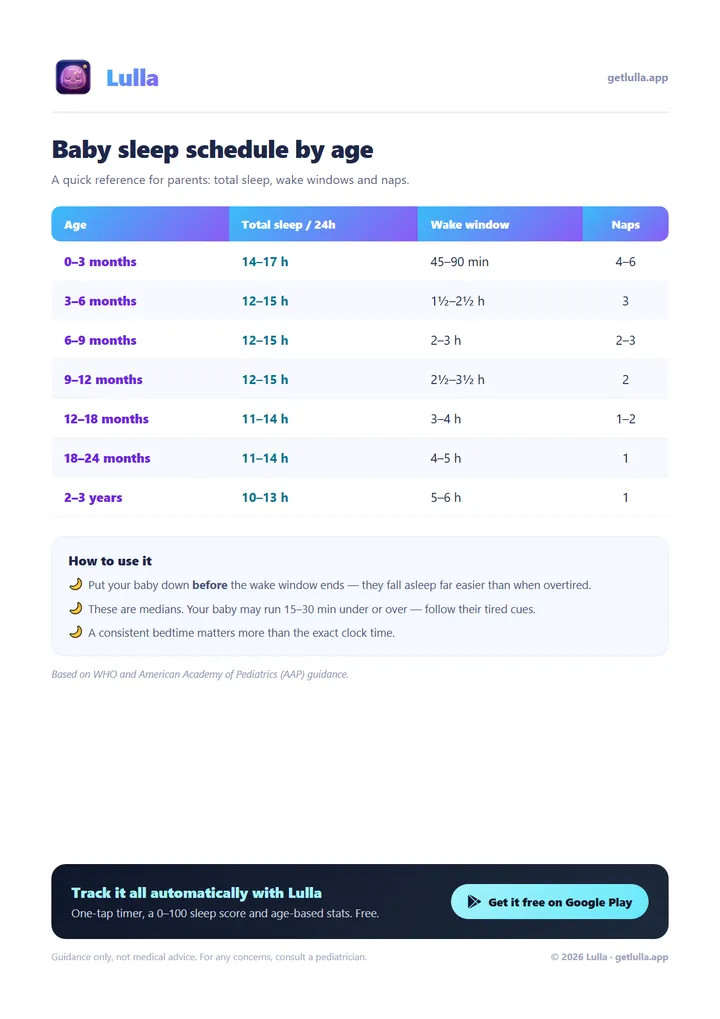
Your baby's sleep schedule, by age
Your baby's sleep schedule, by age
One chart with everything that matters: total sleep per 24h, wake windows and number of naps, from newborn to age 3. Based on WHO and AAP guidance.
Sources and references
This article draws on official guidelines and peer-reviewed studies. Verify the sources directly:
- American Academy of Pediatrics — Healthy Sleep Habits for Babies (HealthyChildren.org)
- National Sleep Foundation — Baby Sleep Hub: Wake Windows and Tired Cues
- Galland BC, Taylor BJ, Elder DE, Herbison P (2012). Normal sleep patterns in infants and children: A systematic review. Sleep Medicine Reviews, 16(3), 213–222.
- Mindell JA, Li AM, Sadeh A, Kwon R, Goh DYT (2015). Bedtime routines for young children: A dose-dependent association with sleep outcomes. Sleep, 38(5), 717–722.
- World Health Organization (2019). Guidelines on physical activity, sedentary behaviour and sleep for children under 5 years of age.
📖 Read also:
- How to build the perfect sleep routine for your baby
- How many hours should your baby sleep? Age-by-age guide
- The 4-month sleep regression: what it is and how to get through it
Or check out the complete baby sleep guide — all 7 articles condensed in one place.