Lulla TeamWe review current pediatric literature and synthesise it into accessible language for parents. All recommendations follow WHO and AAP guidelines.
How to teach your baby to self-soothe: 4 gentle methods
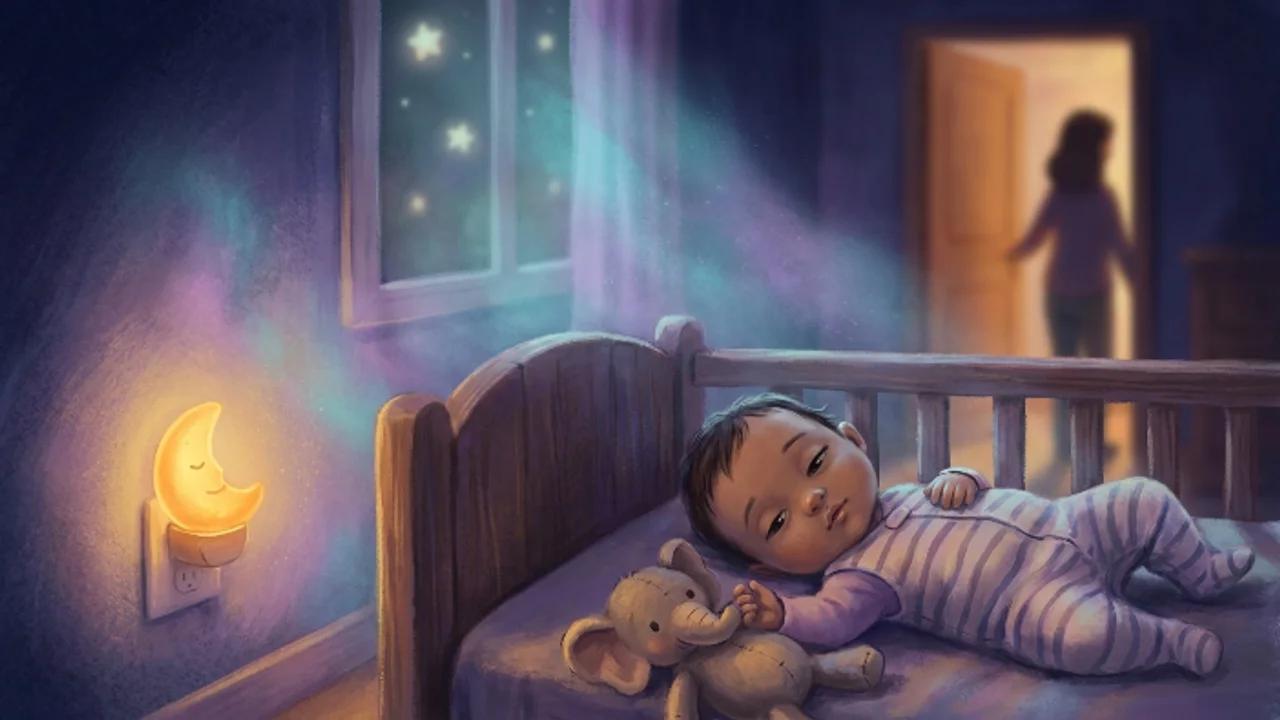
"She only falls asleep in my arms." "He wakes up the second I put him down." If that's your reality, it isn't your fault and there's nothing wrong with your baby. It's the most common situation of the first year, and it has a name: a sleep association. The good news is that it can change — gently, in a few nights.
What "falling asleep on their own" actually means
It doesn't mean your baby no longer needs you. It only means they can move from awake to asleep without an external condition — without being rocked, fed or held at the exact moment sleep arrives.
Why does it matter so much? Because all of us, at any age, wake partially between sleep cycles — babies every 40-60 minutes. An adult rolls over and drifts back off without remembering it. A baby who fell asleep in your arms wakes at 1 AM, discovers that the arms are gone, and cries — not out of being spoiled, but because the exact condition they learned to fall asleep with is missing.
That explains why a baby who falls asleep on their own at bedtime usually sleeps longer stretches: they don't need you in order to slip back into sleep.
When you can start (and when not to)
Not before 4 months. Until then the circadian rhythm isn't mature, and night feeds are a real need, not a habit. The window most families find easiest is 4-8 months, but later works too — it usually just takes a little longer.
Signs your baby is ready:
- they're over 4 months old and gaining weight steadily;
- they sometimes manage to fall asleep on their own, even if rarely (at naptime, for example);
- they have a predictable evening routine;
- they're not in the middle of a growth spurt or an illness.
Postpone if: they have a cold or a fever, they've just started daycare or you've been travelling, they're in the acute phase of the 4-month regression, or your pediatrician is following up on a medical issue (reflux, apnoea, slow growth). In a period like that any method fails, and all you're left with is the frustration.
Before any method: the 4 conditions
This is where most attempts fall apart. No method works without this foundation:
- The same routine every single evening — the same 3-4 steps, in the same order, 20-30 minutes. Predictability is the signal.
- The right bedtime — put them down at the first tiredness signs, not after. An overtired baby has raised cortisol and will fight sleep whatever method you use.
- A dark room and continuous white noise — remove the variables that wake them between cycles.
- Safe sleep — on their back, on their own firm surface, with no pillows, thick blankets or toys in the crib.
4 methods, from the gentlest to the most direct
There is no "correct" method. There is the method you can see through consistently — that's the only variable that truly matters.
1. Gradual fading (the gentlest)
You reduce your help step by step, every 2-3 nights: if you currently rock them until they're fully asleep, move to rocking until they're drowsy and putting them down awake; then just holding them without rocking; then a hand on the chest in the crib; then simply your presence beside the crib.
Who it's for: parents who want no prolonged crying at all. How long: 2-4 weeks. The slowest, but also the least stressful for everyone.
2. The chair method
You sit on a chair next to the crib until they fall asleep, without picking them up. Every 3 nights you move the chair further from the crib, until you reach the door and then the other side of it.
Who it's for: babies who settle when they can see you but get wound up if you touch them. How long: 1-2 weeks.
3. Timed checks (the Ferber method)
You put them in the crib awake, leave the room, and come back at intervals that get progressively longer (3, 5, then 10 minutes, for example). At each check you soothe them briefly — calm voice, a stroke, a minute at most — without picking them up.
Who it's for: families who want fast results and can stay consistent. How long: 3-7 nights. It's the most researched method.
4. Full extinction
You put them in the crib and don't go back until morning (apart from scheduled feeds, if they're still needed).
Who it's for: few parents see it through, and intermittent checks are worse than being inconsistent altogether. How long: 3-5 nights. Mentioned here for completeness — for most families, one of the first three is the better fit.
What to expect: the real timeline
- Nights 1-2: the hardest. Intermittent crying, falling asleep in 20-45 minutes.
- Night 3: often looks worse than night 2. This is the phenomenon known as the extinction burst — one last escalation before the change. Many parents give up right here, one night before the result.
- Nights 4-7: falling asleep in 5-15 minutes, far fewer wake-ups.
- Week 2: a stable pattern.
Setbacks after illness, travel or a developmental leap are normal, and usually resolve within 2-3 nights of going back to the same method.
What the studies say about crying
It's parents' biggest fear, so it deserves concrete numbers. A randomized trial published in Pediatrics (Gradisar et al., 2016) compared timed checks with gradual fading and with a control group. The results at 12 months: no differences in cortisol levels (the stress hormone), no differences in attachment quality, and no emotional or behavioural problems.
A 5-year follow-up (Price et al., 2012, also in Pediatrics) found no difference between children who had been through a sleep intervention and those who hadn't — neither emotionally, nor in their relationship with their parents.
In other words: if you choose a structured method, the current evidence says you are not harming your child. And if you choose to do nothing and wait, that is just as valid — plenty of families choose that, and it's fine.
The 5 mistakes that ruin everything
- You switch method after 2 nights. All your baby learns is that holding out works sometimes. Pick one and stick with it for at least 7 nights.
- You start too late in the evening. An overtired baby cries more and falls asleep harder — whatever the method.
- You start in a busy week. You need 5-7 consecutive evenings at home.
- The two parents do it differently. Agree on exactly the same rules before the first evening.
- You give up on night 3. The very night it seems not to be working is, statistically, the last hard one.
How Lulla helps
What often separates "it isn't working" from "it's working" is just perception — the hard night sticks in your memory, slow progress doesn't. Lulla shows you the time to fall asleep and the number of wake-ups, evening by evening. After 5-6 nights you can see the line dropping on the chart, even when it feels like nothing has changed. The sleep score confirms the trend, and the bedtime reminder keeps you in the right window. If you're both following the same method, sharing between parents keeps you in sync.
One final note: falling asleep independently is a useful skill, not an obligation and not a test of being a good parent. If your current setup works for your family, you have nothing to fix. And if you have any concern about your child's sleep or growth, talk to your pediatrician first.
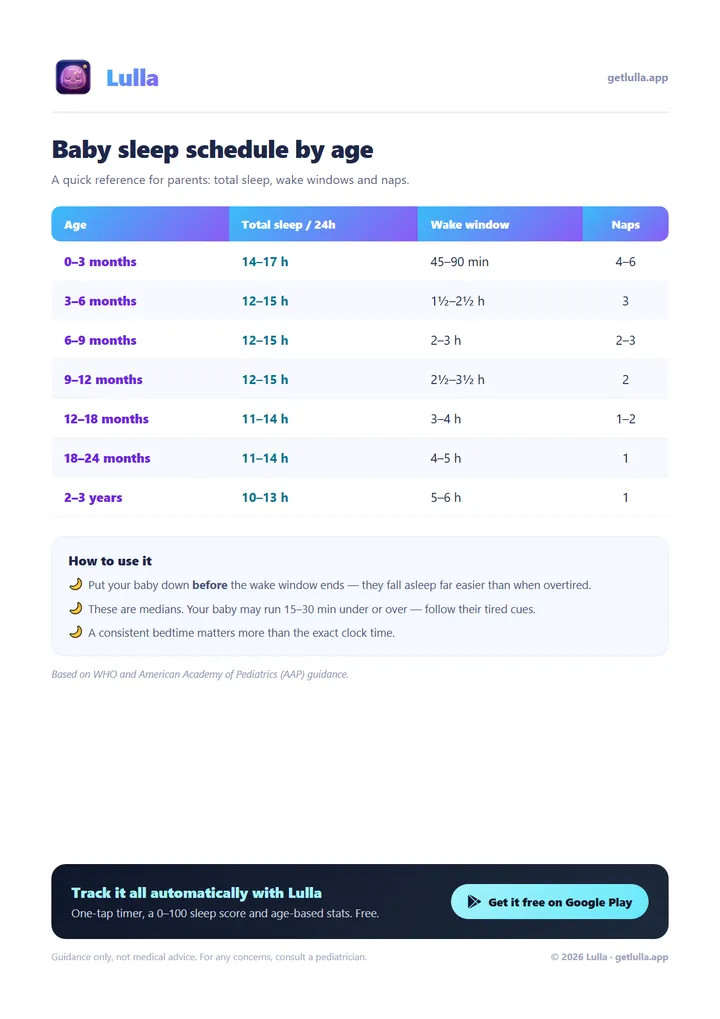
Your baby's sleep schedule, by age
Your baby's sleep schedule, by age
One chart with everything that matters: total sleep per 24h, wake windows and number of naps, from newborn to age 3. Based on WHO and AAP guidance.
Sources and references
This article draws on official guidelines and peer-reviewed studies. Verify the sources directly:
- American Academy of Pediatrics — Getting Your Baby to Sleep (HealthyChildren.org)
- Gradisar M, Jackson K, Spurrier NJ et al. (2016). Behavioral Interventions for Infant Sleep Problems: A Randomized Controlled Trial. Pediatrics, 137(6), e20151486.
- Price AMH, Wake M, Ukoumunne OC, Hiscock H (2012). Five-Year Follow-up of Harms and Benefits of Behavioral Infant Sleep Intervention. Pediatrics, 130(4), 643–651.
- Mindell JA, Kuhn B, Lewin DS, Meltzer LJ, Sadeh A (2006). Behavioral treatment of bedtime problems and night wakings in infants and young children. Sleep, 29(10), 1263–1276.
- American Academy of Pediatrics — Safe Sleep Recommendations
📖 Read also:
- How to build the perfect sleep routine for your baby
- Baby tiredness signs: how to read them before the crying starts
- The 4-month sleep regression: what it is and how to get through it
Or check out the complete baby sleep guide — all 7 articles condensed in one place.