Lulla TeamWe review current pediatric literature and synthesise it into accessible language for parents.
How much do newborns sleep? What's normal by age and when it's too much
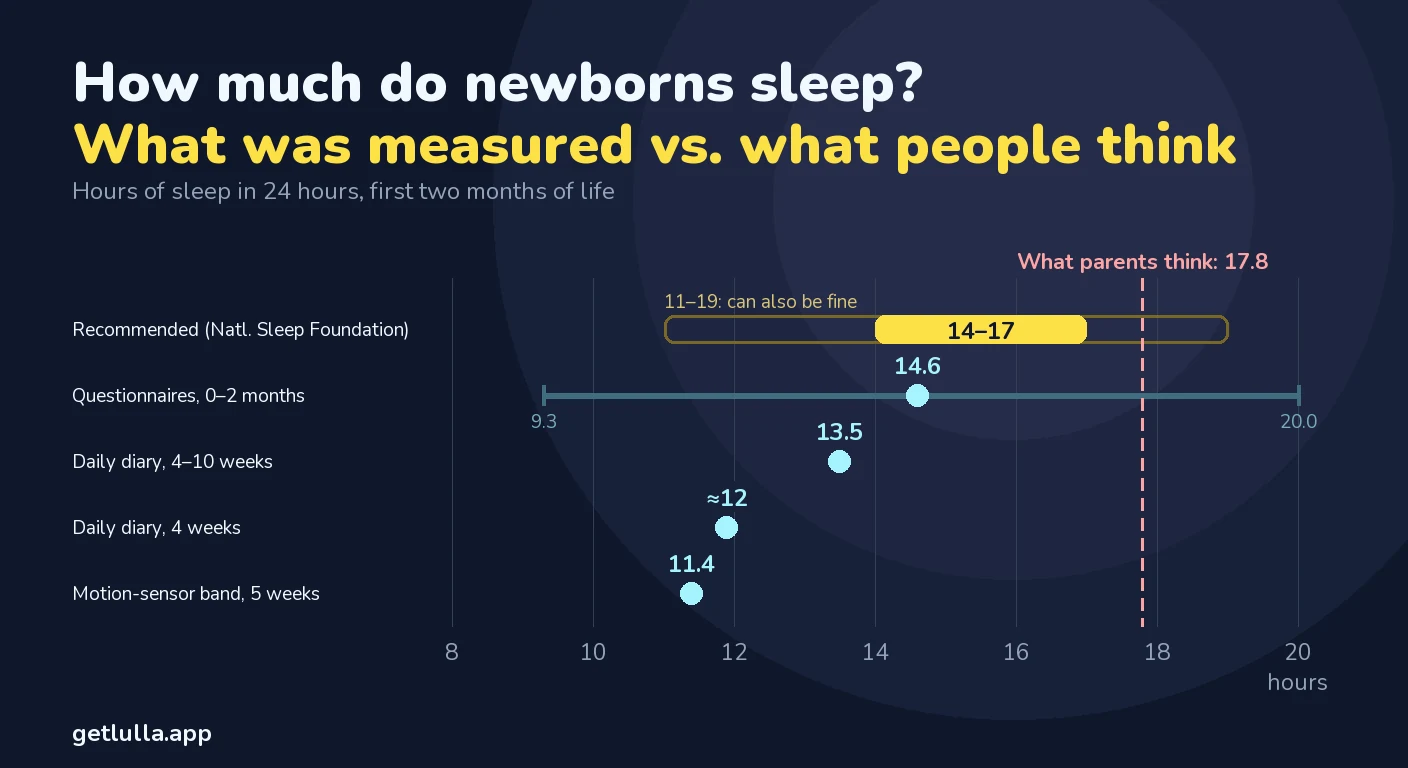
Your baby is three weeks old. You looked up how long newborns sleep and read that it's 16–20 hours, while yours, if you add it all up, slept about 13. Or the other way around: they've been asleep for four full hours and you don't know whether to wake them. Both worries have the same answer: the number of hours tells you less than you think, and what counts as “normal” is much wider than the tables going around suggest.
The short answer: the figure used everywhere for how much newborns sleep (0–3 months) is 14–17 hours in 24 hours. It comes from a 2015 vote by an expert panel of the US National Sleep Foundation, and the same panel says 11–19 hours can be fine. The American Academy of Sleep Medicine, with the endorsement of the American Academy of Pediatrics (AAP), gives no figure below four months, because healthy babies differ too much from one another and evidence on the health effects is lacking. When researchers measured them, they found averages between about 11 and 15 hours, depending on the method. In a newborn, the warning sign isn't the number of hours. What matters is whether, from the second day on, they feed at least eight times in 24 hours, wet diapers, gain weight, and wake up when you wake them. If they're hard to wake or can't be woken, call 911 or go to the ER.
By age, the recommendations look like this (hours per 24 hours, daytime naps included):
| Age | National Sleep Foundation: recommended | National Sleep Foundation: “may be appropriate” | WHO (2019) | American Academy of Sleep Medicine (2016) |
|---|---|---|---|---|
| 0–3 months | 14–17 | 11–13 or 18–19 | 14–17 | no figure |
| 4–11 months | 12–15 | 10–11 or 16–18 | 12–16 | 12–16 (4–12 months) |
| 1–2 years | 11–14 | 9–10 or 15–16 | 11–14 | 11–14 |
Where the 14–17 hours come from
The figure appears on almost every page about newborn sleep, and it comes from one place. In 2015, the National Sleep Foundation brought together 18 experts, who read 312 studies published between 2004 and 2014 and rated, one by one, every possible sleep duration, from zero to 24 hours. The result has three zones, not one:
- recommended: 14–17 hours for 0–3 months;
- “may be appropriate”: 11–13 and 18–19 hours, that is, the hours the experts couldn't agree on;
- not recommended: under 11 or over 19 hours.
The panel's final report says openly what the newborn recommendation rests on: weaker scientific evidence, plus the experts' experience and opinion. It also says that no study has assessed the risks of long sleep in newborns, but that the panel is concerned a newborn who routinely sleeps more than 19 hours might have too little interaction with the world around them. In the first days of life, more than 18 hours may be appropriate, although at three months the same amount may be considered long. For 4–11 months, the panel recommends that long sleep be evaluated by a doctor, because it can signal a health problem.
The American Academy of Sleep Medicine ran the same exercise in 2016, with different experts, and set no figure below four months. The reason, in its own words: the very wide normal variation in sleep duration and patterns, plus the lack of evidence on health effects. The World Health Organization (WHO) adopted the 14–17 hours in 2019 and rated the quality of the evidence behind its sleep recommendations as “very low”.
Two mix-ups come up often. The 12–15 hours at 4–11 months is the National Sleep Foundation's range, not the WHO's, which says 12–16. And the 16–20 hours, very widespread on parenting websites, doesn't appear in any of the guidelines we read, nor as an average in any measurement we found: the National Sleep Foundation's widest zone stops at 19 hours, and 20 hours shows up only as the upper edge of the statistical range in the table below.
How much newborns actually sleep when they're measured
In a study from Ireland, the parents of 106 healthy babies logged their sleep every day, from two to 16 weeks. They were also asked how much a newborn should sleep in 24 hours. The median answer was 17.8 hours. The model built from their diaries gives around 12 hours at four weeks. On the study's chart, 17 hours sits close to the upper limit, reached only by the sleepiest babies.
Other measurements, from the highest figure down:
- Parent reports, mostly questionnaires but also a few diaries, from 10 data sets pooled together, for 0–2 months: 14.6 hours on average.
- Diaries kept day by day, 37 babies, at 4–10 weeks: 13.5 hours on average, split into 6 to 15 stretches a day.
- A motion-sensor band on the ankle, 306 babies in Boston, at about five weeks: 11.4 hours. The method isn't well validated in the first month of life, so the figure is only approximate.
The differences come from what each method counts. Questionnaires filled in from memory give higher figures than diaries kept daily: in the Irish study, 39 more minutes of night sleep at 16 weeks. Many large studies actually measure time in bed. At three months, filmed at night, the babies in an American study had 9 hours and 23 minutes between falling asleep and waking in the morning, but of that they actually slept 7 hours and 47 minutes. And in diaries, parents record more night sleep than the band picks up: 80.7% of the night, versus 73.3%.
The analysis that pooled the parent reports gives, by age:
| Age | Average (hours per 24 h) | Range that about 95% of babies fall within |
|---|---|---|
| 0–2 months | 14.6 | 9.3–20.0 |
| ≈3 months | 13.6 | 9.4–17.8 |
| ≈6 months | 12.9 | 8.8–17.0 |
| ≈9 months | 12.6 | 9.4–15.8 |
| ≈12 months | 12.9 | 10.1–15.8 |
| 1–2 years | 12.6 | 10.0–15.2 |
The range in the table is statistical: about 95% of babies should fall inside it, and its ends aren't the lowest and highest totals observed. The practical takeaway: a newborn who sleeps 12 hours and one who sleeps 17 can both be perfectly healthy.
One more thing that surprises people: although the table shows a decline, in the two studies above that followed the same babies, with daily diaries and with bands, total sleep doesn't drop in the first months. In Ireland it rose by less than an hour between 4 and 16 weeks, and in Boston it stayed practically the same between one month and six months. What changes is the split: more sleep at night, less during the day. How many naps they take, by age, is in the guide to daytime naps, and how long they stay awake between them, in the wake windows guide.
Why newborns sleep so much (or so little), and when it's normal
A few situations in which a healthy baby sleeps more than you'd expect:
- The first days. Some newborns are sleepy in the first 24 hours. The British neonatal blood-sugar guideline (BAPM) says they may feed eagerly right after birth, then sleep for many hours, and that on the first day they may wake to feed only 3–5 times. From the second day, the goal becomes at least eight feeds in 24 hours. The same guideline, however, lists “not waking for feeds” among the signs of abnormal feeding, and for healthy babies who feed poorly it calls for active help with feeding: skin-to-skin contact and expressed colostrum. If your baby doesn't wake for feeds, tell the nurses on the maternity ward or, at home, your baby's doctor.
- The first long stretch at night. At one month, the longest nighttime sleep stretch of the Boston babies averaged 4 hours and 43 minutes. Four to five hours in a row, at this age, is common, not a sign of illness, if the baby is feeding well and growing. In the first weeks, see below for when it's a good idea to wake them for a feed.
- After vaccines. After the first vaccines, at around two months, babies slept on average 69 minutes more over the next 24 hours. Not all of them: 37% slept less.
- Growth spurts. In a small diary study, days with much more sleep came in the same period as growth spurts in length, 0–4 days apart. Not every very sleepy day came with a spurt, nor the other way around, so it's a link, not a rule.
And the other way around, when they sleep less than you'd expect: at six weeks, babies who cried or fussed for more than three hours a day slept 77 minutes less in 24 hours than those who cried a moderate amount. If the evenings are long and full of crying, what's known is in the colic guide.
What to check instead of hours
The breastfeeding and emergency guidelines we read don't judge a newborn by how many hours they sleep in total. They look at four things, which you can check yourself too:
- Feeds. At least eight in 24 hours, from the second day of life. The Academy of Breastfeeding Medicine gives 8–12 as the usual number, and the AAP at least 8–10.
- Diapers. For a breastfed baby, according to the UK's National Health Service (NHS): 2–3 wet diapers in the first 48 hours; from day five, at least 6 wet, heavy diapers in 24 hours; from day four, at least two soft, yellow stools a day. The day-by-day figures differ a little from one source to another, so watch the trend, not a single diaper.
- Weight. It's normal for it to drop in the first 3–4 days. Half of newborns are back to their birth weight by day 9 after a vaginal birth and by day 10 after a C-section. At two weeks, 14% and 24%, respectively, still haven't regained it. That isn't unusual, but the AAP lists it among the signs of a breastfeeding problem, so tell your pediatrician. The British NICE guidelines call for an assessment if the baby has lost more than 10% of their weight or hasn't regained it by three weeks. Formula-fed babies lose less: in half of them, the loss stays under 3–4%, and a loss of more than 7–8% is rare in them.
- Waking. For a child with a fever, the NICE guideline has a three-step scale: green, stays awake or wakes quickly; amber, wakes only after a lot of stimulation; red, doesn't wake or, if woken, doesn't stay awake. With or without a fever, the NHS lists “hard to wake or can't be woken” among the reasons to call emergency services right away.
Should I wake my newborn to feed? It depends on the baby
On parenting websites, the interval after which a newborn “must” be woken ranges from two to five hours, almost never with a source. In the guidelines we read, the rule gets stricter as the risk goes up:
- Breastfed, born at term. The AAP says, on a page for parents: if they sleep more than four hours at night, wake them and offer the breast.
- Formula-fed. Also the AAP: if in the first weeks they sleep more than 4–5 hours and start skipping feeds, wake them and offer the bottle.
- Born a little early, between 34 and 38 weeks. The Academy of Breastfeeding Medicine says you may need to wake them if they show no signs of hunger within four hours of the last feed. The AAP also points out that babies born even a little early can be sleepy and may not eat enough in the first weeks. For babies born prematurely or with a medical problem, the AAP again says the feeding schedule set by the pediatrician is best.
- Low birth weight or at risk of low blood sugar (premature, sick at birth, or the mother has diabetes or took beta-blockers). For a low-birth-weight baby in the first week, the WHO guideline for the care of sick children calls for at least one feed every 2–3 hours, and for waking the baby after three hours if they don't wake on their own. The parent leaflet of the British blood-sugar guideline asks that, in the first days, no more than three hours pass between feeds, until blood sugar is stable. Only then, once they're having at least eight feeds in 24 hours, do you no longer need to wake them every 2–3 hours, unless you've been told to for a specific reason.
- With jaundice (yellowing of the skin). NICE and the NHS say to wake them for feeds if needed, without giving a number of hours.
The rule that gets passed around most, “wake them every three hours until they're back to birth weight,” we didn't find in any of the guidelines we read (AAP, Academy of Breastfeeding Medicine, NICE, WHO and NHS). It's a commonly recommended practice, not a written rule. That doesn't mean you let them sleep as long as they like: the thresholds above still apply, and how long to keep waking them is a question for the doctor who is tracking their weight. If you try to wake them and can't, it's no longer a scheduling question but a warning sign: see the next section. Nor does the opposite rule, “never wake a sleeping baby,” apply to a newborn who is skipping feeds.
When to call the doctor or go to the ER
None of the guidelines on signs of illness that we read (NICE, NHS and the British blood-sugar guideline) uses a number of hours of sleep as a warning sign. All of them look at how the baby wakes and how they feed.
Call 911 or go to the ER if your baby:
- is hard to wake or can't be woken, or falls straight back to sleep after you've woken them;
- is floppy, with no muscle tone;
- is breathing very fast or with effort: grunting, or the belly sucks in with every breath;
- has skin, lips or tongue that are blue, gray, very pale or blotchy;
- isn't feeding;
- hasn't peed in the last 12 hours;
- is under three months old and has a temperature of 38 °C (100.4 °F) or higher;
- has a temperature below 36 °C (96.8 °F), at any age;
- has jaundice in the first 24 hours of life, or has jaundice and is sleepier than usual;
- has a weak, high-pitched or nonstop cry;
- has a seizure or a rash that doesn't fade when you press on it.
Talk to your doctor the same day if:
- they're sleepy and have fed fewer than six times in 24 hours;
- they're clearly less interested in feeding than before;
- they have fewer wet or dirty diapers than the benchmarks above;
- after the first day of life, you notice their skin or the whites of their eyes turning yellow;
- the jaundice isn't going away or is getting worse;
- their urine is dark yellow or brown, or their stool is pale, a creamy white: keep the diaper to show the doctor.
The guidelines also say two things explicitly: in young babies, a serious infection can come without a fever, and a parent's worry that the baby isn't their usual self is a signal the doctor has to take seriously. If you feel something isn't right, don't wait to see how it develops.
Day and night: how the rhythm settles
In a newborn, sleep isn't concentrated at night yet. They sleep in stretches, in a sleep-wake pattern that repeats every two to eight hours, day and night alike. Their internal clock is there before birth, but its signals become clear gradually. The day-night difference shows up in cortisol at around 8 weeks on average and in melatonin at around 9 (in some babies, not until around 15 weeks). The deeper drop in body temperature during night sleep appears between 8 and 16 weeks.
The share of sleep that falls at night grows along with them. In the diaries of a study of 6- to 12-week-old babies, 60% of all sleep fell between 8:00 PM and 8:00 AM at six weeks, and 71% at 12 weeks. For comparison, 50% would mean day and night don't differ at all.
Plenty of light during the day and dark, quiet nights: the advice is reasonable and does no harm, but the evidence that it helps the rhythm settle faster is weak. The same study found more light between noon and 4:00 PM for the babies who slept better at night, without being able to say which was cause and which was effect. A large randomized trial, in which parents were given, among other things, exactly this advice, did not lengthen the longest nighttime sleep stretch measured with the band. And “keep them awake during the day so they sleep at night” isn't supported by any controlled study we found. In a newborn, you don't cut daytime sleep.
Sleeping through the night: what it means and when it comes
“Sleeping through the night” means different things in different studies: five hours between midnight and 5:00 AM, a 1957 definition chosen without any justification; eight hours in a row; or 10:00 PM to 6:00 AM. The figures depend entirely on the definition:
- In a diary study of 75 babies, more than half were sleeping, on at least five of the six nights of the logged week: from midnight to 5:00 AM at three months; eight hours in a row at four months; from 10:00 PM to 6:00 AM at five months.
- In another study, at six months, 37.6% of babies weren't sleeping six hours in a row and 57% weren't sleeping eight, according to their mothers. At one year: 27.9% and 43.4%. Not sleeping through the night was linked neither to the child's development nor to the mother's mood.
- One good night doesn't mean that's how they'll sleep from now on. Followed for 13 nights at six months, almost three in four babies alternated between nights with and without six hours in a row.
If your baby is a few months old and the nights have suddenly fallen apart, read the guide to the sleep regression and the one on nights when they won't sleep.
How to count sleep, and how Lulla helps
Three rules, so the number you compare actually means something:
- Count all the sleep in 24 hours, including sleep in your arms, in the carrier or in the stroller.
- Look at the average over several days, not at one day. The Canadian guideline, which the WHO also drew on, says explicitly that its recommendations are an average, leaving room for normal variation from one day to the next.
- Compare your baby with themselves. The emergency guidelines don't ask how many hours they slept, but whether they're acting differently from usual.
In Lulla you log sleep, feeds and diapers, wet or dirty, in the same place. On the Home screen, “Today's sleep” is measured against a target equal to the midpoint of the National Sleep Foundation range for your baby's age (“of 15h target” at 0–3 months), and from the second day of logging, the full range, 14–17 hours, also appears underneath. The “Duration” component of the sleep score compares the sleep logged that day with the same range: the night that started after 6:00 PM the previous evening, plus today's naps. Read them as a reference point, not a verdict: a healthy newborn who sleeps 12 hours gets 26 out of 30 points for “Duration,” and that says nothing about their health. For the question that really matters, today's feeds, counted on the “Feeding” screen, and today's diapers, on the “Diapers” card on the Home screen, tell you more; with Premium, the “Feeds per day” chart in Stats shows feeds day by day. The pediatrician report puts sleep and, if you've logged them, feeds and growth in one document; the first one, exported in the first 14 days after setting up the app, is free, and the ones after that are part of Premium.
The figures for each month, with an hour-by-hour sample day, are on the age pages. Total sleep uses the same National Sleep Foundation ranges; only at three months, so the switch between age groups isn't abrupt, is the range 13–16 hours. Night sleep, wake windows and the number of naps are Lulla's reference points:
Newborn · 1 month · 2 months · 3 months · 4 months · 5 months · 6 months · 7 months · 8 months · 9 months · 10 months · 11 months · 12 months · 13 months · 14 months · 15 months · 16 months · 17 months · 18 months · 19 months · 20 months · 21 months · 22 months · 23 months · 24 months
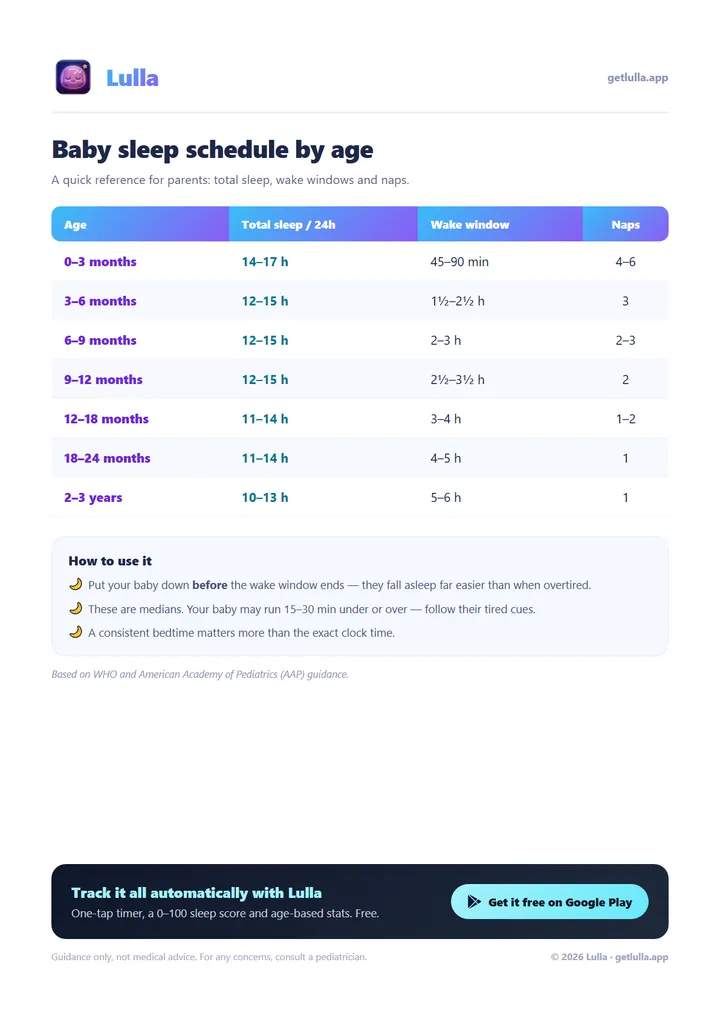
Your baby's sleep schedule, by age
Your baby's sleep schedule, by age
One table with everything that matters: total sleep per 24h, wake windows and number of naps, from newborn to age 3. Total sleep follows the National Sleep Foundation recommendations.
Sources and references
This article draws on official guidelines and peer-reviewed studies. Verify the sources directly:
- Hirshkowitz M, Whiton K, Albert SM, Alessi C, Bruni O, DonCarlos L, et al. National Sleep Foundation’s sleep time duration recommendations: methodology and results summary. Sleep Health. 2015;1(1):40–43.
- Hirshkowitz M, Whiton K, Albert SM, Alessi C, Bruni O, DonCarlos L, et al. National Sleep Foundation’s updated sleep duration recommendations: final report. Sleep Health. 2015;1(4):233–243.
- Paruthi S, Brooks LJ, D’Ambrosio C, Hall WA, Kotagal S, Lloyd RM, et al. Recommended Amount of Sleep for Pediatric Populations: A Consensus Statement of the American Academy of Sleep Medicine. Journal of Clinical Sleep Medicine. 2016;12(6):785–786.
- Paruthi S, Brooks LJ, D’Ambrosio C, Hall WA, Kotagal S, Lloyd RM, et al. Consensus Statement of the American Academy of Sleep Medicine on the Recommended Amount of Sleep for Healthy Children: Methodology and Discussion. Journal of Clinical Sleep Medicine. 2016;12(11):1549–1561.
- World Health Organization. Guidelines on physical activity, sedentary behaviour and sleep for children under 5 years of age. Geneva: WHO; 2019.
- Tremblay MS, Chaput JP, Adamo KB, Aubert S, Barnes JD, Choquette L, et al. Canadian 24-Hour Movement Guidelines for the Early Years (0–4 years): An Integration of Physical Activity, Sedentary Behaviour, and Sleep. BMC Public Health. 2017;17(Suppl 5):874.
- Galland BC, Taylor BJ, Elder DE, Herbison P. Normal sleep patterns in infants and children: a systematic review of observational studies. Sleep Medicine Reviews. 2012;16(3):213–222.
- O Sullivan MP, Livingstone V, Korotchikova I, Dempsey EM, Murray DM, Boylan GB. Reference centiles for infant sleep parameters from 4 to 16 weeks of age: findings from an Irish cohort. Archives of Disease in Childhood. 2023;108(6):481–485.
- Thomas KA, Foreman SW. Infant sleep and feeding pattern: effects on maternal sleep. Journal of Midwifery & Women’s Health. 2005;50(5):399–404.
- Yu X, Quante M, Rueschman M, Ash T, Kaplan ER, Guo N, et al. Emergence of racial/ethnic and socioeconomic differences in objectively measured sleep-wake patterns in early infancy: results of the Rise & SHINE study. Sleep. 2021;44(3):zsaa193.
- Gnidovec B, Neubauer D, Zidar J. Actigraphic assessment of sleep-wake rhythm during the first 6 months of life. Clinical Neurophysiology. 2002;113(11):1815–1821.
- Rioualen S, Roué JM, Lefranc J, Gouillou M, Nowak E, Alavi Z, et al. Actigraphy is not a reliable method for measuring sleep patterns in neonates. Acta Paediatrica. 2015;104(11):e478–e482.
- Camerota M, Tully KP, Grimes M, Gueron-Sela N, Propper CB. Assessment of infant sleep: how well do multiple methods compare? Sleep. 2018;41(10):zsy146.
- So K, Adamson TM, Horne RS. The use of actigraphy for assessment of the development of sleep/wake patterns in infants during the first 12 months of life. Journal of Sleep Research. 2007;16(2):181–187.
- British Association of Perinatal Medicine. Identification and Management of Neonatal Hypoglycaemia in the Full-Term Infant (Birth to 72 hours): A BAPM Framework for Practice. 2024.
- Holmes AV, McLeod AY, Bunik M. ABM Clinical Protocol #5: Peripartum breastfeeding management for the healthy mother and infant at term, revision 2013. Breastfeeding Medicine. 2013;8(6):469–473.
- Franck L, Gay CL, Lynch M, Lee KA. Infant sleep after immunization: randomized controlled trial of prophylactic acetaminophen. Pediatrics. 2011;128(6):1100–1108.
- Lampl M, Johnson ML. Infant growth in length follows prolonged sleep and increased naps. Sleep. 2011;34(5):641–650.
- St James-Roberts I, Conroy S, Hurry J. Links between infant crying and sleep-waking at six weeks of age. Early Human Development. 1997;48(1–2):143–152.
- Meek JY, Noble L; Section on Breastfeeding. Policy Statement: Breastfeeding and the Use of Human Milk. Pediatrics. 2022;150(1):e2022057988.
- NHS. Breastfeeding: is my baby getting enough milk? 2026.
- Paul IM, Schaefer EW, Miller JR, Kuzniewicz MW, Li SX, Walsh EM, Flaherman VJ. Weight Change Nomograms for the First Month After Birth. Pediatrics. 2016;138(6):e20162625.
- Miller JR, Flaherman VJ, Schaefer EW, Kuzniewicz MW, Li SX, Walsh EM, Paul IM. Early weight loss nomograms for formula fed newborns. Hospital Pediatrics. 2015;5(5):263–268.
- Macdonald PD, Ross SR, Grant L, Young D. Neonatal weight loss in breast and formula fed infants. Archives of Disease in Childhood. Fetal and Neonatal Edition. 2003;88(6):F472–F476.
- National Institute for Health and Care Excellence. Faltering growth: recognition and management of faltering growth in children (NG75). 2017.
- National Institute for Health and Care Excellence. Fever in under 5s: assessment and initial management (NG143). 2019, actualizat 2021.
- American Academy of Pediatrics, Section on Breastfeeding. Warning Signs of Breastfeeding Problems. HealthyChildren.org. 2024.
- American Academy of Pediatrics. Amount and Schedule of Baby Formula Feedings. HealthyChildren.org. 2022.
- Jain S, Bunik M. How Often and How Much Should Your Baby Eat? HealthyChildren.org, American Academy of Pediatrics. 2024.
- Boies EG, Vaucher YE; Academy of Breastfeeding Medicine. ABM Clinical Protocol #10: Breastfeeding the Late Preterm (34–36 6/7 Weeks of Gestation) and Early Term Infants (37–38 6/7 Weeks of Gestation), Second Revision 2016. Breastfeeding Medicine. 2016;11(10):494–500.
- World Health Organization. Integrated Management of Childhood Illness: Chart Booklet. Geneva: WHO; 2014.
- National Institute for Health and Care Excellence. Jaundice in newborn babies under 28 days (CG98). 2010, actualizat 2023.
- NHS. When to get urgent medical help for babies and children under 5. 2026.
- NHS. Jaundice in babies. 2026.
- UNICEF UK Baby Friendly Initiative. How can I tell that breastfeeding is going well?
- National Institute for Health and Care Excellence. Postnatal care (NG194). 2021, actualizat 2026.
- Rivkees SA. Developing circadian rhythmicity in infants. Pediatrics. 2003;112(2):373–381.
- Löhr B, Siegmund R. Ultradian and circadian rhythms of sleep-wake and food-intake behavior during early infancy. Chronobiology International. 1999;16(2):129–148.
- Lodemore MR, Petersen SA, Wailoo MP. Factors affecting the development of night time temperature rhythms. Archives of Disease in Childhood. 1992;67(10):1259–1261.
- Joseph D, Chong NW, Shanks ME, Rosato E, Taub NA, Petersen SA, et al. Getting rhythm: how do babies do it? Archives of Disease in Childhood. Fetal and Neonatal Edition. 2015;100(1):F50–F54.
- Kennaway DJ, Goble FC, Stamp GE. Factors influencing the development of melatonin rhythmicity in humans. Journal of Clinical Endocrinology and Metabolism. 1996;81(4):1525–1532.
- Harrison Y. The relationship between daytime exposure to light and night-time sleep in 6–12-week-old infants. Journal of Sleep Research. 2004;13(4):345–352.
- Stremler R, Hodnett E, Kenton L, Lee K, Weiss S, Weston J, et al. Effect of behavioural-educational intervention on sleep for primiparous women and their infants in early postpartum: multisite randomised controlled trial. BMJ. 2013;346:f1164.
- Henderson JM, France KG, Owens JL, Blampied NM. Sleeping through the night: the consolidation of self-regulated sleep across the first year of life. Pediatrics. 2010;126(5):e1081–e1087.
- Pennestri MH, Laganière C, Bouvette-Turcot AA, Pokhvisneva I, Steiner M, Meaney MJ, et al. Uninterrupted Infant Sleep, Development, and Maternal Mood. Pediatrics. 2018;142(6):e20174330.
- Pennestri MH, Burdayron R, Kenny S, Béliveau MJ, Dubois-Comtois K. Sleeping through the night or through the nights? Sleep Medicine. 2020;76:98–103.
📖 Read also:
- Wake windows by age: the full chart from newborn to 2 years
- How many naps by age: the full chart and the 4 nap drops
- When your newborn won't sleep: what to check, in order
- Newborn colic: how long it lasts, when it ends, what helps
Or check out the complete baby sleep guide — all 7 articles condensed in one place.