Lulla TeamWe review current pediatric literature and synthesise it into accessible language for parents.
Wake windows by age: the full chart from newborn to 2 years
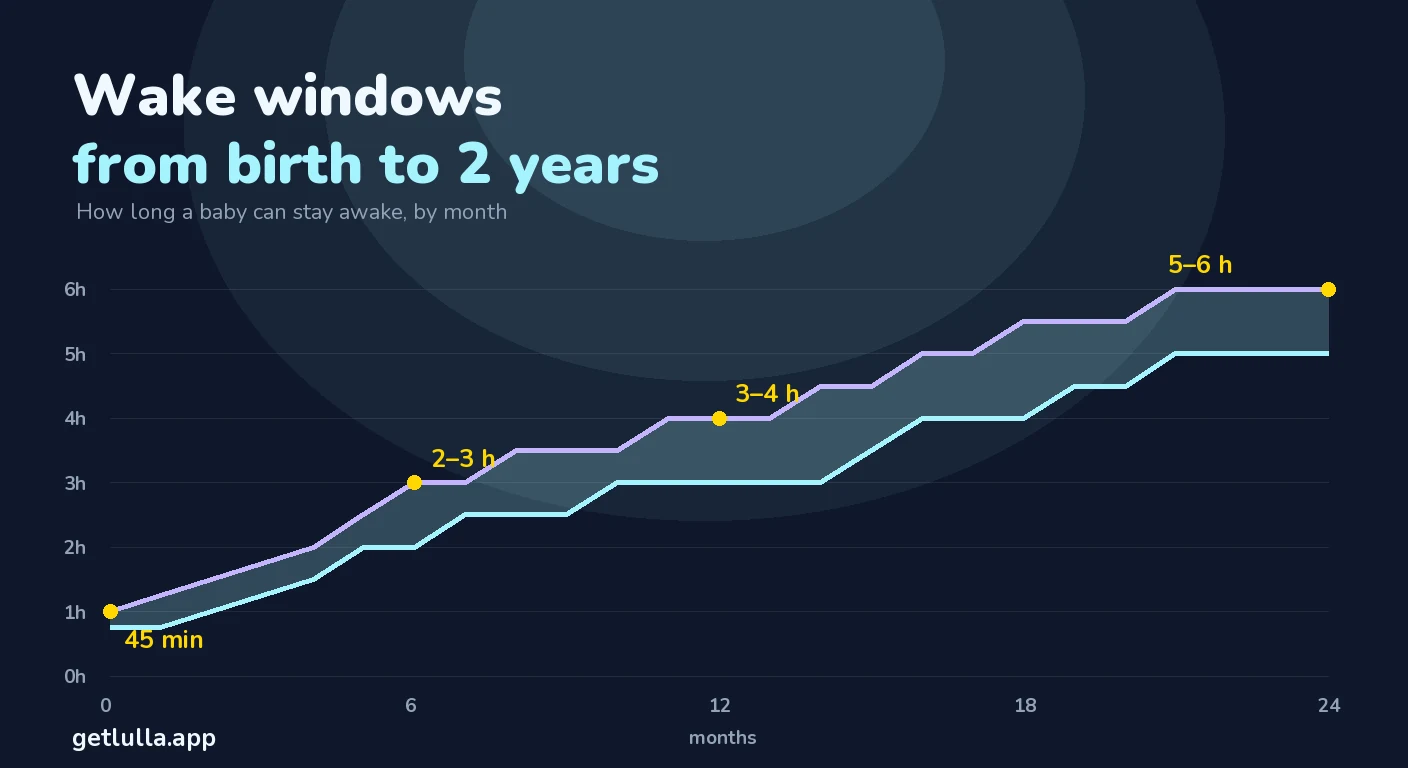
You put them down at the time they ‘should’ go down and they fight it for forty minutes in the crib. The next night you put them down an hour later and they are asleep in three minutes — but they wake at five in the morning. Nothing about the routine changed between those two evenings. The only thing that changed was how long they had been awake beforehand.
That is the wake window, and it is the one variable in a small child's day that you control directly. Below is the full chart, month by month, from newborn to two years — the same figures we use on our age-by-age pages, gathered in one place.
What a wake window actually is
It is the time between the moment your baby wakes up and the moment they fall asleep again. That's all. It isn't a discipline rule and it isn't a target to hit — it is a measure of how fast sleep pressure builds up at their age.
While they are awake, adenosine builds up in the brain, the substance that produces the feeling of sleepiness. In a newborn it accumulates in forty-five minutes. A two-year-old needs five or six hours for the same amount. That is why a schedule that worked perfectly six weeks ago doesn't work today: your baby isn't broken, they've grown.
And that is why it goes wrong in both directions:
- Window too short — the sleep pressure hasn't built up yet. You put them in the crib and they play, chat, stand up. They aren't defying you; they genuinely aren't sleepy.
- Window too long — they are past the optimal point, and the tiredness no longer shows as sleepiness but as disorganization: they get agitated, arch their back, lose their temper over nothing, can't let go of a toy. The paradox every parent knows: an overtired baby looks more wired, not sleepier. Don't read it as "they aren't sleepy yet" — it is the sign that you have gone past the end of the range, not that they can stay awake for longer.
The full chart, month by month
Every row links to the detailed page for that month, with a model day.
| Age | Wake window | Daytime naps | Sleep per 24 h |
|---|---|---|---|
| Newborn | 45 min – 1 h | 4–6 | 14–17 h |
| 1 month | 45 min – 1 h 15 min | 4–5 | 14–17 h |
| 2 months | 1 h – 1 h 30 min | 4–5 | 14–17 h |
| 3 months | 1 h 15 min – 1 h 45 min | 4 | 13–16 h |
| 4 months | 1 h 30 min – 2 h | 3–4 | 12–15 h |
| 5 months | 2 h – 2 h 30 min | 3 | 12–15 h |
| 6 months | 2 h – 3 h | 3 | 12–15 h |
| 7 months | 2 h 30 min – 3 h | 2–3 | 12–15 h |
| 8 months | 2 h 30 min – 3 h 30 min | 2 | 12–15 h |
| 9 months | 2 h 30 min – 3 h 30 min | 2 | 12–15 h |
| 10 months | 3 h – 3 h 30 min | 2 | 12–15 h |
| 11 months | 3 h – 4 h | 2 | 12–15 h |
| 12 months | 3 h – 4 h | 2 | 11–14 h |
| 13 months | 3 h – 4 h | 1–2 | 11–14 h |
| 14 months | 3 h – 4 h 30 min | 1–2 | 11–14 h |
| 15 months | 3 h 30 min – 4 h 30 min | 1–2 | 11–14 h |
| 16 months | 4 h – 5 h | 1 | 11–14 h |
| 17 months | 4 h – 5 h | 1 | 11–14 h |
| 18 months | 4 h – 5 h 30 min | 1 | 11–14 h |
| 19 months | 4 h 30 min – 5 h 30 min | 1 | 11–14 h |
| 20 months | 4 h 30 min – 5 h 30 min | 1 | 11–14 h |
| 21 months | 5 h – 6 h | 1 | 11–14 h |
| 22 months | 5 h – 6 h | 1 | 11–14 h |
| 23 months | 5 h – 6 h | 1 | 11–14 h |
| 24 months | 5 h – 6 h | 1 | 11–14 h |
Read it as a range, not as a fixed time. The differences between two healthy babies of the same age are large, and that is the norm, not the exception. The Zurich longitudinal study followed 493 children precisely so it could draw percentiles — that is, show how wide normal is at each age. A meta-analysis of 34 studies finds, for infants aged 0–23 months rather than for toddlers, an average of 12.8 hours of sleep per 24 hours, with a normal range between 9.7 and 15.9 hours. More than six hours' difference between two equally healthy children.
Three things the chart doesn't tell you
1. The first window of the day is the shortest
After a full night, sleep pressure is at its lowest — but in babies it rebuilds fast. In practice, the morning window is 15–30 minutes shorter than the bottom of the range, and the one before bedtime is the longest of the day.
2. In newborns, the evening breaks the chart
Between the last nap and bedtime, a baby under six months stays awake far longer than the range says — sometimes two or three times longer. It isn't a math error and it isn't your fault: it is the evening fussy period, with cluster feeding, which the literature describes as normal in the first months. You will see it in the model day on the pages for months 0–5 too.
3. The range shifts on the day of the transition, not gradually
When your baby drops a nap, the window jumps all at once. That is why months 7, 13, 14 and 15 show two options for the number of naps in the chart: these are the months where some babies have already made the jump and others haven't.
The signs you've got it wrong
Too short: they lie awake in the crib for more than 20 minutes without crying; the nap lasts under 30 minutes and they wake up cheerful; they consistently refuse the first nap of the day.
Too long: inconsolable crying at bedtime; rubbing eyes and ears, arching the back, suddenly going very wired; falling asleep in the car on the shortest trip; waking at 5 AM. Early waking has this cause far more often than any other.
Tired signs show up before the end of the window, not after. If you wait for the yawn you are usually already late — the early signals are the glazed stare, losing interest in toys and slower movements.
The two transitions that break the schedule
From 3 naps to 2, somewhere around 6–8 months. The late-afternoon nap goes first. The evening window grows by nearly an hour overnight, and bedtime needs to move earlier for a few weeks.
From 2 naps to 1, between 13 and 18 months. It is the longest transition of the first two years and the one that causes the most chaos: two naps on Monday, one on Tuesday, a dreadful day on Wednesday. We've written separately about how to make the switch without losing your nights.
The rule that matters for both: the signs have to hold for one or two weeks, not two days. A baby who refuses naps three days in a row because they are teething isn't ready for a transition; they are a baby who is teething.
Three mistakes that make the chart useless
- Using it as a timetable. The range tells you where to look, your baby tells you when. If at 10 months the range says 3–3.5 hours and yours consistently gives out at 2 hours 45 minutes, yours is right.
- Changing the window every day. Give one setting three or four days before you judge it. Babies have bad days for no reason at all.
- Making up for a missed window with an even longer one. If the morning nap came out at 25 minutes, the next window needs to be shorter, not longer — your baby is already running a deficit.
How Lulla helps
The problem with wake windows isn't that you don't know the number, it is that you can't track it from memory: after a day with three naps of different lengths, nobody remembers correctly how long the baby was awake in between. Lulla works out every window automatically, shows you the average over the last few days and tells you when the end of the range for your baby's age is coming up. And if there are two of you, sharing between parents means you both see the same schedule — which, in the transition weeks, matters enormously.
Worth remembering: the 24-hour sleep in the table is the National Sleep Foundation range (at 3 months, a transition smoothed by us); the American Academy of Sleep Medicine, whose recommendation has been endorsed by the American Academy of Pediatrics, makes no recommendations below 4 months. Wake windows and the number of naps, month by month, are Lulla's reference points, not recommendations from these organizations. The article is for information only. For any concern about your child's sleep or growth, your pediatrician is still the first place to go — they have the full history.
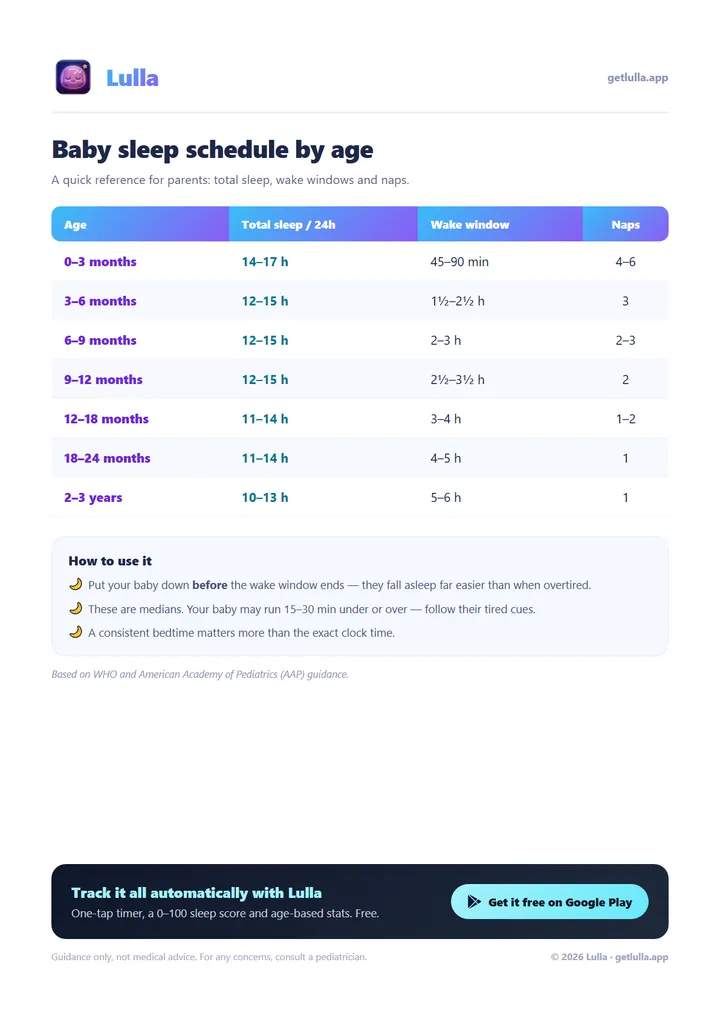
Your baby's sleep schedule, by age
Your baby's sleep schedule, by age
One table with everything that matters: total sleep per 24h, wake windows and number of naps, from newborn to age 3. Total sleep follows the National Sleep Foundation recommendations.
Sources and references
This article draws on official guidelines and peer-reviewed studies. Verify the sources directly:
- Iglowstein I, Jenni OG, Molinari L, Largo RH. Sleep duration from infancy to adolescence: reference values and generational trends. Pediatrics. 2003;111(2):302–307.
- Galland BC, Taylor BJ, Elder DE, Herbison P. Normal sleep patterns in infants and children: a systematic review of observational studies. Sleep Medicine Reviews. 2012;16(3):213–222.
- Paruthi S, Brooks LJ, D’Ambrosio C, Hall WA, Kotagal S, et al. Recommended Amount of Sleep for Pediatric Populations: A Consensus Statement of the American Academy of Sleep Medicine. J Clin Sleep Med. 2016;12(6):785–786.
📖 Read also:
- From 2 naps to 1: when it happens and how to do it without chaos
- Baby tiredness signs: how to read them before the crying starts
- How much do newborns sleep? What's normal by age and when it's too much
- How many naps by age: the full chart and the 4 nap drops
- When your newborn won't sleep: what to check, in order
Or check out the complete baby sleep guide — all 7 articles condensed in one place.