Lulla TeamWe review current pediatric literature and synthesise it into accessible language for parents.
How many naps by age: the full chart and the 4 nap drops
The question always arrives in the same shape: “at this age, how many naps should they be having?” And the answer that gets repeated in every parenting group — “two, until they turn one” — is wrong for half of all babies, and for half of the first year.
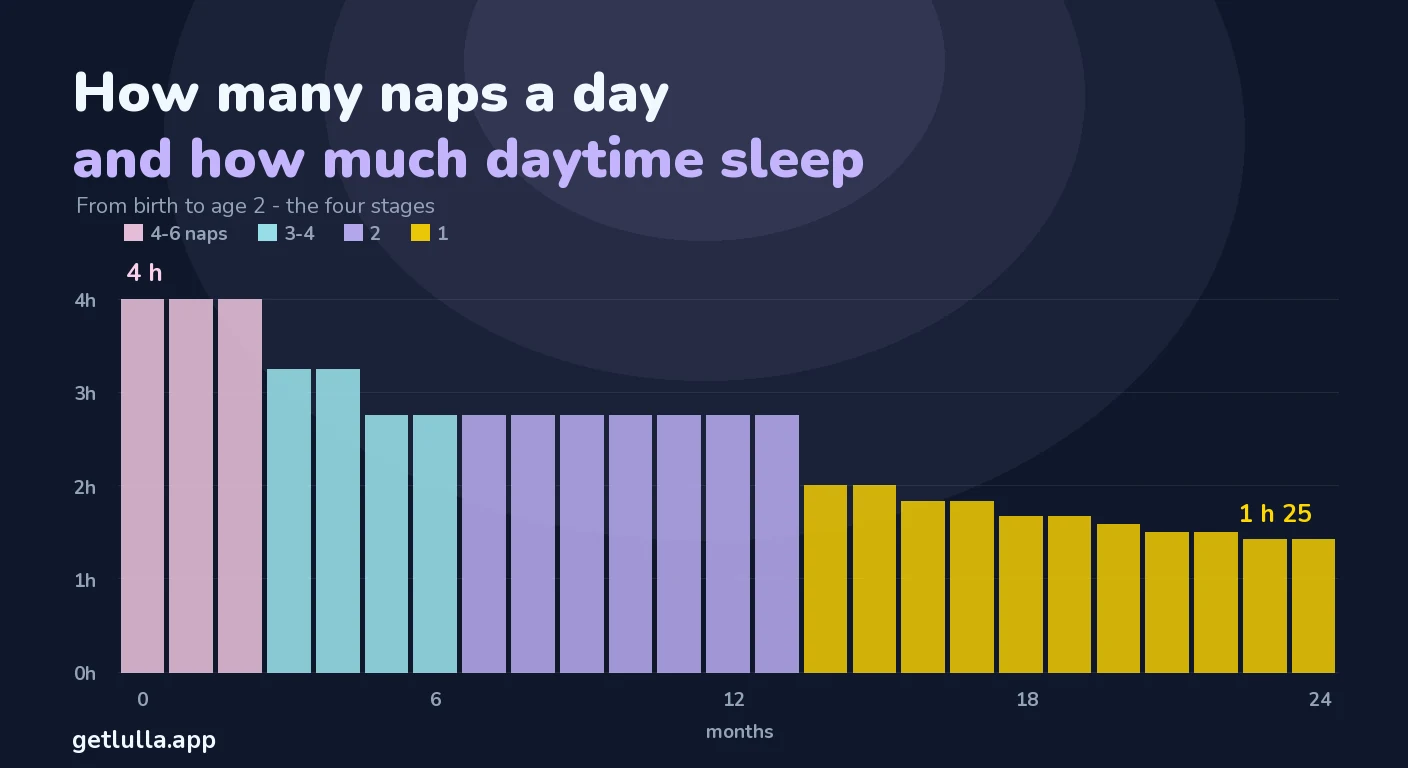
The number of naps doesn’t taper off gradually. It falls in four drops, and between them it holds steady for months at a time. Below is the full chart — how many naps, how long each one lasts, and how much total nap time that comes to, month by month.
The full chart, month by month
The lengths are taken from each month’s model day. Every row links through to that month’s page, with the exact times.
| Age | Naps a day | Length of each | Total nap time |
|---|---|---|---|
| Newborn | 4–6 | 45 + 60 + 45 + 60 + 30 min | 4 hr |
| 1 month | 4–5 | 45 + 60 + 45 + 60 + 30 min | 4 hr |
| 2 months | 4–5 | 45 + 60 + 45 + 60 + 30 min | 4 hr |
| 3 months | 4 | 60 + 60 + 45 + 30 min | 3 hr 15 min |
| 4 months | 3–4 | 60 + 60 + 45 + 30 min | 3 hr 15 min |
| 5 months | 3 | 60 + 75 + 30 min | 2 hr 45 min |
| 6 months | 3 | 60 + 75 + 30 min | 2 hr 45 min |
| 7 months | 2–3 | 75 + 90 min | 2 hr 45 min |
| 8 months | 2 | 75 + 90 min | 2 hr 45 min |
| 9 months | 2 | 75 + 90 min | 2 hr 45 min |
| 10 months | 2 | 75 + 90 min | 2 hr 45 min |
| 11 months | 2 | 75 + 90 min | 2 hr 45 min |
| 12 months | 2 | 75 + 90 min | 2 hr 45 min |
| 13 months | 1–2 | 75 + 90 min | 2 hr 45 min |
| 14 months | 1–2 | 120 min | 2 hr |
| 15 months | 1–2 | 120 min | 2 hr |
| 16 months | 1 | 110 min | 1 hr 50 min |
| 17 months | 1 | 110 min | 1 hr 50 min |
| 18 months | 1 | 100 min | 1 hr 40 min |
| 19 months | 1 | 100 min | 1 hr 40 min |
| 20 months | 1 | 95 min | 1 hr 35 min |
| 21 months | 1 | 90 min | 1 hr 30 min |
| 22 months | 1 | 90 min | 1 hr 30 min |
| 23 months | 1 | 85 min | 1 hr 25 min |
| 24 months | 1 | 85 min | 1 hr 25 min |
Two things jump out if you read the right-hand column. First: total nap time halves between birth and age two, from four hours to under an hour and a half. Second: it keeps falling after the number of naps has already settled at one — the single nap shortens slowly, from two hours at 14 months to about an hour and 25 minutes at two years. Nobody warns you about the second part, and it’s the part that worries parents most.
The four drops
From 4–6 naps to 4, around 3 months
The first drop, and the least dramatic. A newborn sleeps in short bursts with no pattern at all — four, five or six a day, wherever they land. At around three months the bursts settle into four recognizable naps, and the day starts to take shape.
From 4 naps to 3, around 5 months
This time it’s the short evening nap that goes — the 30-minute one, at 5:00 PM. You can see it in the chart: at 4 months the model day has four naps, at 5 months it has three, and the total drops from 3 hr 15 min to 2 hr 45 min.
From 3 naps to 2, around 7 months
The drop every parent notices. The third nap goes, the late-afternoon one, and the two that are left stretch out to make up for it: 75 and 90 minutes. Total nap time stays exactly where it was, 2 hr 45 min — which is why this transition tends to go more smoothly than it looks.
From 2 naps to 1, between 13 and 15 months
The longest and the messiest. The chart says 1–2 at 13, 14 and 15 months precisely because some babies have made the jump and others haven’t, and the same baby can take two naps on Monday and one on Tuesday. The single nap settles around midday and runs about two hours. There’s a separate piece on how to make the switch without losing your nights.
Signs it’s time to drop a nap
The same three, at every drop:
- They refuse one of the naps, consistently — lying awake in the crib for 20–30 minutes, even though you know they’re tired.
- If they do take that nap, they refuse the next one, or the other way around. They won’t take both anymore.
- To fit all the naps in, bedtime creeps toward 9:00 PM or later.
The rule that matters more than the signs: it has to hold for a week or two, not for two days. A baby who skips a nap three days running because they’re teething isn’t ready for the next drop.
The 30-minute naps
The most common question after “how many naps” is “why do they only sleep for half an hour?” The answer has two halves, and most parents only ever hear the first.
A baby’s sleep cycle lasts 40–50 minutes. At the end of each one, they half-wake. Some babies slide into the next cycle on their own; others wake up fully and look for what they had when they fell asleep, the arms or the breast. How much falling asleep independently lengthens daytime naps, we don’t know: the studies of the methods that we found followed bedtime and the nights, and there what changed was mostly how often the child calls you, not how often they wake.
The second half: a 30-minute nap isn’t automatically a problem. If they wake up in a good mood and last until the next window, that’s all they needed. Look at the 24-hour total, not at the length of any one nap. The chart above gives you exactly that, in the right-hand column.
What the chart doesn’t tell you
The first nap of the day is the best one
Sleep pressure is at its cleanest in the morning, and the morning nap has the most deep sleep in it. That’s why, when something has to give, don’t start with that one.
A missed nap isn’t made up for with a longer one
It’s made up for with an earlier bedtime. If the morning nap only came to 25 minutes, don’t stretch the next wake window hoping for a long one — shorten it and put them down earlier that evening.
The number of naps depends on how long they can stay awake
The two are two sides of the same coin: if the wake window gets longer, a nap has to go, or the day no longer fits into 24 hours. For the other side of the sum, the wake windows chart by age has the exact ranges.
Three mistakes
- Forcing the drop because that’s what the chart says. If yours is still taking three naps at 7 months and is well rested, you’re doing fine. The chart describes the average, not a target.
- Dropping a nap from one day to the next. You move it, you don’t cut it: 15–30 minutes later every 3–4 days, until it lands where it should.
- Not moving bedtime during the transition weeks. Your baby loses 45 minutes of nap time and nobody gives it back — that’s how they end up overtired, and the signs of tiredness turn into false energy in the evening.
How Lulla helps
The number of naps is easy to keep in your head; the 24-hour total isn’t. And the total is the figure that tells you whether the transition is going well or your baby is simply sleeping less. Lulla logs every nap and shows you the daily total next to the recommended range for their age, so within a few days you can see whether the figure has really dropped or has just moved. If there are two of you, sharing between parents keeps you both on the same schedule — essential during the transition weeks.
Worth knowing: the number and length of naps, month by month, are Lulla’s reference points, not recommendations from the American Academy of Pediatrics, the American Academy of Sleep Medicine or the National Sleep Foundation. The article is for general information only. For any concern about your child’s sleep or growth, your pediatrician is still the first place to go — they have the full history.
Your baby's sleep schedule, by age
Your baby's sleep schedule, by age
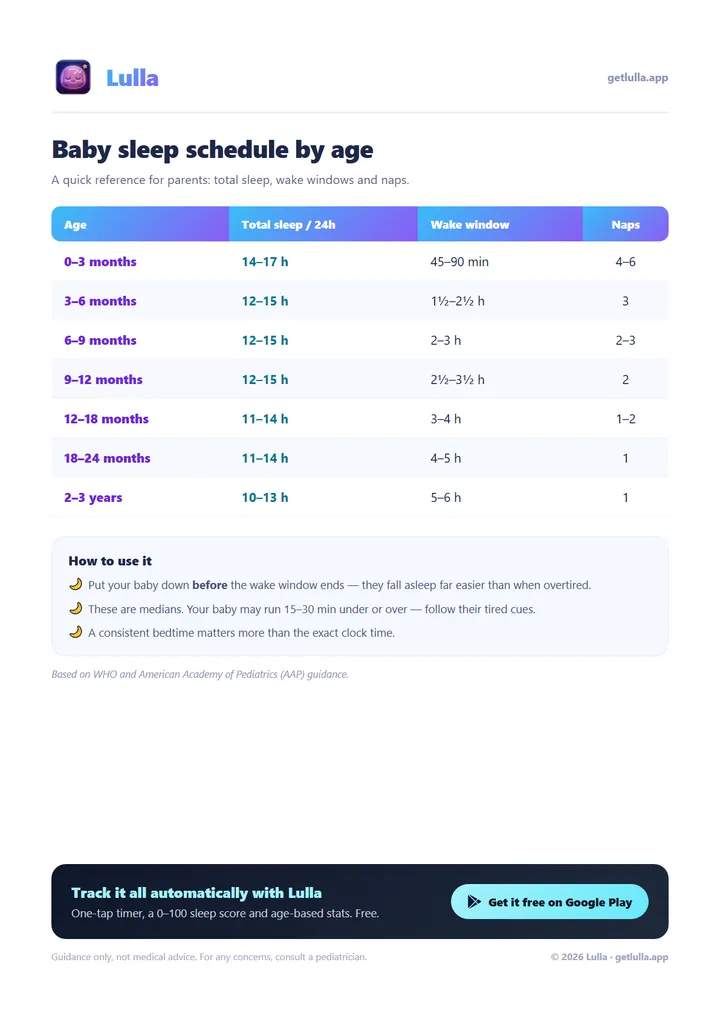
One table with everything that matters: total sleep per 24h, wake windows and number of naps, from newborn to age 3. Total sleep follows the National Sleep Foundation recommendations.
Sources and references
This article draws on official guidelines and peer-reviewed studies. Verify the sources directly:
- Iglowstein I, Jenni OG, Molinari L, Largo RH. Sleep duration from infancy to adolescence: reference values and generational trends. Pediatrics. 2003;111(2):302–307.
- Galland BC, Taylor BJ, Elder DE, Herbison P. Normal sleep patterns in infants and children: a systematic review of observational studies. Sleep Medicine Reviews. 2012;16(3):213–222.
- Paruthi S, Brooks LJ, D’Ambrosio C, Hall WA, Kotagal S, et al. Recommended Amount of Sleep for Pediatric Populations: A Consensus Statement of the American Academy of Sleep Medicine. J Clin Sleep Med. 2016;12(6):785–786.
📖 Read also:
- Wake windows by age: the full chart from newborn to 2 years
- From 2 naps to 1: when it happens and how to do it without chaos
- Sleep training methods: Ferber, cry it out, the chair and what studies show
- When your newborn won't sleep: what to check, in order
Or check out the complete baby sleep guide — all 7 articles condensed in one place.