Lulla TeamWe review current pediatric literature and synthesise it into accessible language for parents.
Newborn colic: how long it lasts, when it ends, what helps
It's 6:40 PM. This started about a week ago and it happens every evening, at roughly the same time. The crying comes in waves, the body stiffens, the knees pull up to the chest. You've fed them, changed them, walked them around the house, tried the pacifier, white noise and one more feed. Nothing holds for longer than two minutes. Two hours later it stops on its own and they fall asleep.
If you've looked up what is happening, you've probably found the same thing everywhere: that crying rises until six weeks, hits a peak, and then falls away. The meta-analysis of 8,690 babies does not find the peak. And the real shape of the curve changes the answer to the only question that matters to you right now: how much longer this lasts.
It isn't a peak. It's a plateau that drops sharply.
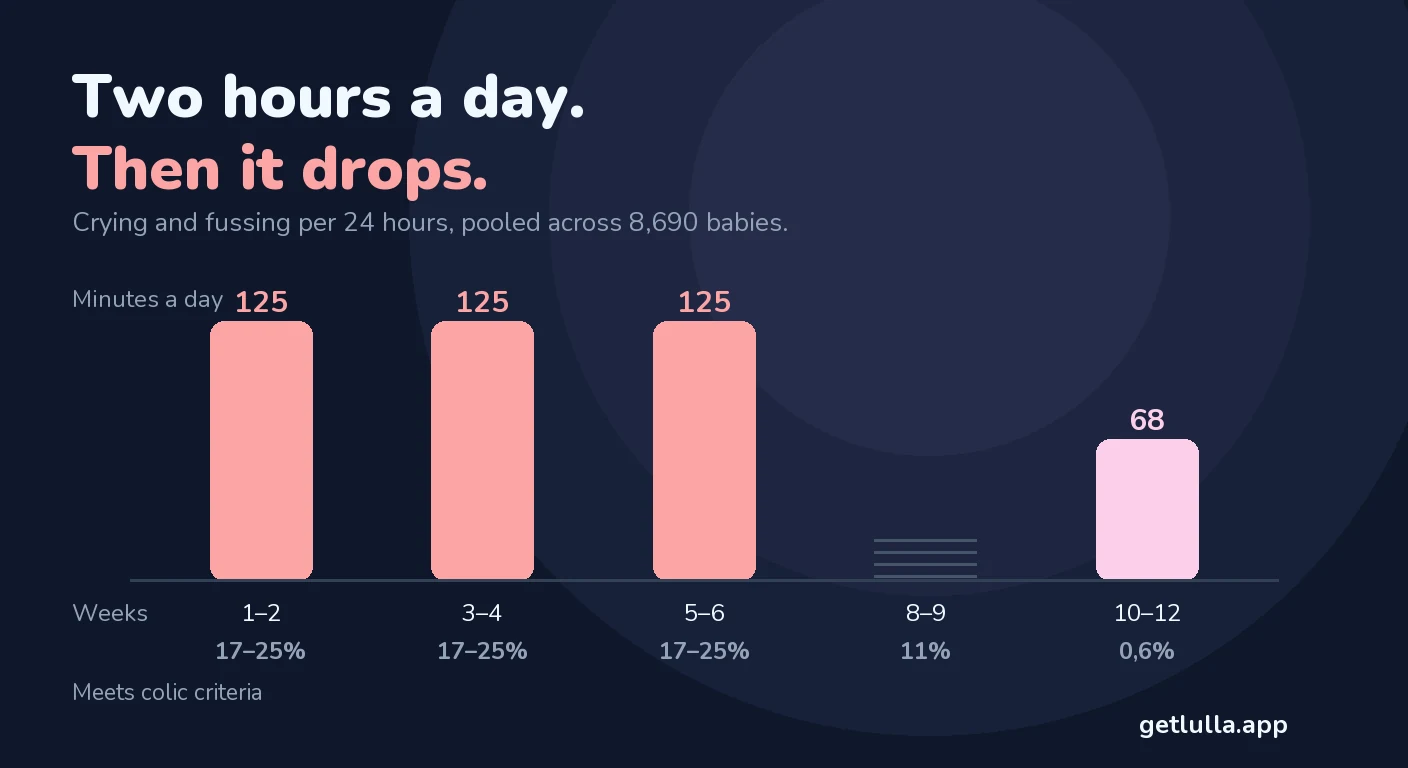
In 2017, a team gathered every study in which parents kept hour-by-hour crying diaries and pooled 8,690 babies from 33 samples. Their conclusion, in their own words: there is no statistical evidence for a universal crying peak at six weeks.
What they found instead is more useful, because it tells you when it ends:
| Age | Crying and fussing, per 24 hours | How many meet the colic definition |
|---|---|---|
| 1–2 weeks | about two hours | 17–25% |
| 3–4 weeks | about two hours | 17–25% |
| 5–6 weeks | about two hours | 17–25% |
| 8–9 weeks | starts to fall | 11% |
| 10–12 weeks | 68 minutes | 0.6% |
The average stayed between 117 and 133 minutes a day across the first six weeks — it did not climb toward a peak, it stayed there — and fell to 68 minutes by ten to twelve weeks. The share of babies who meet the colic criteria goes from one in four-to-six down to fewer than one in a hundred.
The difference between “a peak at six weeks” and “a plateau that drops after eight” is not academic. If your baby is five weeks old, the first version tells you you're nearly through. The second tells you the truth: you have a few more weeks of the same, and then it ends quickly. That is harder to hear and much easier to carry than an expectation that doesn't hold up.
One qualification the numbers deserve: those two hours are an average across studies, and the spread is wide — the standard deviation is over an hour. A baby who cries for forty minutes and a baby who cries for three hours are both inside the range. The figure is not a target and not an alarm threshold; it's a scale to place yourself on.
Why the evening
Crying isn't spread evenly across the day: it collects in the late afternoon and the evening. Two things overlap there, and neither one is your fault.
The internal clock isn't giving clear signals yet. The day-night rhythm isn't there from birth: it settles over the first months. Until then there is no mechanism to reconcile the evening with sleep, the way there is later on. The hour at which your baby gives out is not one they chose.
The day's sleep debt comes due in the evening. At this age naps are short and irregular, and whatever they didn't sleep by five o'clock shows up at seven. You can't control the circadian rhythm, but you can control how long they stay awake between naps — and in a newborn that stretch is forty-five to sixty minutes, far shorter than anyone expects. One exception, so you don't blame yourself for nothing: the window between the last nap and bedtime runs well past the band anyway in babies under six months, sometimes two or three times over — that is the evening fussing period, the witching hour, described as normal, not a measure you missed. The band for each month is the one thing you can change this afternoon that shows up tonight.
If the crying doesn't land in the evening but at some other hour, or if your baby wakes from sleep screaming and doesn't recognize you, that isn't what we're talking about here — those are three other things, with a different clock and a different answer.
The sample day for each of the first months, with naps and wake windows — pick their month:
Newborn · 1 month · 2 months · 3 months · 4 months · 5 months
Is it colic or something else?
“Colic” isn't a diagnosis of cause, it's a description: a healthy baby who is growing normally cries a lot and is hard to console, with no reason found. The word points at the gut, but the gut is an assumption, not a finding.
Three signs take you out of this conversation and to a doctor, not to another article:
- They aren't gaining well or they refuse feeds. Crying that arrives alongside a weight curve that is flattening out is no longer about evenings.
- A fever, or any second symptom. Fever comes first and doesn't wait: in a baby under three months, 38 °C (100.4 °F) or higher means calling 911 or going to the ER, even if they seem perfectly fine between episodes and even if the crying looks like it has another explanation. Then the rest — projectile vomiting, blood in the stool, a spreading rash, labored breathing. The triad that separates a physical cause from a scheduling one is in the triage guide.
- The crying sounds different from usual — high-pitched, weak or unbroken — or your baby is hard to wake and floppy between episodes. For any of these, don't wait for an appointment: call 911 or go to the ER.
There is one more boundary, in age: after three or four months, inconsolable evening crying is no longer this pattern. The figures above show why — at ten to twelve weeks, fewer than one baby in a hundred still meets the definition. If the evenings are still hard at five months, you look elsewhere: most often an overshot wake window, the overtiredness you didn't see coming or the four-month sleep reorganization, which falls exactly on this boundary.
What helps, with numbers
Here is the part worth knowing before you buy anything.
Short version, before the detail: the best evidence belongs to probiotics in breastfed babies. Carrying, although it is the first thing advised everywhere, has thinner evidence than it looks — and we explain it below, because the reason matters. And the things that sell best for colic are precisely the ones without evidence.
Carrying, on top of however much you already hold them. The first randomized trial to test this took 99 mother-baby pairs and asked one group to carry the baby more during the day — not in response to crying, but anyway, between feeds. At six weeks, the extra-carried babies cried and fussed 43% less in total (an hour and a quarter against two hours and ten minutes) and 51% less between four in the afternoon and midnight. In percentage terms the effect on the evening is larger than the effect on the total — which is to say it lands exactly on the hour that hurts.
The trial is from 1986 and it is built on the premise of the six-week peak, that is, on exactly what the 2017 meta-analysis could not confirm. That doesn't cancel its result: the groups were drawn by lot and the difference between them is real, whatever the curve is called. The framing has aged; the measurement hasn't.
But there is another limit, and it's the one that counts on this page: those 99 babies were healthy infants, not babies brought to a doctor for crying. Five years later the same team repeated the experiment on exactly those babies: 66 mothers who had come to the pediatrician for excessive crying, half of them advised to carry the baby 50% more. They did carry them more than two hours a day beyond the others — and at six weeks their babies cried three minutes a day less, a difference that falls inside the margin of error. A third trial, from 1995, tried carrying as prevention from birth, across three groups and more than two hundred babies: carrying went up for real, crying came out the same. So carrying lowers the normal crying of the first months, but in a baby who already cries a lot it has not been shown to lower anything further. It stays cheap, safe and good for both of you — it just isn't the treatment you are looking for at 6:40 PM.
What the evidence shows about probiotics. A 2024 meta-analysis pooled the randomized trials and found an average reduction of 51 minutes of crying a day. Broken down: 64 minutes for Lactobacillus reuteri DSM 17938 and 74 minutes in exclusively breastfed babies. The authors also say what they don't know: the evidence for formula-fed babies and for those born by cesarean is limited. An earlier review had reached the same conclusion — probiotics have the best evidence of the treatments tried, and especially in breastfed babies. That is all: this is what the evidence shows, not a nudge to buy something. A supplement given to a baby a few weeks old is discussed with their doctor first — the evidence from the trials is on particular strains and doses, not on any box with probiotic written on it, and they know what else your baby is getting.
What has no evidence. The same review examined four common approaches. Probiotics, above, were one of them. Simethicone — the drops you find in any pharmacy — has moderate-to-low quality evidence showing that it brings no benefit at all, and in places does harm. For drugs that lower stomach acid, a meta-analysis did not support the use of proton pump inhibitors to reduce crying — and what the joint guideline of the pediatric gastroenterology societies explicitly recommends about them is in the triage guide. Manual therapies did show a reduction, but on moderate-to-low quality evidence.
And what the three national guidelines included in that review recommend unanimously isn't a product: parent education, reassurance, and clinical assessment of mother and baby. In other words, exactly the page you are reading now and an appointment, not a shelf.
What to try tonight, in order
Nothing that follows stops an episode that has already started. All of it makes the episodes rarer and gentler, and all of it is judged after a few days, not after one evening.
- Look back at the whole day, not the last hour. How much they slept, how long they were awake between naps. Two hours of the total go missing easily, without your noticing. How many naps and how long each one lasts.
- Move the last nap closer to the evening. A baby who last slept at four in the afternoon goes into the hard stretch rested; one who last slept at two thirty does not. Moved, not lengthened: if the day came out short, the next wake window gets shorter and bedtime moves earlier, not the other way around.
- Start the carrying before the hour, not after. That is the point of the trial above: not as a response to crying, but as a habit across the day. If you carry them in a sling or carrier rather than just in your arms, the position is not a detail at this age: face free and visible, chin off the chest, back supported, high enough that you can kiss the top of their head. A newborn can't clear their own airway if their neck folds forward, so you check it often in the first months.
- One change at a time, three days. If you change four things in one evening, you will never know which one mattered — and because the curve falls on its own after eight weeks, you will believe the last thing you tried was what worked.
Background noise helps some babies and not others; if you use it, the volume, the distance and how long it stays on matter more than the kind of sound. And if the crying only ends when they fall asleep in your arms, and that is really the problem, that's a different conversation and it is for later — before four months you don't start anything of that kind.
One thing to avoid, on the subject of old folk remedies for colic in babies: teas, caraway water and “gripe water” all mean fluid taking the place of milk in a baby who needs nothing else — and under six months that carries risks of its own, not just a lack of effect.
The part nobody talks about
A baby who cries for two hours and won't be consoled does something to you. That isn't weakness and it isn't a lack of love — it's physiology: inconsolable crying is built to be unbearable, otherwise it wouldn't work.
Research on abusive head trauma shows that normal, prolonged, inconsolable crying is precisely the most commonly reported trigger. Not because parents are bad, but because it is the point at which an ordinary interaction gives way. That is why we say it beforehand, not afterwards.
What you do when you feel you can't take any more: you put them in the crib, on their back, safely, and you leave the room for ten minutes, going back in every so often to check that they're all right. That is the standard recommendation for exactly this situation, and it is not the same thing as leaving them to cry as a method: you aren't teaching anyone anything, you're giving yourself ten minutes so you can come back in one piece. Call someone. Swap shifts, if there are two of you. Never shake them, not even in play, and say that to anyone who looks after them — grandparents, a sitter, whoever is left alone with them on a hard evening. And one more thing, because this page gets read afterwards too, not only before: if it has already happened, even once, take them to a doctor the same day and say exactly what took place, even if they seem fine now. Shaking injuries aren't always visible on the spot, and time is the only part still up to you.
How Lulla helps
The table above is an average across studies; your own baby you can plot yourself, and it takes only two numbers a day: how many minutes they cried and how much they slept. After three weeks you can see whether the minutes really are coming down toward the lower end, that is, whether you are already on the falling slope — and whether the hard evenings land after the days with little daytime sleep, the one link you can break. And in three weeks' time, when you no longer know whether anything has improved, you have the numbers, not the impression of one night.
Worth keeping in mind: this article is informational, not medical advice, and the figures quoted come from the studies in the source list, each with its own limitations. For any worry about your baby's crying, growth or feeding, your pediatrician remains the first stop — they have the full history.
Your baby's sleep schedule, by age
Your baby's sleep schedule, by age
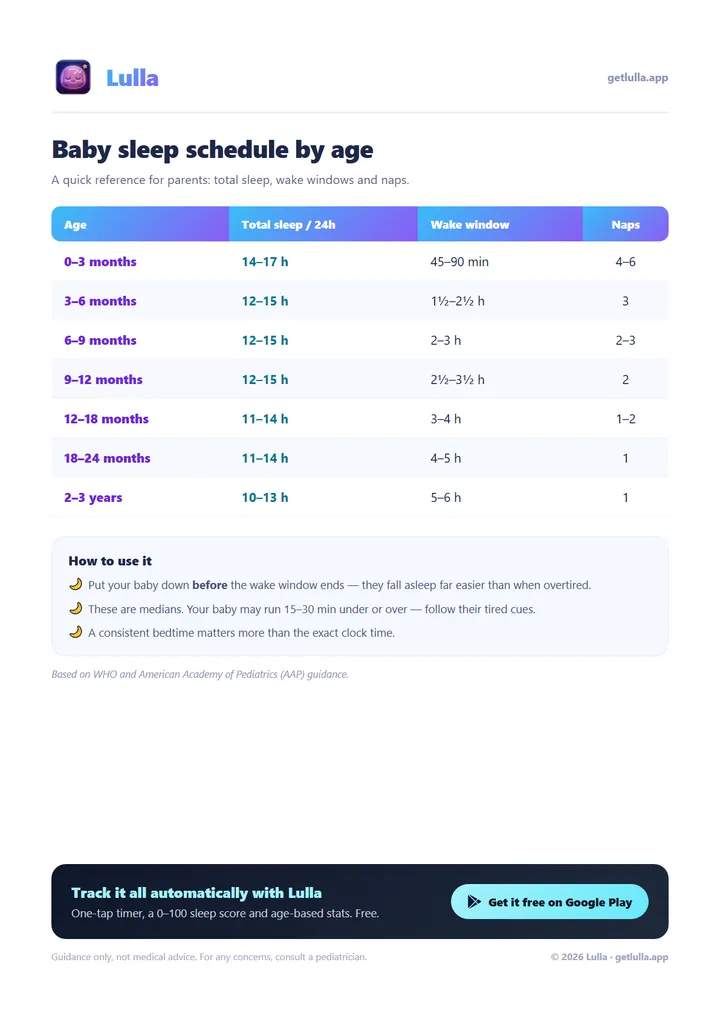
One table with everything that matters: total sleep per 24h, wake windows and number of naps, from newborn to age 3. Total sleep follows the National Sleep Foundation recommendations.
Sources and references
This article draws on official guidelines and peer-reviewed studies. Verify the sources directly:
- Wolke D, Bilgin A, Samara M. Systematic Review and Meta-Analysis: Fussing and Crying Durations and Prevalence of Colic in Infants. The Journal of Pediatrics. 2017;185:55–61.
- Hunziker UA, Barr RG. Increased carrying reduces infant crying: a randomized controlled trial. Pediatrics. 1986;77(5):641–648.
- Ellwood J, Draper-Rodi J, Carnes D. Comparison of common interventions for the treatment of infantile colic: a systematic review of reviews and guidelines. BMJ Open. 2020;10(2):e035405.
- Vaz SR, Tofoli MH, Avelino MAG, da Costa PSS. Probiotics for infantile colic: Is there evidence beyond doubt? A meta-analysis and systematic review. Acta Paediatrica. 2024;113(2):170–182.
- Barr RG. Preventing abusive head trauma resulting from a failure of normal interaction between infants and their caregivers. Proceedings of the National Academy of Sciences. 2012;109(Suppl 2):17294–17301.
- Barr RG, McMullan SJ, Spiess H, Leduc DG, Yaremko J, et al. Carrying as colic "therapy": a randomized controlled trial. Pediatrics. 1991;87(5):623–630.
- St James-Roberts I, Hurry J, Bowyer J, Barr RG. Supplementary carrying compared with advice to increase responsive parenting as interventions to prevent persistent infant crying. Pediatrics. 1995;95(3):381–388.
📖 Read also:
- When your newborn won't sleep: what to check, in order
- Wake windows by age: the full chart from newborn to 2 years
- Baby tiredness signs: how to read them before the crying starts
- Sleep training methods: Ferber, cry it out, the chair and what studies show
Or check out the complete baby sleep guide — all 7 articles condensed in one place.