Lulla TeamWe review current pediatric literature and synthesise it into accessible language for parents. All recommendations follow WHO and AAP guidelines.
Can I give my baby water? Not before 6 months
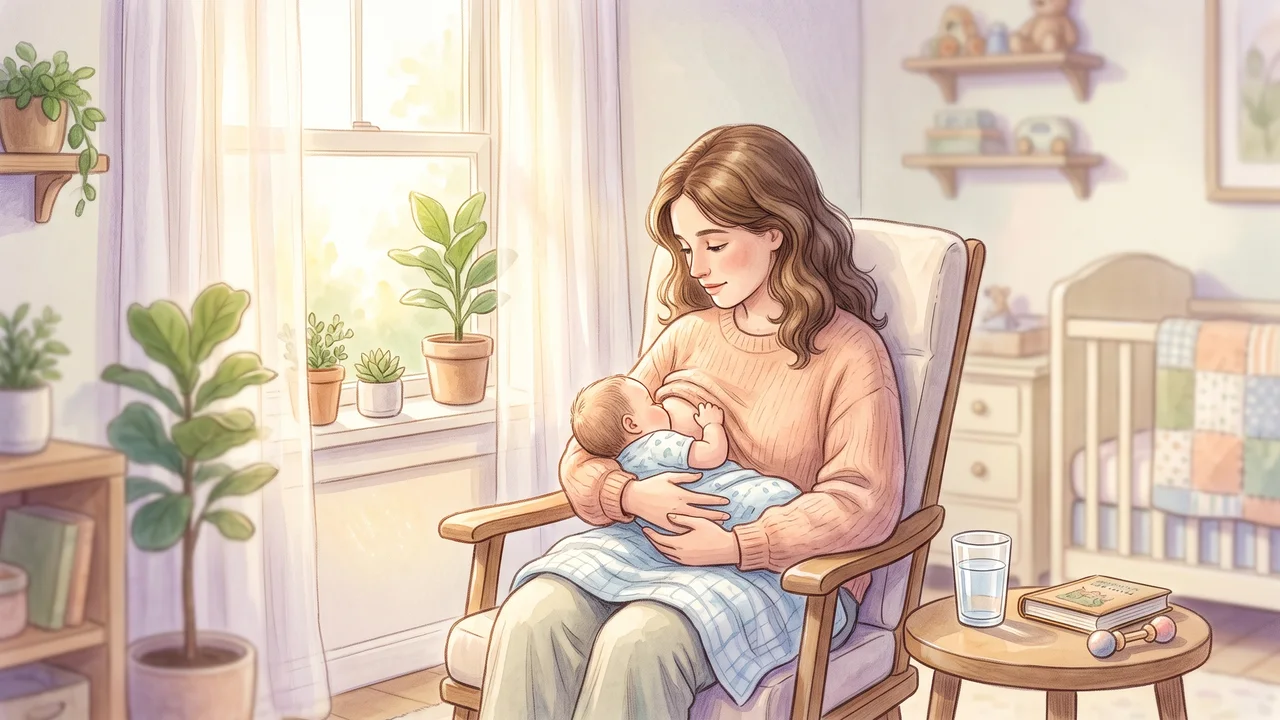
It's hot outside, the baby seems unsettled, and someone in the family says: "Give the poor thing some water, they must be thirsty." The advice comes from genuine care — but under 6 months, it's one of the most dangerous suggestions you can be given.
The short answer: a healthy baby under 6 months does not need water. Not in summer, not in a heatwave, not between feeds. Breast milk or formula covers their fluid needs entirely. And extra water isn't just unnecessary — it can be dangerous.
Why milk is enough
Breast milk is roughly 87% water. Correctly prepared formula has a similar content. In other words, at every feed your baby is already getting water — it just arrives packaged with calories, protein, fat, minerals and antibodies.
The World Health Organization recommends exclusive breastfeeding for the first 6 months, and "exclusive" means it literally: no water, no tea, no juice, nothing other than milk (the exception being vitamins or medicines prescribed by a doctor).
Water intoxication: what actually happens
This is the part many parents don't know. A baby's kidneys are immature — they can't clear excess fluid as efficiently as an adult's. When a baby drinks too much water, it dilutes the sodium in their blood, a state called hyponatraemia.
Sodium controls the fluid balance between cells. When it drops suddenly, water moves into the cells and they swell — including brain cells. The consequences can be:
- unusual irritability or, conversely, excessive drowsiness;
- a low body temperature;
- puffiness of the face;
- seizures;
- in severe cases, cerebral oedema.
This isn't a theoretical scenario. A case published in 2024 describes a 5-month-old girl who went into status epilepticus (prolonged seizures) after being given too much water. Another reported case describes hyponatraemic seizures in a 6-month-old baby, for the same reason.
Important: the dangerous amount is smaller than most people imagine. In a baby weighing a few kilograms, we're not talking about litres — a few bottles of water in one day can be enough.
The second risk: less dramatic, but more common
Even small amounts have a cost. A newborn's stomach is roughly the size of a cherry at birth. Every millilitre of water takes up space that should have been milk.
The result: the baby feels full without taking in a single calorie, feeds less at the next meal and, over time, may gain weight more slowly. And if you're breastfeeding, fewer feeds mean a weaker signal for milk production — so your supply drops too.
"But it's a heatwave out there"
The most common objection, and a fair one. The paediatric answer, though, isn't water: more frequent feeds, not water.
In very hot weather, your baby may ask to feed more often and for shorter stretches. That's normal, and it's exactly the right mechanism — the first mouthfuls of breast milk are more watery and quench thirst. What else you can do:
- offer the breast or the bottle more often, on demand;
- keep the room cool and dark (it also helps with settling in the evening);
- thin clothing, a single layer;
- avoid direct sun exposure between 11:00 and 17:00.
Signs of dehydration that mean you call the doctor rather than give water: fewer than 6 wet nappies in 24 hours, dark, strong-smelling urine, a dry mouth, crying without tears, a sunken fontanelle, lethargy.
When you can start offering water
At around 6 months, when solids are introduced. And even then:
- small amounts — 30-60 ml a day is plenty at first;
- offered in a cup, not a bottle, so it doesn't replace milk feeds;
- only with meals, to help with swallowing;
- milk remains the main source of nutrition until 1 year.
Between 6 and 12 months, water is an extra, not a replacement.
Three related mistakes, just as important
1. Diluting formula
Never. Adding extra water to "make it stretch further" or because "it's too thick" creates exactly the same hyponatraemia, plus malnutrition. Always follow the ratio on the tin, to the millilitre.
2. Baby teas
Chamomile or fennel tea "for colic" is still calorie-free fluid and carries the same risks as water, plus added sugars in the commercial versions. Under 6 months, only on a doctor's instruction.
3. Water for hiccups
Hiccups in babies are normal and pass on their own. They don't need water.
When water IS indicated under 6 months
There are situations — but they all have one thing in common: they are decided by a doctor. For example, an oral rehydration solution prescribed for severe diarrhoea or vomiting. That isn't plain water, and it isn't something you start on your own initiative. If your baby has diarrhoea or is vomiting, call your paediatrician before giving them anything.
How Lulla helps
Many of the worries that lead to "maybe they're thirsty" come from a lack of context: have they eaten enough today? did they sleep worse because of the heat? In Lulla you can track feeding sessions alongside sleep sessions, in one place. During a heatwave you can see in black and white whether your baby is asking to feed more often and whether sleep is getting shorter — concrete information you can take to your paediatric check-up instead of an impression. See also how many hours they should sleep at their age or how to read the tiredness signs.
Remember: this article is for information only and summarises WHO and AAP recommendations. For any concern about your child's hydration, feeding or growth, your paediatrician remains the first port of call — they know the full history.
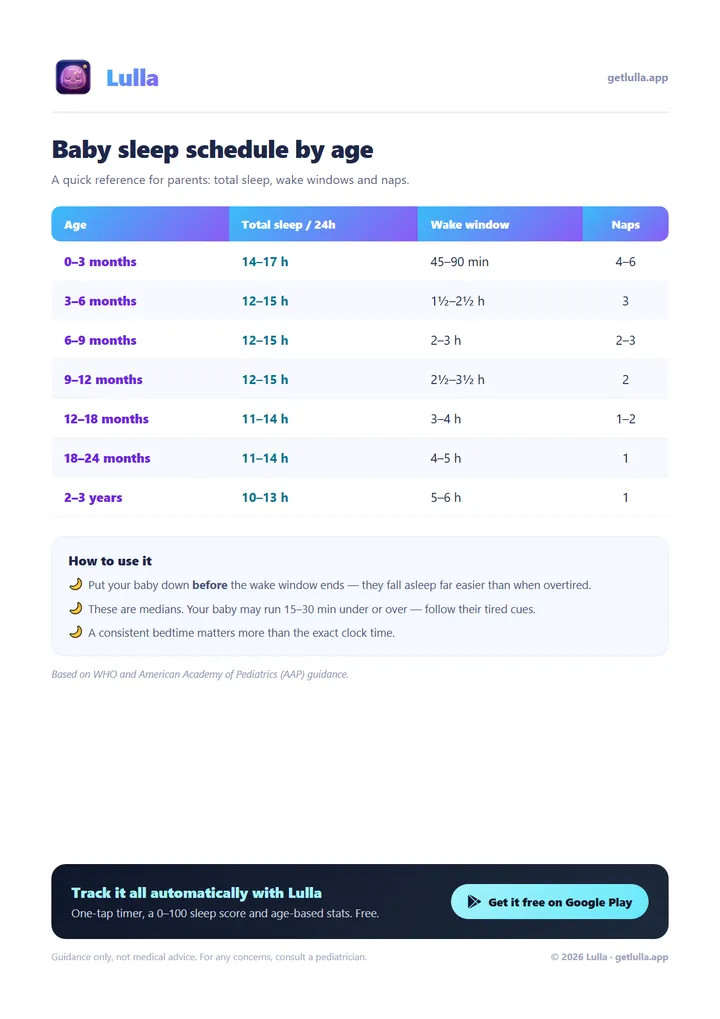
Your baby's sleep schedule, by age
Your baby's sleep schedule, by age
One chart with everything that matters: total sleep per 24h, wake windows and number of naps, from newborn to age 3. Based on WHO and AAP guidance.
Sources and references
This article draws on official guidelines and peer-reviewed studies. Verify the sources directly:
- World Health Organization — Infant and young child feeding (fact sheet): exclusive breastfeeding for the first 6 months.
- Alshaikh A, Aldoseri AA, Jadah RHS (2024). Infantile Status Epilepticus: A Case of Excessive Water Intake in a Five-Month-Old Girl. Cureus, 16(4), e59115.
- Hansen R (2017). Hyponatraemic seizure in a 6-month-old infant due to water intoxication. Journal of Paediatrics and Child Health, 53(7), 717–719.
- American Academy of Pediatrics — Starting Solid Foods (HealthyChildren.org)
- NHS — Bottle feeding advice: making up infant formula correctly.
📖 Read also:
- How many hours should your baby sleep? Age-by-age guide
- Baby tiredness signs: how to read them before the crying starts
- How to build the perfect sleep routine for your baby
Or check out the complete baby sleep guide — all 7 articles condensed in one place.