Lulla TeamWe review current pediatric literature and synthesise it into accessible language for parents.
Newborn feeding schedule: how often, how much and cluster feeding
It's 2:40 a.m. Your daughter is 12 days old, she fed at 1:15 and again at 1:50, and now she's rooting for the breast again. During the day she slept three hours between feeds; now she can't seem to get full. You wonder whether you have enough milk, whether you should give her a bottle, whether this is normal. For some of these questions there are good measurements. For many of the numbers going around, there aren't.
The short answer on a newborn feeding schedule, how often and how much a newborn eats:
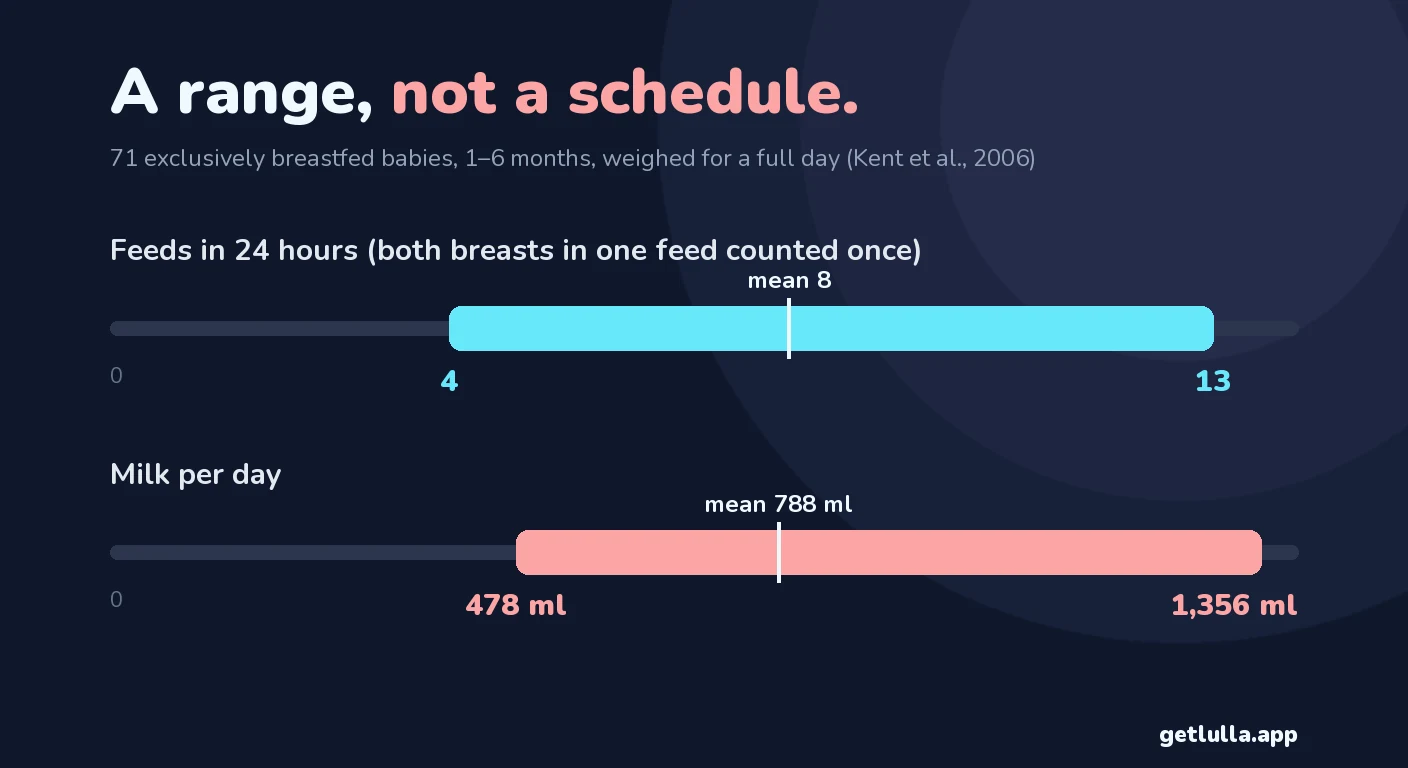
- Normal is a wide range, not a schedule. For a breastfed baby, the guidelines give at least 8–12 feeds in 24 hours in the first weeks. Measured at 1–6 months: 8 feeds on average, but anywhere from 4 to 13 from one baby to the next.
- How much milk: on the first day, a few grams per feed; at 1–6 months, a breastfed baby drinks about 750–800 ml (25–27 oz) a day, with big differences, and the amount doesn't necessarily rise from one month to the next. For formula, the only official figures we found are American and Polish.
- Night feeds are the rule in the first months, not a problem to solve.
- Cluster feeding (very frequent feeds for a few hours in a row, often in the evening) is described by the guidelines as normal, but it hasn't been studied as such; that it “boosts supply” is something no one has tested.
- Growth spurts at fixed ages have no evidence behind them, and the guidelines don't even agree on the weeks.
- Whether your baby is eating enough is something weight and diapers tell you, not minutes at the breast or the milliliters in one feed.
How often should a newborn eat? A range, not a schedule
Almost all the guidelines we read (country by country, in the table below) give at least 8–12 feeds in 24 hours for a breastfed baby in the first weeks; the World Health Organization gives no number and says instead “as often as the child wants, day and night.” The first days are different: in a Japanese study of 140 newborns, there were on average 4 feeds in the first 24 hours and 7 in the next, and the Hungarian guideline gives a minimum of 4 feeds on the first day, 6 on the second and 8 from the third.
The studies that counted feeds show how wide the range is. In Australia, 71 babies aged 1–6 months, exclusively breastfed on demand, were weighed before and after every feed for a full day. They fed on average 11 times in 24 hours, anywhere from 6 to 18, but that figure counts each breast separately; if both breasts in the same feed are counted once, it comes to 8 feeds on average, anywhere from 4 to 13. In Sweden, among 506 exclusively breastfed babies, the average number of daytime feeds at 2 weeks ranged from 2.9 to 10.8 from one baby to another. And in the Australian study, the number of feeds had no relationship to how much milk the mother made: a baby who feeds 6 times doesn't necessarily get less than one who feeds 12. This was measured at 1–6 months, not in newborns: in the first weeks, from the second day on, the guidelines ask for at least 8 feeds in 24 hours, and if your baby has fewer, tell the doctor.
Over time, feeds space out: in another study from the same Australian lab, between 1 and 3 months feeds became fewer and larger, then stayed the same up to 6 months. For formula, American pediatricians give a newborn a feed every 2–3 hours, at least 8 a day; at one month, roughly one every 3–4 hours; and at 6 months, 4–5 feeds a day. We didn't find a diary study counting formula feeds month by month (PubMed, Nov. 17, 2026: 56 results, all read by title; the closest is a one-day diary of 67 babies at 6 months, which doesn't give feeds by age).
The guidelines' conclusion: you feed your baby when they show hunger cues, not at set times; the NHS and the CDC say the same for formula. For breastfeeding, a Cochrane review of three old maternity-ward studies, with methodological limitations, found that scheduled feeds every 4 hours in the first days led more often to stopping breastfeeding at 4–6 weeks.
How much should a newborn eat, at the breast and from the bottle
In the first days, very little. In Brazil, 90 exclusively breastfed newborns, weighed on a very sensitive scale, took on average 1.5 g of colostrum per feed on the first day and about 15 g over the whole day; the NHS says “about a teaspoon” per feed. The amount rises fast: in one small American study, from 13 g per kilogram per day on the first day to 98 g/kg on the third and 155 g/kg on the fifth; in another, to about 500 g a day by day 5. On formula, left to drink as much as they want, newborns drink more from the start: 57 ml per kilogram per day in the first 48 hours, 2–3 times what breastfed babies drink according to other studies, and they lose less weight.
Then, about 750–800 ml a day, with big differences. At 1–6 months, the exclusively breastfed babies in the Australian study drank on average 788 ml in 24 hours, anywhere from 478 to 1,356, and took on average two-thirds of the milk available in the breast. Other weighings give 818 g a day at 3 months and 753 g at 3–5 months. Whether daily intake keeps rising after the first month is something the studies disagree on: in the Australian babies it stayed the same from 1 to 6 months, with feeds that were fewer but larger; in California, in 20 babies, it rose on average from 673 to 896 ml. The researchers at the Australian lab that made the Perth measurements (the 788 ml, the two-thirds, the milk staying the same from 1 to 6 months) declare, in a 2021 review, that they are paid from a grant from Medela, a breast pump maker; the other weighings in this paragraph come from American universities.
Newborn stomach size: “the size of a cherry.” The picture with fruit or marbles (a cherry on the first day, a walnut on the third, an egg around day 10) doesn't come from a measurement: the marble version, at 5–7, 22–27 and 60–81 ml, comes, according to a 2020 analysis, from an educational card by Ameda, a breast pump maker. A 2008 review concluded that such models don't reflect reality well, and when it was measured in 17 newborns, the stomach became more stretchy over the first three days and held more. None of the official guidelines we read uses the cherry or the walnut; American pediatricians compare an infant's stomach to an egg, without saying at what age. What remains true: on the first day, feeds are a few milliliters, and that's normal.
On formula, how much? The only official figures we found come from the US and Poland. American pediatricians give at most 30–60 ml (1–2 oz) per feed in the first week, 90–120 ml (3–4 oz) at one month, 180–240 ml (6–8 oz) 4–5 times a day at 6 months; on average, about 75 ml (2.5 oz) a day for every 453 g (1 lb) of body weight (about 165 ml per kilogram) and, usually, no more than about 960 ml (32 oz) a day. The Polish guideline gives about 110 ml 8–10 times a day at one month, the same as the American figure, 120–140 ml 6 times a day at 2–4 months and 150–160 ml 5 times a day at 5–6 months, less per feed than the American 180–240 ml. For the first day or two, a page from American pediatricians gives only half an ounce per feed (about 15 ml), and the CDC, for the first days, 30–60 ml every 2–3 hours. The NHS no longer gives figures, and American pediatricians themselves write that no book or website can tell you exactly how much your baby needs.
The “150 ml per kilogram per day” rule and the “age in months plus 3 ounces per feed” rule have, as far as we found, neither an official source nor an original study. The first one comes close to the energy measured in formula-fed babies at 3–6 months (the math is ours), but per kilogram, small babies drink more and bigger ones less (an analysis done by employees of a formula maker, on data from 13 of the company's studies). The right amount comes from your baby's cues, the label on the can and the doctor who follows their weight.
How long a breastfeed lasts. In Scotland, in 50 babies aged 5–7 days, feeds lasted between 7 and 30 minutes, with 42–125 g of milk, and how much they drank didn't depend on how long the feed lasted. The breast doesn't “empty in 10–15 minutes”: a baby takes on average two-thirds of the available milk, and the German institute writes that a feed of 10–45 minutes is normal.
What the studies counted: feeds, milliliters, nights and weight
The table puts the measurements in this guide side by side and says, for each one, what was counted and how.
| Study | Country | Age | How many babies | What was counted and what was found | How it was measured |
|---|---|---|---|---|---|
| Kent et al., 2006 | Australia (Perth) | 1–6 months | 71 mother–baby pairs | Exclusively breastfed, on demand: 11 ± 3 feeds in 24 hours if each breast is counted separately (range 6 to 18), that is, 8 ± 2 feeds if both breasts in the same feed are counted once (range 4 to 13); 788 ± 169 ml of milk in 24 hours (range 478 to 1,356). The number of feeds had no relationship to how much milk the mother made | Weighing the baby before and after every feed, at each breast, for a full day; a single day per pair. The number of feeds counted by session (both breasts in the same feed counted once) and milk per day come from a review by the same lab, from 2021; its authors declare salaries from a grant from Medela, a breast pump maker (we haven't seen the funding statement of the 2006 study) |
| Kent et al., 2013 | Australia (Perth) | 1–6 months | Not given in the abstract | Between 1 and 3 months, feeds became less frequent and the milk per feed increased; between 3 and 6 months, both stayed the same. Milk per 24 hours stayed the same from 1 to 6 months | One-day weighings, repeated 2–5 times in the same pair; exclusively breastfed; same lab (Medela) |
| Hörnell et al., 1999 | Sweden (Uppsala) | 0–6 months | 506 | At 2 weeks, the average number of daytime feeds ranged from 2.9 to 10.8 from one baby to another, and of nighttime feeds from 1.0 to 5.1; at any age, at most 2% didn't feed at night | Mothers' daily diaries; exclusively breastfed; mothers who had breastfed a previous child for at least 4 months |
| Santoro et al., 2010 | Brazil (Ribeirão Preto) | First day | 90 (307 feeds weighed) | On average 1.5 g of colostrum per feed and about 15 g over the whole first day (standard deviation: 11 g) | Very sensitive scale, before and after the feed; exclusively breastfed, healthy, full-term |
| Davila-Grijalva et al., 2017 | US (Michigan) | First 48 hours | 37 analyzed, out of 50 enrolled | Formula-fed as much as they wanted: 57.2 ml per kilogram per day, 2–3 times what breastfed babies drink on the same days according to other studies (breastfed babies weren't measured here); they had lost 2.7% at about 48 hours | Amounts recorded in the hospital, in a single hospital; formula only |
| De Carvalho et al., 1983 | US | First 35 days | 44 (24 in the scheduled group, 20 in the frequent-feeding group) | In the first 2 weeks, 9.9 versus 7.3 feeds in 24 hours; on day 15, babies in the frequent-feeding group drank 725 versus 502 ml in 24 hours; on day 35, no difference | Two groups: frequent breastfeeding on demand, or on a schedule, every 3–4 hours; how they were assigned isn't given in the abstract |
| Flaherman et al., 2015 | US (Northern California, Kaiser Permanente network) | First 2–3 days | 108,907 exclusively breastfed | At 48 hours, almost 5% of those born vaginally and more than 10% of those born by cesarean had lost 10% or more of their weight; at 72 hours, more than 25% of those born by cesarean | Electronic hospital records; exclusively breastfed only (weights after any formula feed were removed) |
| Miller et al., 2015 | US (Northern California, Kaiser Permanente network) | First 2–3 days | 7,075 formula-fed | Median loss: 2.9% at 48 hours after a vaginal birth; a loss of more than 7% was rare, and after a cesarean a loss of more than 8% was rare | Same database; only babies formula-fed from the start |
| Paul et al., 2016 | US (Northern California, Kaiser Permanente network) | First month | 143,889 | Half were at or above birth weight on day 9 (vaginal birth) and day 10 (cesarean), respectively. Still below it at 14 days: 14% and 24%, respectively; at 21 days: 5% and 8%, respectively | Same database, plus weighings at checkups; all newborns, however they were fed |
| Nommsen-Rivers et al., 2008 | US (Sacramento) | First week | 242 | Median wet and stool diapers: day 1, 2 and 3; day 4, 5 and 4; day 7, 7 and 6. The number of stools on day 4 was a weak predictor of a large weight loss, with many false alarms | Mothers' diaries; exclusively breastfed |
| Pinilla and Birch, 1993 | US | First 8 weeks | 26 | A package of three changes: an evening feed, between 10:00 p.m. and midnight, nights gradually stretched out with care other than feeding, and day-night contrast. At 8 weeks, 100% versus 23% were sleeping between midnight and 5:00 a.m.; milk per 24 hours, the same | Randomized; exclusively breastfed, first-time parents; the evening feed wasn't tested separately from the rest |
| Macknin et al., 1989 | US (Cleveland) | Cereal from 5 weeks or from 4 months; sleep followed up to 21 weeks | 106 | A spoonful of rice cereal for every ounce of milk (about 30 ml), in the evening bottle, didn't change sleeping through the night | Randomized; sleep recorded by parents, one day a week |
| Perkin et al., 2018 (EAT study) | England and Wales | From 3 months; the biggest difference at 6 months | 1,303 | Babies exclusively breastfed to 3 months, given solid foods from 3 months, first non-allergenic ones, then six allergenic ones (not cereal in the bottle): at 6 months, 16.6 minutes more sleep per night and 1.74 instead of 2.01 night wakings | Randomized, on allergy prevention; sleep reported by parents, who knew which group their child was in |
Almost all of them are small studies or studies of exclusively breastfed babies; for formula, there are far fewer measurements.
Cluster feeding (feeding in bursts), especially in the evening
Cluster feeding (feeding in bursts) means several feeds very close together, sometimes once an hour or several times within an hour, followed by a longer break. The CDC describes it this way: after the first weeks, some babies sometimes eat as often as every hour, and at other times take a 4–5 hour stretch of sleep; at first, the CDC also writes, feeds come every 2–4 hours and you sometimes have to wake your baby. Spanish pediatricians call it “grouped feeds” and describe it as normal, “especially in the afternoon and evening,” in the first days.
As a term, it has no shared definition in research: “cluster feeding” doesn't appear in the title or abstract of any paper in PubMed (Nov. 17, 2026, zero results), and in the Europe PMC full text it appears in 53 papers on infants, almost all qualitative or with the term only mentioned in passing. The only one that counts it is a New Zealand study of 62 healthy, full-term newborns (GLOW), and only as a label: a session with three or more sucking bouts was a “cluster,” 15% of the breastfeeding sessions in the first 5 days; it says nothing about milk supply. The idea that feeding in bursts “increases milk supply” is something no one has tested. The closest to the question are two studies: mothers who breastfed more often in the first two weeks (9.9 feeds a day versus 7.3) had more milk on day 15, but by day 35 there was no longer any difference; later, in a cohort from four countries, at 1–8.5 months, each extra feed a day was associated with only about 6 g more milk a day (feeding frequency was analyzed in only three of the countries).
In practice: an evening of back-to-back feeds, in a baby who wets diapers and gains weight, is normal, not a sign that the milk “isn't enough.” If the evening comes with crying that's hard to stop, also read the guide to colic and evening crying.
Newborn growth spurts at 3 weeks, 6 weeks and 3 months: what was measured
A growth spurt is the usual explanation for days when a baby asks for the breast far more often. But the official guidelines give different ages: the German institute, around 6 weeks; Spanish pediatricians, “breastfeeding crises” at 3 weeks, at a month and a half and at 3 months; Italy's National Institute of Health, around 10 days and around 2 months; the Turkish protocol, at 2 weeks, 6 weeks and 3 months. American pediatricians, the CDC, the NHS, the WHO and the Romanian guideline give no age at all.
The study usually cited, from 1992, measured length, not feeds. In 31 babies, length grew in jumps of 0.5–2.5 cm, separated by 2–63 days with no measurable growth, at irregular intervals and at no fixed ages. A 2024 editorial that looked for the evidence found just six relevant papers, and the two that measured growth found neither a periodicity nor an age, and it called growth spurts at fixed ages “a simple and compelling theory.” For the 4-month “spurt” or regression, which is about sleep, read the guide to the 4-month sleep regression.
Days with more frequent feeds do happen; that they come at a particular age hasn't been shown. You feed on demand, and if you're not sure your baby is getting enough, the scale at the doctor's office answers better than a calendar.
Night feeds: until when?
In the first months, almost all breastfed babies feed at night. In Sweden, at any age between 0 and 6 months, at most 2% of exclusively breastfed babies didn't feed at night. In the Australian study, all babies under 9 weeks fed between 10:00 p.m. and 4:00 a.m. and took about a fifth of the day's milk during those hours. Even at 6–12 months, in a British survey, 61% were still feeding at night, at the breast or from a bottle. The NHS says night breastfeeding matters for milk supply.
An age for dropping it is given only by American pediatricians, and only for formula: between 2 and 4 months, or above 5.4 kg (about 12 lb), most formula-fed babies no longer need the middle-of-the-night feed. The German institute says it varies a great deal from child to child: some sleep 6–8 hours without a feed at 3 weeks, others still wake once or twice at 7 months. The same institute, though, asks for at most 4 hours between feeds in the first week, and if the baby is gaining little weight, sucking weakly or has jaundice, how long you let them sleep is something you decide with the doctor or midwife. The Polish guideline puts the target only after one year. The sample day and sleep for your baby's month:
Newborn · 1 month · 2 months · 3 months · 4 months · 5 months · 6 months
Dream feed and cereal in the bottle: do they help your baby sleep?
A dream feed is a feed given around 10–11 p.m. to a baby who is already asleep, without fully waking them, with the idea that they'll sleep longer afterward. The term doesn't appear in any title or abstract in PubMed (Nov. 17, 2026). The only randomized trial that included such a feed, in 26 breastfed babies, tested it as a package with two other changes: nights gradually stretched out with care other than feeding, and day-night contrast. At 8 weeks, according to the parents' diaries, all 13 babies in the package group were sleeping between midnight and 5 a.m., versus 23% in the other group, with the same milk over 24 hours. What each component did can't be separated, and in a British study of 610 families, the evening feed asked of the 205 in the scheduled group didn't happen in practice.
The NHS writes that a big feed doesn't mean the baby will last longer until the next one, and the Brazilian guideline doesn't recommend a bottle in the evening to make the baby sleep longer. None of the authorities we read recommends the dream feed, and none forbids it. You can try it, but the effect hasn't been shown; after the feed, you still put your baby down on their back, as for any sleep.
Cereal in the bottle doesn't make them sleep through the night: in a randomized trial of 106 babies, a spoonful of rice cereal for every 30 ml (1 oz) of milk, in the evening, made no visible difference to sleeping through the night (sleep was recorded by the parents, one day a week). American pediatricians say not to put cereal in the bottle, because the baby can choke and can gain too much weight (the exception is reflux, on the doctor's advice), and the NHS says not to add sugar or cereal to the milk. Only one result points in another direction, and it has to be read exactly: in the English EAT study, exclusively breastfed babies who were given solid foods from 3 months, first non-allergenic ones, then six allergenic ones (not cereal in the bottle), slept 16.6 minutes more per night at 6 months, according to their parents, who knew which group their child was in. The study was about allergies, and the WHO and the NHS still recommend solid foods at around 6 months. For the feed in the bedtime routine and falling asleep at the breast, see the guide to the bedtime routine.
Newborn hunger cues and crying
The CDC lists the hunger cues: bringing hands to the mouth, turning the head toward the breast or the bottle, puckering, smacking or licking the lips, clenched fists. The signs of fullness: closing the mouth, turning the head away, relaxing the hands. The Brazilian guideline puts them in order: opens the mouth and turns the head as if looking for the breast, gets restless, brings the hands to the mouth “and, finally, cries.”
“Crying is a late sign of hunger,” write American pediatricians, the CDC, the NHS, Italy's National Institute of Health and the Brazilian guideline, and Spanish pediatricians say to feed your baby before they cry. It's practical advice with a good reason behind it: a crying baby is harder to latch on. As a research finding, we didn't find a study that measured crying as a “late” sign (PubMed, Nov. 17, 2026: zero results). The only interval measured, 31 minutes on average from the first oral cue to the first sustained crying, comes from a 1984 study of 15 newborns in their first hours of life (the details are in the guide to tired signs). And in a study of 7 newborns, rooting appeared more often before feeds, but in only one baby did it usually appear without crying, so the study doesn't show that feeding at this cue prevents crying. The German institute and the Polish guideline simply list crying among the hunger cues, and the German institute adds that the cues “are not always clear.”
The reverse isn't a rule either: not every cry is hunger, and the Hungarian guideline lists among the mistakes formula started because the baby “cries a lot.” In a small American study of 45 children whose feeds were filmed at home in the first 6 months (measured at 3 and at 6 months), falling asleep and relaxing muscles were the most frequent early signs of fullness.
Bottle feeding and paced bottle feeding: how to avoid overfeeding
American pediatricians write that bottle-fed babies can be overfed more easily, because milk comes out of a bottle faster and with less effort. In an American cohort of 1,250 babies, those fed a lot from the bottle in the first months more often emptied the bottle or cup later on (68% of those fed only from the bottle, versus 27% of those fed only at the breast), the same with pumped milk as with formula; it's an association, reported by mothers.
The British NICE guideline describes responsive bottle feeding: you hold your baby close, pace the feed and don't force them to finish, recognizing the signs that they've had enough. The NHS adds holding the bottle nearly horizontal, only slightly tilted, and not worrying if they don't finish it; the German institute, a nipple that lets one drop per second flow out when you turn the bottle upside down, and a feed that usually lasts 10–15 minutes. In an experiment with 29 babies, paced bottle feeding made feeds longer and slower without changing how much they drank; whether it prevents overfeeding hasn't been tested.
Preparing formula. The NHS and the 2007 WHO guideline call for boiled water, left to cool for no more than 30 minutes so that it is still at least 70 °C, or 158 °F (at that temperature the bacteria in the powder are killed), poured into the bottle before the powder; no extra powder (NHS: it can cause constipation and dehydration; the German institute: “under no circumstances”), no extra water (NHS: too little powder doesn't give enough nourishment), no sugar or cereal and no microwave. Don't prop the bottle up on anything, and don't leave your baby alone in bed with it. Why you don't give extra water or dilute the milk is explained in the guide to when babies can have water.
Waking a newborn to feed: the rules differ from country to country
This is where the guidelines agree least. American pediatricians: a breastfed baby shouldn't go more than 2–3 hours during the day and 4 hours at night without a feed, even if they have to be woken; on formula, you wake them if they sleep more than 4–5 hours in the first weeks. Spanish pediatricians: a newborn shouldn't go more than 3 hours without a feed, “including at night,” although, in the same paragraph, a healthy baby who is gaining well doesn't need to be woken at night. The German institute: at most 4 hours, only in the first week. The Romanian guideline: if they sleep more than 4 hours straight during the day, in the first weeks. The NHS, the WHO, Brazil and Turkey give no hours; the other countries are in the table below. Few say how long the rule applies: apart from the German institute, only the triage guide on the American pediatricians' website gives a limit, the first month; after that, if your baby is gaining well, you feed on demand and stop waking them. For formula, American pediatricians say, like the Romanian guideline, “in the first weeks.”
We didn't find any study that tested waking at set times in healthy, full-term newborns (PubMed, Nov. 17, 2026: zero results). The rules get stricter for babies born early, with low birth weight, with jaundice or at risk of low blood sugar; you'll find them by category in the guide to how much a newborn sleeps. And for every baby: if you can't manage to wake them, it's no longer a question of schedule but a reason to call 911.
Signs a newborn is eating enough: weight and how many wet diapers
Weight. It's normal for it to drop in the first days. In the American Kaiser Permanente network, at 48 hours, almost 5% of exclusively breastfed babies born vaginally and more than 10% of exclusively breastfed babies born by cesarean had lost 10% or more; formula-fed babies lost much less (the median, 2.9% at 48 hours after a vaginal birth). The thresholds differ a little: American pediatricians give at most 8–10%, the British NICE guideline calls for an assessment above 10%, and Spanish pediatricians and the Hungarian guideline say attention increases from 7%. The return to birth weight was measured in the same network, in all newborns, however they were fed: half were back at birth weight on day 9 or 10, and at two weeks 14–24% still hadn't gotten back. The guidelines give 7–10 days (Germany), 2 weeks (Spain, Hungary, Romania) or 3 weeks (NICE, the point after which it recommends that a referral to a pediatrician be considered). If yours isn't back at two weeks, that isn't unusual, but you tell the doctor.
Diapers. For a breastfed baby, the NHS gives 2–3 wet diapers in total in the first 48 hours, at least 6 wet and heavy diapers a day from day 5 and, from day 4, at least two soft, yellow stools a day; for formula, around 6 wet diapers a day after the first days and at least one stool a day. American pediatricians say to call the doctor within 24 hours if, after the first five days, the baby has fewer than 6 wet diapers a day. Measured in 242 breastfed babies (the figures are in the table above), the number of stools was a weak predictor of who loses a lot of weight, with many false alarms: diapers are a signal; the reliable answer comes from the scale. How to recognize dehydration is in the guide to water for babies. What color and texture a normal stool has is in our guide to newborn poop.
Newborn feeding chart by country: what the guidelines say
The table puts side by side what we found officially in the ten countries we write for, plus the WHO and the UK. They all say “on demand”; on the rules, almost no column matches from one country to the next.
| Who | Feeds in 24 hours | Waking to feed | Back to birth weight | Formula: how much | Growth spurts |
|---|---|---|---|---|---|
| World Health Organization (WHO) | On demand, “as often as the child wants, day and night”; no number | Doesn't say | Doesn't say | Doesn't say | Doesn't say |
| US (American pediatricians, AAP, and CDC) | Breastfed: at least 8–12 (one AAP page: 10–12 “are the norm”); formula: at least 8 (CDC: 8–12) | Breastfed: no more than 2–3 hours during the day and 4 hours at night without a feed, even if you wake them; formula: wake them if they sleep more than 4–5 hours in the first weeks. For breastfeeding, the triage guide on the AAP website gives a limit: after one month, if they're gaining well, you stop waking them | A loss of at most 8–10% in the first days; no day for getting back (in the pages we read) | At most 30–60 ml per feed in the first week; 90–120 ml at one month; 180–240 ml 4–5 times a day at 6 months; on average ~75 ml a day for every 453 g of body weight (≈165 ml/kg); usually at most ~960 ml a day | Gives no ages |
| UK (NHS and NICE) | At least 8–12 or more, in the first weeks (“a very rough guide”) | Gives no number of hours; the doctor checks whether the baby wakes for feeds | Most by 3 weeks; assessment if they lost more than 10% or aren't back by 3 weeks | No longer gives figures: at first “quite small amounts,” then following the baby's cues | Doesn't say |
| Germany (federal public health institute, BIÖG) | 8–12 or more often; many take a single longer break in 24 hours | At most 4 hours between feeds, only in the first week; after that, with poor growth, weak sucking or jaundice, with the doctor or midwife | Around 7 days, at the latest around 10 days | Doesn't say; formula “as needed,” without pushing the baby to finish the bottle | One at around 6 weeks |
| Spain (Spanish pediatricians, AEP) | 8–12 in the first month | A newborn shouldn't go more than 3 hours without a feed, “including at night”; in the same paragraph: a healthy baby who is gaining well doesn't need to be woken at night | Usually by 2 weeks; a loss of 7–10% in the first 5 days is possible | Doesn't say (in what we found) | “Breastfeeding crises” at 3 weeks, at a month and a half and at 3 months |
| Brazil (Ministry of Health, 2021 guide) | On demand (“livre demanda”), no number | Doesn't say | Doesn't say (in the summary version) | We couldn't read the ministry's table of amounts | Doesn't say |
| Italy (National Institute of Health, ISS) | 8–12 in 24 hours; waking several times at night is normal | Doesn't say (in the materials we read) | A few days, sometimes 2 weeks (the 2004 leaflet); 2–3 weeks (the dossier for professionals, 2013) | Doesn't say | Around 10 days and around 2 months |
| Hungary (ministry guideline, 2019, for professionals) | Minimum by day: 4, 6, then 8 from the third day; usually 8–12 | Only when sleepy or not gaining enough; a checklist in the appendix asks whether more than 5 hours go by between feeds, including at night | By 2 weeks; a loss under 10%, with closer attention from 7% | For formula, no; for breastfeeding, 3–40 ml/kg a day in the first one or two days | Mentions the growth spurt, with no age |
| Poland (pediatric gastroenterology and nutrition society, 2021) | Breastfed: 8–12 in 24 hours, in the first 6 months; formula: 8–10 feeds at one month | Parents' guide by authors from the same group (supported by the Nutricia Foundation): a sleepy baby should be woken regularly; no number of hours | Doesn't say (in what we read) | As a rough guide: ~110 ml 8–10 times a day at one month; 120–140 ml 6 times at 2–4 months; 150–160 ml 5 times at 5–6 months | Doesn't say |
| Japan | We couldn't download the ministry's 2019 guide; a daycare manual that cites it: at the breast, “as much as they want”; on formula, what counts is the daily amount, not the number of feeds | We couldn't read it | We couldn't read it | We didn't find official figures | We couldn't read it |
| Turkey (Ministry of Health protocol, 2018) | At least 8 a day, “without limit,” day and night, in the first 6 months | Doesn't say | Doesn't say; growth is poor below 20 g a day at 0–3 months | Doesn't say | Hunger comes “especially” at 2 weeks, 6 weeks and 3 months |
| Romania (INSMC neonatology guideline, 2021, for doctors) | On demand, day and night; no number | Wake them if they sleep more than 4 hours straight during the day, in the first weeks; nothing about nights | Within 2 weeks at most; then 115–220 g a week up to 3 months | Doesn't say | Doesn't say |
The details for your country:
In the US, American pediatricians (the AAP, on HealthyChildren.org) and the CDC give more figures than any other country in the table. For a breastfed baby, the AAP writes on one page that 10–12 feeds in 24 hours “are the norm,” on another “at least 8–12,” and that no more than 2–3 hours during the day or 4 hours at night should go by without a feed; the CDC gives 8–12 for formula-fed newborns too and names cluster feeding explicitly. For formula, the AAP gives the figures in the table, in ounces with milliliters alongside, plus the rule of about 75 ml a day for every 453 g of body weight (2.5 ounces per pound), usually capped at around 960 ml (32 ounces) a day, and adds that no book or website can tell you exactly how much your baby needs. The AAP also compares an infant's stomach to an egg, without giving an age, and writes that between 2 and 4 months, or above 5.4 kg (about 12 pounds), most formula-fed babies no longer need the middle-of-the-night feed. First pediatrician visit: no later than 48 hours after discharge from the hospital. For emergencies, 911.
When to see a doctor or go to the ER
Call 911 or go to the ER (outside the US, your local emergency number) if your baby:
- is hard to wake or can't be woken, or falls straight back to sleep after you've woken them;
- is floppy, with no muscle tone;
- has stopped eating altogether: won't suck or drink even when you offer the breast or the bottle;
- is breathing very fast or with difficulty: grunting, or the belly pulls in with every breath;
- has skin, lips or tongue that are blue, gray, very pale or blotchy;
- hasn't peed in 12 hours;
- vomits green or yellow-green (the color of bile), vomits blood or something that looks like coffee grounds;
- is under 3 months old and has a temperature of 38 °C (100.4 °F) or higher (at 3–6 months, the NHS gives a threshold of 39 °C (102.2 °F));
- has a temperature below 36 °C (96.8 °F);
- has jaundice in the first 24 hours of life, or has jaundice and, on top of that, is sleepier than usual or isn't feeding;
- has a weak, high-pitched or nonstop cry, has a seizure or has a rash that doesn't fade when you press on it.
See a doctor or go to the ER right away, not the next day, if:
- your baby gets sleepier from one feed to the next;
- after the first days of life, they haven't had a wet diaper in more than 8 hours, haven't fed or have taken very little in more than 8 hours, or have a very dry mouth and cry without tears.
Talk to the doctor the same day if:
- your baby is sleepy and has fed fewer than six times in 24 hours;
- is eating noticeably less or less often than before, or refuses some feeds;
- has fewer wet or dirty diapers than the benchmarks above;
- after the first day of life, you notice the skin or the whites of the eyes turning yellow, or the jaundice isn't going away or is getting stronger;
- the urine is dark yellow or brown, or the stool is pale, creamy white: keep the diaper so you can show it to the doctor;
- vomits forcefully (projectile vomiting) or the vomit is yellow, or there is a little blood in the stool (if there's a lot, see a doctor right away).
If your baby has lost more than 10% of their weight, the British guideline calls for an assessment, and if they aren't back to birth weight at three weeks, it recommends that a referral to a pediatrician be considered; at two weeks, you already tell the doctor. And, as the guidelines put it, a parent's worry that the baby isn't their usual self counts: if you feel something isn't right, don't wait to see how it develops.
How Lulla helps
In Lulla you log each feed with one tap, for free: breastfeeding with a timer (with pause and resume, and it keeps running with the screen off; when you start, you choose “Left breast” or “Right breast” or “Both breasts”), bottles in milliliters or ounces, solid food and water (under 6 months, the app tells you water isn't needed). On the Home screen you see how many feeds your baby has had today and how long it's been since the last one. Diapers (“Wet” or “Dirty” or “Both”) and weight are also logged for free. With Premium, in Stats you see “Feeds / day” over 7 or 30 days, “Milk / day (ml)” for bottles and “Breast / day” in minutes.
What it doesn't do, on purpose: it doesn't alert you when your baby should eat, because your baby tells you. It doesn't calculate the interval between feeds or a target for feeds or milliliters, it doesn't time each breast separately, it doesn't give you diaper thresholds and it doesn't calculate how much weight your baby has lost from birth weight. It gives you the numbers you logged, so you have them at hand when you talk to the doctor. The exceptions, with no alarm: if you log the color “Pale”, “Red” or blood for a diaper, or “Black” after the first 5 days (only if the birth date is set), the app tells you to mention it to the doctor. For white, gray or very pale stool, don't wait for the next checkup: call the doctor the same day (details in our guide to newborn poop).
Worth keeping in mind: this article is informational, not medical advice, and the recommendations in it come from the guidelines and studies in the source list, each with its own limitations. For any worry about your baby's feeding, your pediatrician remains the first stop: they know your baby's history.
Your baby's sleep schedule, by age
Your baby's sleep schedule, by age
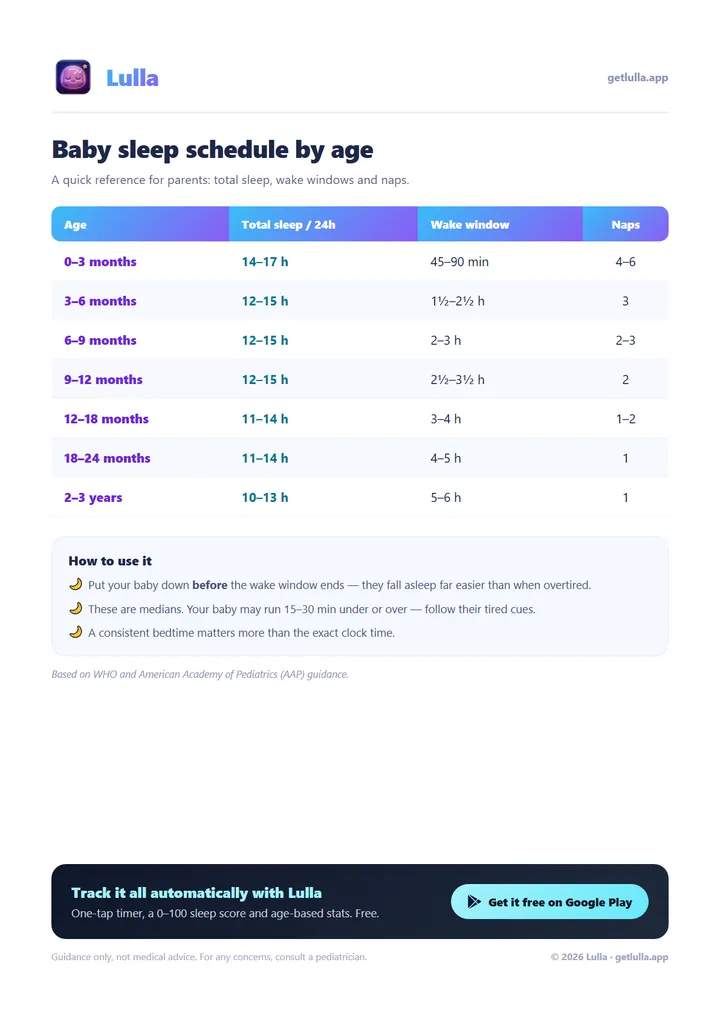
One table with everything that matters: total sleep per 24h, wake windows and number of naps, from newborn to age 3. Total sleep follows the National Sleep Foundation recommendations.
Sources and references
This article draws on official guidelines and peer-reviewed studies. Verify the sources directly:
- World Health Organization. Infant and young child feeding. Fact sheet; 2026.
- World Health Organization. Breastfeeding. Health topic.
- World Health Organization, FAO. Safe preparation, storage and handling of powdered infant formula: guidelines. Geneva: WHO; 2007.
- Jain S; American Academy of Pediatrics. How often and how much should your baby eat? HealthyChildren.org; last updated 2 April 2024.
- American Academy of Pediatrics. Amount and schedule of baby formula feedings. HealthyChildren.org; last updated 16 May 2022.
- Meek JY; American Academy of Pediatrics, Section on Breastfeeding. How to tell if your breastfed baby is getting enough milk. HealthyChildren.org; last updated 13 January 2025.
- American Academy of Pediatrics. How often to breastfeed. HealthyChildren.org; last updated 21 November 2015.
- Jana LA, Shu J; American Academy of Pediatrics. Waking up is sometimes hard to do. HealthyChildren.org; last updated 7 October 2021.
- Jana LA, Shu J; American Academy of Pediatrics. Cereal in a bottle: solid food shortcuts to avoid. HealthyChildren.org; last updated 14 May 2015.
- American Academy of Pediatrics. When can babies start solid foods? HealthyChildren.org; last updated 23 June 2026.
- American Academy of Pediatrics. Signs of dehydration in infants & children. HealthyChildren.org; 2019.
- Schmitt BD. Breast-feeding questions. Pediatric Care Advice, HealthyChildren.org symptom checker.
- Centers for Disease Control and Prevention. How much and how often to breastfeed. 16 April 2026.
- Centers for Disease Control and Prevention. How much and how often to feed infant formula. 21 April 2026.
- Centers for Disease Control and Prevention. Signs your child is hungry or full. 11 March 2026.
- NHS. Breastfeeding: the first few days. Page last reviewed 14 September 2026.
- NHS. Breastfeeding: is my baby getting enough milk? Page last reviewed 30 April 2026.
- NHS. Formula milk: common questions. Page last reviewed 8 September 2023.
- NHS. Bottle feeding advice. Page last reviewed 2 April 2024.
- NHS. How to make up baby formula. Page last reviewed 31 August 2023.
- NHS. When to get urgent medical help for babies and children under 5. Page last reviewed 6 August 2026.
- NHS. Jaundice in babies. Page last reviewed 24 March 2026.
- NHS. Reflux in babies.
- NHS. Your baby's first solid foods.
- National Institute for Health and Care Excellence. Postnatal care (NG194). 2021, updated 2026.
- National Institute for Health and Care Excellence. Faltering growth: recognition and management of faltering growth in children (NG75). 2017.
- National Institute for Health and Care Excellence. Fever in under 5s: assessment and initial management (NG143). 2019, updated 2021.
- British Association of Perinatal Medicine. Identification and Management of Neonatal Hypoglycaemia in the Full-Term Infant (Birth to 72 hours): A BAPM Framework for Practice. 2024.
- Moon RY, Carlin RF, Hand I; Task Force on Sudden Infant Death Syndrome and the Committee on Fetus and Newborn. Sleep-related infant deaths: updated 2022 recommendations for reducing infant deaths in the sleep environment. Pediatrics. 2022;150(1):e2022057990.
- Bundesinstitut für Öffentliche Gesundheit (BIÖG). Stillalltag. kindergesundheit-info.de; 28.05.2024.
- Bundesinstitut für Öffentliche Gesundheit (BIÖG). Gewichtsentwicklung (0–12 Monate). kindergesundheit-info.de; 21.01.2026.
- Bundesinstitut für Öffentliche Gesundheit (BIÖG). Hunger und Sättigung – so können Sie Signale richtig deuten. kindergesundheit-info.de; 16.12.2025.
- Bundesinstitut für Öffentliche Gesundheit (BIÖG). Tipps für die Flaschenfütterung. kindergesundheit-info.de; 16.12.2025.
- Bundesinstitut für Öffentliche Gesundheit (BIÖG). FAQ: Mein Baby wird mit der üblichen Flasche offenbar nicht mehr satt. Soll ich mehr Milchpulver nehmen? kindergesundheit-info.de.
- Ares S; Comité de Nutrición y Lactancia Materna, Asociación Española de Pediatría. Lactancia materna a demanda. En Familia.
- Asociación Española de Pediatría. Crisis de lactancia: los “baches” durante la lactancia materna. En Familia.
- Asociación Española de Pediatría. Lactancia materna: ¿cuándo es necesario dar suplementos de leche? En Familia.
- Brasil, Ministério da Saúde. Guia alimentar para crianças brasileiras menores de 2 anos: versão resumida. Brasília; 2021.
- Brasil, Ministério da Saúde. SAMU 192.
- Istituto Superiore di Sanità; Ministero della Salute. Allattamento materno: una goccia di saggezza, una grande opportunità. 2004.
- Istituto Superiore di Sanità, Guadagnare Salute. Allattamento al seno: tra arte, scienza e natura. Dossier; 2013.
- Emberi Erőforrások Minisztériuma. Szakmai irányelv az egészséges csecsemő (0–12 hónapos) táplálásáról. Egészségügyi Közlöny 2019/18.
- Szajewska H, Socha P, Horvath A, Rybak A, Zalewski BM, Nehring-Gugulska M, et al.; Polskie Towarzystwo Gastroenterologii, Hepatologii i Żywienia Dzieci. Zasady żywienia zdrowych niemowląt. Stanowisko PTGHiŻD. Standardy Medyczne/Pediatria. 2021;18:7–24.
- Szajewska H, Horvath A (red.). Poradnik żywienia niemowląt. Krok po kroku od narodzin do pierwszych urodzin. Wyd. II. Kraków: Medycyna Praktyczna; 2020. Publikacja powstała dzięki wsparciu Fundacji Nutricia.
- 佐賀県. 保育所における食事の提供ガイド 第3章 授乳・離乳の進め方(授乳・離乳の支援ガイド 2019 厚生労働省 による).
- 厚生労働省. 子どもの症状は♯8000.
- T.C. Sağlık Bakanlığı, Halk Sağlığı Genel Müdürlüğü. Bebek, Çocuk, Ergen İzlem Protokolleri. Ankara; 2018.
- T.C. İçişleri Bakanlığı, 112 Acil Çağrı ve Koordinasyon Genel Müdürlüğü.
- Institutul Național pentru Sănătatea Mamei și Copilului „Alessandrescu-Rusescu”; Asociația de Neonatologie din România. Ghidul nr. 02: Alimentația cu lapte matern și formule de început a copilului sănătos în primele 6 luni de viață. Revizia 1; 2021.
- European Commission. 112: the EU's emergency phone number.
- National 911 Program. Calling 911. 911.gov.
- Kent JC, Mitoulas LR, Cregan MD, Ramsay DT, Doherty DA, Hartmann PE. Volume and frequency of breastfeedings and fat content of breast milk throughout the day. Pediatrics. 2006;117(3):e387–e395.
- Kent JC, Hepworth AR, Sherriff JL, Cox DB, Mitoulas LR, Hartmann PE. Longitudinal changes in breastfeeding patterns from 1 to 6 months of lactation. Breastfeeding Medicine. 2013;8(4):401–407.
- Geddes DT, Gridneva Z, Perrella SL, Mitoulas LR, Kent JC, Stinson LF, Lai CT, Sakalidis V, Twigger AJ, Hartmann PE. 25 years of research in human lactation: from discovery to translation. Nutrients. 2021;13(9):3071.
- Hörnell A, Aarts C, Kylberg E, Hofvander Y, Gebre-Medhin M. Breastfeeding patterns in exclusively breastfed infants: a longitudinal prospective study in Uppsala, Sweden. Acta Paediatrica. 1999;88(2):203–211.
- Yamauchi Y, Yamanouchi I. Breast-feeding frequency during the first 24 hours after birth in full-term neonates. Pediatrics. 1990;86(2):171–175.
- Renfrew MJ, Lang S, Martin L, Woolridge MW. Feeding schedules in hospitals for newborn infants. Cochrane Database of Systematic Reviews. 2000;(2):CD000090.
- Santoro W Jr, Martinez FE, Ricco RG, Jorge SM. Colostrum ingested during the first day of life by exclusively breastfed healthy newborn infants. Journal of Pediatrics. 2010;156(1):29–32.
- Casey CE, Neifert MR, Seacat JM, Neville MC. Nutrient intake by breast-fed infants during the first five days after birth. American Journal of Diseases of Children. 1986;140(9):933–936.
- Neville MC, Keller R, Seacat J, Lutes V, Neifert M, Casey C, Allen J, Archer P. Studies in human lactation: milk volumes in lactating women during the onset of lactation and full lactation. American Journal of Clinical Nutrition. 1988;48(6):1375–1386.
- Davila-Grijalva H, Troya AH, Kring E, DeRidder J, Maisels MJ. How much do formula-fed infants take in the first 2 days? Clinical Pediatrics. 2017;56(1):46–48.
- Dewey KG, Heinig MJ, Nommsen LA, Lönnerdal B. Maternal versus infant factors related to breast milk intake and residual milk volume: the DARLING study. Pediatrics. 1991;87(6):829–837.
- Dewey KG, Lönnerdal B. Milk and nutrient intake of breast-fed infants from 1 to 6 months: relation to growth and fatness. Journal of Pediatric Gastroenterology and Nutrition. 1983;2(3):497–506.
- Watchmaker B, Boyd B, Dugas LR. Newborn feeding recommendations and practices increase the risk of development of overweight and obesity. BMC Pediatrics. 2020;20:104.
- Spangler AK, Randenberg AL, Brenner MG, Howett M. Belly models as teaching tools: what is their utility? Journal of Human Lactation. 2008;24(2):199–205.
- Zangen S, Di Lorenzo C, Zangen T, Mertz H, Schwankovsky L, Hyman PE. Rapid maturation of gastric relaxation in newborn infants. Pediatric Research. 2001;50(5):629–632.
- Heinig MJ, Nommsen LA, Peerson JM, Lönnerdal B, Dewey KG. Energy and protein intakes of breast-fed and formula-fed infants during the first year of life and their association with growth velocity: the DARLING Study. American Journal of Clinical Nutrition. 1993;58(2):152–161.
- Shafaeizadeh S, Henry CJ, van Helvoort A, Alles M, Abrahamse-Berkeveld M. Tailored recommendations for infant milk formula intake results in more accurate feeding. European Journal of Pediatrics. 2024;183(11):4693–4704.
- Howie PW, Houston MJ, Cook A, Smart L, McArdle T, McNeilly AS. How long should a breast feed last? Early Human Development. 1981;5(1):71–77.
- De Carvalho M, Robertson S, Friedman A, Klaus M. Effect of frequent breast-feeding on early milk production and infant weight gain. Pediatrics. 1983;72(3):307–311.
- Silva GT, Campos ADS, Paula DP, Figueiredo ACC, Michaelsen KF, Islam MM, Peerson JM, Allen LH, Moore SE, Kac G. Trajectory and predictors of human milk intake from 1 to 8.5 months of lactation: findings from the multicenter MILQ cohort study. American Journal of Clinical Nutrition. 2026;124(3):101442.
- Lampl M, Veldhuis JD, Johnson ML. Saltation and stasis: a model of human growth. Science. 1992;258(5083):801–803.
- Davanzo R, Baldassarre ME. Infant growth spurts in the context of perceived insufficient milk supply. Nutrients. 2024;16(21):3657.
- Brown A, Harries V. Infant sleep and night feeding patterns during later infancy: association with breastfeeding frequency, daytime complementary food intake, and infant weight. Breastfeeding Medicine. 2015;10(5):246–252.
- Pinilla T, Birch LL. Help me make it through the night: behavioral entrainment of breast-fed infants' sleep patterns. Pediatrics. 1993;91(2):436–444.
- St James-Roberts I, Sleep J, Morris S, Owen C, Gillham P. Use of a behavioural programme in the first 3 months to prevent infant crying and sleeping problems. Journal of Paediatrics and Child Health. 2001;37(3):289–297.
- Macknin ML, Medendorp SV, Maier MC. Infant sleep and bedtime cereal. American Journal of Diseases of Children. 1989;143(9):1066–1068.
- Perkin MR, Bahnson HT, Logan K, Marrs T, Radulovic S, Craven J, Flohr C, Lack G. Association of early introduction of solids with infant sleep: a secondary analysis of a randomized clinical trial. JAMA Pediatrics. 2018;172(8):e180739.
- Gill NE, White MA, Anderson GC. Transitional newborn infants in a hospital nursery: from first oral cue to first sustained cry. Nursing Research. 1984;33(4):213–217.
- Glodowski KR, Thompson RH, Martel L. The rooting reflex as an infant feeding cue. Journal of Applied Behavior Analysis. 2019;52(1):17–27.
- Hodges EA, Wasser HM, Colgan BK, Bentley ME. Development of feeding cues during infancy and toddlerhood. MCN: The American Journal of Maternal/Child Nursing. 2016;41(4):244–251.
- Li R, Fein SB, Grummer-Strawn LM. Do infants fed from bottles lack self-regulation of milk intake compared with directly breastfed infants? Pediatrics. 2010;125(6):e1386–e1393.
- Ventura AK, Drewelow VM, Richardson TN. Does paced bottle-feeding improve the quality and outcome of bottle-feeding interactions? Early Human Development. 2025;201:106181.
- Flaherman VJ, Schaefer EW, Kuzniewicz MW, Li SX, Walsh EM, Paul IM. Early weight loss nomograms for exclusively breastfed newborns. Pediatrics. 2015;135(1):e16–e23.
- Miller JR, Flaherman VJ, Schaefer EW, Kuzniewicz MW, Li SX, Walsh EM, Paul IM. Early weight loss nomograms for formula fed newborns. Hospital Pediatrics. 2015;5(5):263–268.
- Paul IM, Schaefer EW, Miller JR, Kuzniewicz MW, Li SX, Walsh EM, Flaherman VJ. Weight change nomograms for the first month after birth. Pediatrics. 2016;138(6):e20162625.
- Nommsen-Rivers LA, Heinig MJ, Cohen RJ, Dewey KG. Newborn wet and soiled diaper counts and timing of onset of lactation as indicators of breastfeeding inadequacy. Journal of Human Lactation. 2008;24(1):27–33.
- Harris DL, Weston PJ, Harding JE. Relationships between feeding and glucose concentrations in healthy term infants during the first five days after birth: the Glucose in Well Babies Study (GLOW). Frontiers in Pediatrics. 2023;11:1147659.
📖 Read also:
- How much do newborns sleep? What's normal by age and when it's too much
- Newborn poop: colors, green poop, how often and when to worry
- Starting solids: when to start, baby-led weaning and allergens
- When can newborns have water? From what age, how much and what about tea
- Newborn colic: how long it lasts, when it ends, what helps
Or check out the complete baby sleep guide — all 7 articles condensed in one place.