Lulla TeamWe review current pediatric literature and synthesise it into accessible language for parents.
Newborn poop: colors, green poop, how often and when to worry
It's 3 a.m. You're changing a diaper by the light of your phone and you stop: it's green, like spinach. Yesterday it was yellow; the day before there were five dirty diapers, today just one. You search on your phone with your free hand and find everything: “it's the foremilk,” “it's teething,” “take the baby to the doctor.” More has been measured about baby poop than you'd think, and some of what gets repeated online nobody has measured.
The short answer on newborn poop (or stool, as the doctor calls it):
- Normal is a wide range that changes fast. Poops are most frequent at about 2–3 weeks (median: 4–6 a day), breastfed babies go more often than formula-fed babies at least for the first 4 months, and the pace slows down for all of them. At 2 months, between a quarter and almost 40% go less than once a day.
- A “normal” number of days without pooping doesn't exist, not in studies and not in guidelines. What matters is whether the stool stays soft and whether the baby is feeding, wetting diapers and growing.
- Green is normal. Almost half of healthy babies have weeks with mostly green poop, just as often at the breast as on the bottle.
- The color to recognize is the pale one: white, gray, clay-colored or very pale yellow. It can be the sign of a rare liver disease where weeks matter, so you call the doctor that very day. Blood in the diaper, whenever it appears, and black poop after the first days also get shown to the doctor.
- Straining isn't constipation. A baby who turns red, pushes and cries, and then passes a soft stool, isn't constipated.
- A breastfed baby's soft or watery poop isn't diarrhea. Diarrhea means a sudden change from what their poop was like.
Meconium poop and the first days: how newborn poop changes
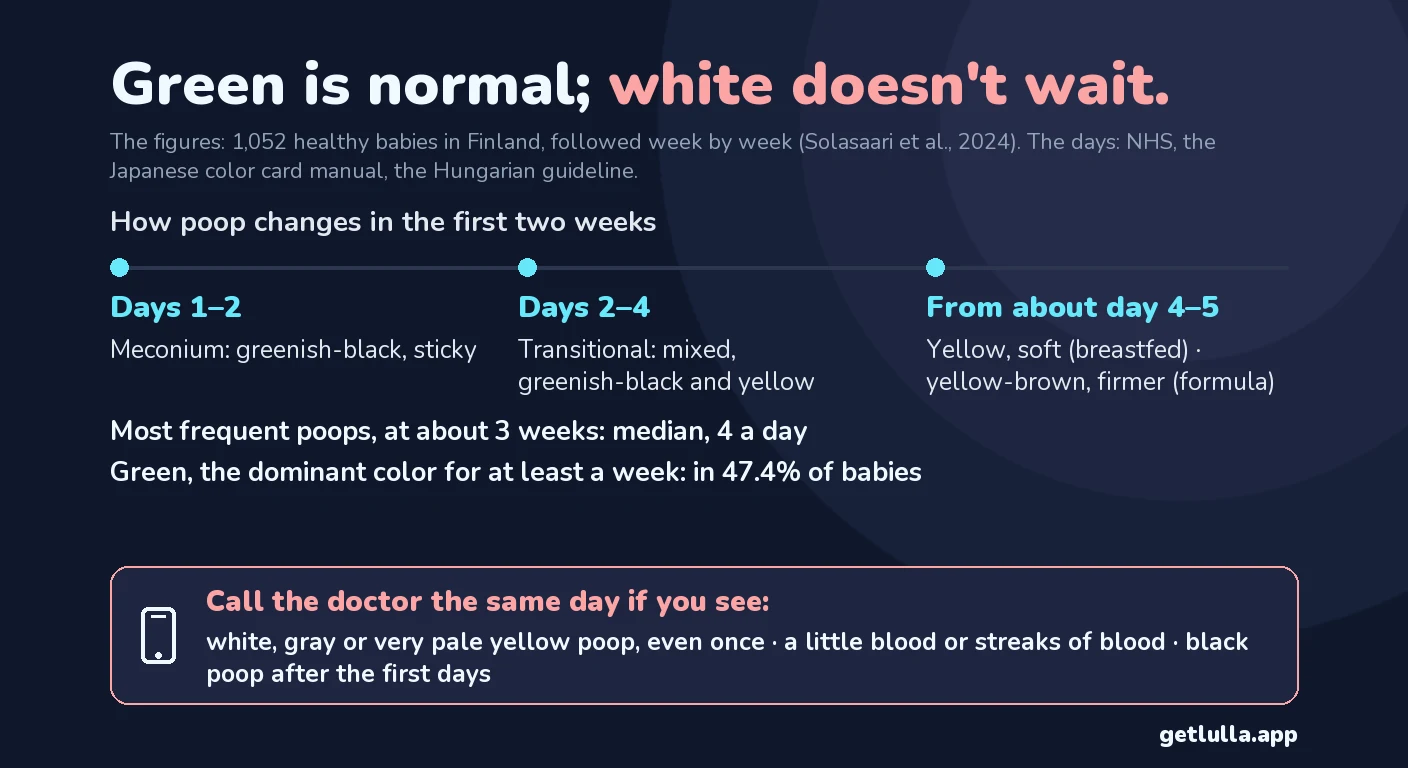
The first stool is meconium: sticky, greenish-black, made of what built up in the intestine before birth. In one American maternity ward it came, on average, almost 8 hours after birth, the same in breastfed and formula-fed babies. The British NICE guideline considers meconium normal within the first 48 hours in a baby born at term, and a warning sign if it comes later; Spanish pediatricians want a doctor to see the baby if it hasn't passed within the first 24 hours.
Next come a few transitional days, with mixed stool, greenish-black and yellow (around days 2–4, according to the Japanese color card manual). Then the poop turns yellow or mustard; the Hungarian ministry's guideline puts the switch at around day 5. In a breastfed baby it's soft or even runny and almost odorless, with little bits that “remind many parents of seeds,” American pediatricians write. In a formula-fed baby it's firmer, darker, toward brown, and smells stronger.
How many poopy diapers in the first week show that a breastfed baby is eating enough is a separate question, with day-by-day thresholds, in the guide to how much a newborn eats. In short: in an American study of exclusively breastfed babies, more stools in the first 5 days went together with less weight loss, and the authors recommend that a baby with few stools or a late switch to yellow be weighed at the doctor's office.
Green poop in newborns: why it happens and why it's normal
Green is the color that scares parents most often, and it's actually one of the most common. In Finland, 1,052 healthy babies were followed week by week up to 4 months: in 47.4% of them, green was the dominant color for at least one week, and in breastfed babies it showed up just as often as in formula-fed ones (47.7% vs. 45.2%). And the 152 Finnish babies with green poop for at least three weeks in a row, followed up to 1–2 years, had no worrying sign of digestive disease, although their parents reported mild digestive discomfort 1.5–2 times as often.
Green comes from bile: bilirubin, which is yellow, can turn in the intestine into biliverdin, which is green, the Japanese manual explains. American pediatricians write that, after meconium, all shades of yellow, brown and even green are “perfectly acceptable.” And some formulas turn poop green: one with more iron (12 mg per liter), in an American study; one with hydrolyzed protein, in a German study with three co-authors from HiPP, a formula maker; and switching from the breast to formula, in a study written by employees of Abbott, another manufacturer.
“Green poop means too much foremilk” has no measurement behind it. In PubMed, “foremilk/hindmilk imbalance” doesn't appear in the title or abstract of a single paper (search from Nov. 20, 2026), and “lactose overload” in breastfed babies appears in a 2013 Australian review article about babies who cry a lot, with no measurements and not a word about color; no official guideline we read mentions it. The idea seems to come from a 1988 hypothesis about colic and diarrhea, not about color. It doesn't fit what was measured, either: formula-fed babies are green just as often. Don't change the way you breastfeed because of the color.
Neither teething nor a cold explains it: we found no study linking them to green poop (Europe PMC, title and abstract, Nov. 20, 2026: zero results), and in an American study with daily diaries, stools had no connection with teeth coming in. A practical tip: very dark green can look black in dim light; smear a little on white paper and look at it in bright light.
Black, red or brown: the other poop colors
Brown. As your baby grows, poop gets darker, and after starting solids it turns brown and firmer. That's normal.
Black. In the first week, meconium is black, and that's expected. Later, black is rare: in the Finnish study, 3.4% of babies had nearly black as a dominant color in the first week, and at most 0.1% after that. Iron can darken it, toward dark brown. But blood from the upper part of the intestine also turns black on the way down, so black poop after the first days is something you tell the doctor about, even if the baby takes iron; if it's just very dark green, the white-paper test will settle it.
Red or with blood. Finnish parents saw blood in the diaper in a single week in 9.3% of healthy babies and in several weeks in 5.2% (in all, almost one in seven), in the first 4 months. The causes are usually minor: a small anal fissure, which leaves streaks on the outside of the stool, or blood swallowed at birth. In a breastfed baby who is otherwise well, streaks of blood can come from allergic proctocolitis, a rare food allergy: 0.18% of children seen at a Turkish allergy center. American pediatricians say any blood should be checked, and a lot of blood means calling right away. In baby girls, in the first week, there can also be a small spot of blood caused by the mother's hormones, American pediatricians write, although in an Italian study most of the reddish stains in baby girls' diapers were actually urate crystals (below).
White, gray or very pale yellow poop: the color that can't wait
White, gray, clay- or chalk-colored, or very washed-out yellow poop can be the first sign of biliary atresia: the ducts that carry bile out of the liver are blocked, bile no longer reaches the intestine, and the stool loses its color. The disease is rare, about 1 in 17,000–18,000 births in England and Wales and in France, about twice as common in one Japanese prefecture and about three times as common in Taiwan. Besides pale stool, there may be dark urine that stains the diaper, and jaundice that doesn't go away after the first two weeks.
Why the day matters: the treatment is an operation (Kasai), and the outcome depends on the age at which it's done. In France, 39% of children operated on in their first month of life still had their own liver at 20 years, compared with 32% of those operated on in the second month, 28% in the third and 19% later. In a survey of 18 European centers, among children operated on in 2015–2019, the median age at surgery was 60 days. And the sign doesn't necessarily come early: in one Japanese hospital, almost half the children had their first pale stool after one month.
That's why several countries give parents a stool color card: Japan (first in one prefecture, from 1994; nationwide, from 2012), Taiwan (from 2004), and in Europe, for example, Switzerland, France and Germany. Used at around one month, the card catches about 80–88% of affected children. But the cards aren't numbered the same way: in Japan the abnormal shades are 1–3, in Germany 5–7, and in Brazil they have no numbers. If your country has a card in the child's health booklet, use that one, in daylight; a phone screen doesn't show pale shades faithfully, which is why we don't put colors to compare here either.
How fast: the guidelines don't agree (table below), from “without losing a single day” in Japan to “during office hours, if it happens at least twice” in the triage guide on the American pediatricians' website. In practice: if you see a stool like this in the first months, even once, call your family doctor or pediatrician the same day, not at the next checkup. Put the diaper in a bag or photograph it in daylight, and tell the doctor whether the urine is dark or the skin still yellow. It's not a reason to call 911, unless the baby is also very sleepy, hard to wake or no longer feeding.
How often should a newborn poop, breastfed or formula-fed
Poops are most frequent at about 2–3 weeks: a median of 4–6 a day, in the studies from Finland and Turkey. After that, the pace slows, faster in breastfed babies. In France, exclusively breastfed babies had on average 4.9 stools a day in the first month, and exclusively formula-fed ones 2.3. By about 4 months the difference shrinks but doesn't disappear: in week 17 of the Finnish study, the median was 2 stools a day in breastfed babies and 1.1 in formula-fed ones (figures by month and by country in the table below).
The range is very wide. In the British ALSPAC cohort, of almost 13,000 babies, the average was 3 stools a day at 4 weeks, but between 0.6 and 5.9 for 94% of them. At 2 months, a quarter of the babies in one Turkish study and almost 40% in another went less than once a day.
The studies, with how the babies were fed and what was counted:
| Study | Country | Age | How many babies | How they were fed | What was counted and what was found | How it was measured |
|---|---|---|---|---|---|---|
| Metaj et al., 2003 | US (Buffalo) | First 24 hours | 979 (211 breastfed, 540 formula-fed, 228 mixed-fed) | Breastfed, compared with formula-fed (mixed-fed babies weren't part of the comparison) | The first stool came on average at 7.6 hours in breastfed babies and at 7.9 hours in formula-fed ones, no difference; the first pee, at 7.3 vs. 8.5 hours | Maternity records, read retrospectively; newborns of at least 34 weeks |
| Çamurdan et al., 2014 | Turkey | Day 15 to 12 months | 125 | Mostly breastfed: exclusively breastfed babies compared with those also getting formula | Median: 6 stools a day on day 15, 4 at one month, 3 at 2 months and 2 a day between 3 and 12 months. Less than once a day: most at 2 months (24.8%). Exclusively breastfed babies went more often than those also getting formula, in the first 5 months | Babies followed from birth; small study |
| Tunc et al., 2008 | Turkey (Ankara) | 0–24 months | 1,021 | All, however they were fed | Median: 6 stools a day in the first month, then one a day from the second month. At 2 months, 39.3% went less than once a day, which lasted until about 6 months | Questionnaire at a well-child clinic, from parents' recall |
| Solasaari et al., 2024 (HELMi cohort) | Finland | Weeks 1–17 | 1,052 | Breastfed, compared with formula-fed | The peak, at 3 weeks: a median of 4 stools a day. In week 17: 2 a day in breastfed babies, 1.1 in formula-fed ones. Green was dominant for at least one week in 47.4% of babies (47.7% of breastfed, 45.2% of formula-fed). Nearly black in the first week in 3.4%, then in at most 0.1%. Blood seen by parents in a single week: 9.3%; in several weeks: 5.2% | Weekly online questionnaires filled in by parents (the week's “dominant” color); healthy babies born at term |
| Moretti et al., 2019 | France (Lille) | 1–3 months | 118 enrolled; at 3 months, 40 exclusively breastfed and 13 exclusively formula-fed | Exclusively breastfed, compared with exclusively formula-fed | Stools a day, on average: 4.9 vs. 2.3 in the first month, 3.2 vs. 1.6 in the second. At least one stretch of infrequent stools: 28% of breastfed, 8% of formula-fed babies (difference not statistically significant) | Prospective study; only 13 exclusively formula-fed babies at 3 months |
| den Hertog et al., 2012 | Netherlands | 1–3 months | 600, selected from 1,175, with no digestive problems | Breastfed, on standard formula and mixed-fed | In breastfed babies, from 3.65 to 1.88 stools a day between 1 and 3 months; on formula and on mixed feeding, no significant change. At 3 months, 50% of formula-fed babies' stools were green | Standardized questionnaire and stool diary; babies with complaints were left out |
| Weaver et al., 1988 | UK | 2–20 weeks | 240 (120 breastfed, 120 formula-fed) | Breastfed, compared with babies on cow's-milk-based formula | Breastfed babies went more often at 2, 4 and 8 weeks; at 16 weeks, both groups, on average 2 stools a day. Stool described as yellow in both groups until solids (newer studies have often found green too) | Prospective study; formula from the '80s |
| Steer et al., 2009 (ALSPAC cohort) | UK (Avon) | 4 weeks (then followed up to 42 months) | 12,984 | All feeding types, pooled | On average 3.0 stools a day at 4 weeks (between 0.6 and 5.9 for 94% of babies); nearly half, liquid or curdy stool; 14% usually hard; yellow at 4 weeks, brown by about 6 months; black, extremely rare | Questionnaires filled in by parents, in a cohort from the '90s |
| Courdent et al., 2014 | France, plus an online survey | First months | 198 in the first study, 85 in the second (online) | Exclusively breastfed | At least one stretch of infrequent stools (more than 24 hours between two stools) in 37% of babies; in 19% of cases, before one month. In the online survey, the longest gap reported: 28 days, one account, not a limit | Two questionnaires; in the second, mothers who volunteered online; no follow-up of the children afterward |
| Hyams et al., 1995 | US | One month | 285 enrolled, 238 completed | Four formulas (with 1 or 12 mg of iron per liter, soy-based, with hydrolyzed protein) and a breastfed group | Green stool was more common on formula with 12 mg of iron per liter (including the soy and hydrolyzed formulas) than on the one with 1 mg or on breast milk; spit-up, gas and crying, the same in all formula groups | Double-blind; formula from the '90s; the effects of iron and of hydrolysis can't be separated in the hydrolyzed formula |
| Typpö et al., 2026 (HELMi cohort) | Finland | First months; followed up at 1–2 years | 152 with mostly green stool, 300 for comparison | Babies with mostly green stool, compared with similar babies | Green for at least 3 weeks in a row. None had any worrying sign of digestive disease; at 1–2 years, 1.5–2 times more mentions of mild digestive discomfort; mucus in stool at one year: 8.6% vs. 3.1% | Case-control within the same cohort; an association, not a cause |
Almost all are studies of healthy babies born at term, with data from parents; little is known about mixed-fed babies. The model day and sleep for the first months:
Newborn · 1 month · 2 months · 3 months
How many days can a breastfed baby go without pooping
After the first weeks, many exclusively breastfed babies start pooping less often, sometimes once every few days. In a French study, 37% of exclusively breastfed babies had at least one stretch of more than 24 hours between two stools. The guidelines say the same, but with different ages and durations. The gaps can start at about 2–3 weeks (Spanish pediatricians) or at about 6 weeks (NHS). How long they can last: “a few days” (NHS), 3–4 days (the German institute, which sums it all up in the rule “five times a day or once every five days”), up to a week (American pediatricians) or “three, four, seven or even 15 days” (Spanish pediatricians).
A maximum number of days after which a gap would no longer be normal isn't given by any official guideline we read, and we didn't find one in any study (Europe PMC, title and abstract, Nov. 20, 2026). The 28-day figure that gets passed around comes from the same French study, from an online survey: it's the longest gap described there, not a safe limit. What matters, all the guidelines say: the stool, when it comes, is soft; the baby feeds well, wets diapers, grows and doesn't seem to have a sore tummy.
Two exceptions. In the first weeks, infrequent poops in a breastfed baby can mean the baby isn't eating enough: Spanish pediatricians want a bowel movement every day in the first two weeks (the thresholds are in the guide to newborn feeding). And a formula-fed baby usually poops on most days, American pediatricians write, but can also go 1–2 days between stools; if the stool is hard or comes out with pain, it may be constipation.
Straining and crying: infant dyschezia isn't constipation
Many young babies turn red, push, grunt and cry for minutes on end before a bowel movement, and then the stool comes out soft. The Rome IV criteria, used by pediatric gastroenterologists, have a name for this, infant dyschezia: in a baby under 9 months, at least 10 minutes of straining and crying before soft stool comes out or doesn't, with no other health problem. The proposed cause is coordination that's still clumsy: the baby pushes with the belly but doesn't yet relax the muscles at the exit well.
It's common early on and goes away on its own. In the Netherlands, the strict criteria of the time (Rome III, which required the stool to actually pass) were met by 3.9% of babies at one month and 0.9% at 3 months, but parents described such episodes in 17.3% and 6.5%, respectively; in a small Swedish cohort (122 babies), up to 22.1% in the first 6 months. The NHS writes that it's normal for babies to strain or even cry when pooping.
What to do: soothe your baby, don't give laxatives, and don't stimulate the anus; the authors of the criteria say stimulation can get the baby used to waiting for it, and Spanish pediatricians say it plainly: not with a finger, not with a thermometer. The “thermometer trick” hasn't been tested as a home remedy (the only case series comes from a surgical center, with no comparison group), and perforation of the bowel by a thermometer appears in the medical literature as an accident. If the straining comes with long crying in the evening, also read the guide to colic and evening crying.
Newborn constipation: what the criteria require and what helps
True constipation isn't recognized by the number of days. The Rome IV criteria require, for one month, at least two of: two or fewer stools a week; excessive stool retention; painful or hard stools; very large-diameter stools; a large mass of stool in the rectum, felt by the doctor. Two stools a week are, then, just one sign out of five. The British NICE guideline specifies that the “fewer than three stools a week” threshold doesn't apply to exclusively breastfed babies after 6 weeks.
By these criteria, constipation is rare in infants: 2.7% in the Netherlands and 3.4% in Italy, in a three-country study. In a Swedish cohort, breastfeeding was associated with a lower chance of constipation, and formula-fed babies' stool is generally firmer. A constipated stool is hard, dry, sometimes like small pebbles, and comes out with pain or with a little blood on it.
In controlled studies, iron didn't cause constipation. In a 1980 controlled study of 93 newborns, iron-fortified formula didn't change the number of stools, their type or the days without a stool, and in one-year-olds on iron drops, constipation was actually rarer than with placebo (1% vs. 9%). Don't switch away from iron-fortified formula because of the poop without talking to the doctor. What does matter is preparation: too much powder can cause constipation or dehydration, the NHS writes.
Water, juice and tea. The 2026 European and North American guideline on treating constipation says there's no evidence that fluids beyond the recommended daily amount help. The NHS recommends more breastfeeds, and for formula allows cooled boiled water between feeds; Spanish pediatricians say not to give juices, laxatives or teas. For fennel tea we found no study in constipated infants (PubMed, Nov. 20, 2026). What to give and when is in the guide to water for babies.
If you think your baby is constipated, talk to the doctor before giving anything. NICE calls for urgent referral to a specialist for a baby under one year whose constipation doesn't improve within 4 weeks of treatment.
Mucus in newborn poop, foam and “seeds”
The seeds and curds in a breastfed baby's poop are normal: American pediatricians describe them as little bits that look like seeds, and in the British cohort, at 4 weeks, almost half the babies had liquid or curdy stool. Foam: the German institute lists “greenish or slightly foamy” stool among the normal variations in a breastfed baby.
Mucus is harder to judge, because little has been measured. The only figures found in healthy children also come from the Finnish study, and only from one year of age: mucus in the stool in 3.1% of comparison children and in 8.6% of those who had had mostly green poop. For the first months, we didn't find such a figure. Nor is “mucus means a milk allergy” a rule: allergy is recognized by blood in the stool, not by mucus alone. If the diaper has a lot of mucus, a lot of blood or very watery stool, American pediatricians want you to call right away; during a bout of diarrhea, NICE lists blood or mucus among the signs that it could be something other than a virus. A little mucus now and then, in a baby who is feeding, growing and in good spirits, you can mention at the next checkup.
Newborn diarrhea or soft breastfed poop?
A breastfed baby's soft, even watery, poop isn't diarrhea. The World Health Organization says so explicitly: diarrhea means at least three loose or liquid stools a day, but not the loose, pasty stools of breastfed babies.
Diarrhea is recognized by the change: a sudden increase in the number of stools, to more than one per feed, with unusually watery stools, American pediatricians write; the Romanian ministry's guideline for doctors says that in young infants a change in consistency matters more than the number of stools. How many diarrheal stools mean a trip to the doctor differs from one guideline to another: more than 4 in 24 hours in an infant (the German institute), 6 or more in children (Italy's ISS); NICE, the British guideline for doctors, lists more than 5 diarrheal stools in 24 hours among the signs of a higher risk of dehydration. After the rotavirus vaccine, a mild, short-lived diarrhea can occur.
What to do: keep breastfeeding or giving formula, in smaller, more frequent feeds if the baby is also vomiting. Don't dilute the formula (NHS; Romanian guideline: usually not necessary); the German institute is the only one that calls for diluting. No juices, which can make diarrhea worse; plain water and tea aren't used for rehydration, the Romanian guideline writes. If extra fluid is needed, the doctor recommends an oral rehydration solution from the pharmacy. A baby under 3 months with diarrhea needs to be seen by a doctor without delay: American pediatricians say to call the pediatrician right away.
Dehydration shows up first in the diapers: fewer wet ones than usual. How many hours without peeing should set off the alarm, the guidelines don't agree: from 3 to 12 (table below). On this site we use the same markers as in the articles on feeding and on water: if, past the first few days, the diaper stays dry for 8 hours straight, go to the doctor or the ER right away; if the baby hasn't peed at all in 12 hours, call 911. The other signs are in the guide to water for babies.
Wet diapers and brick-dust stains in the first days
How many wet diapers to expect on each of the first days is in the guide to how much a newborn eats; here, just one stain that scares a lot of parents. In the first days, a pink, orange or brick-red stain, like brick dust, can show up in the diaper. Usually these are urate crystals, from the concentrated urine of the first days. In an Italian study of 638 newborns, reddish stains appeared in 22% of girls and 13% of boys, most of them urate crystals; in girls they appeared, at the median, on the second day and lasted two days. If, in the first week, your baby wets at least four diapers a day, it's probably not a cause for concern, American pediatricians write (from day 5 on, the markers in the feeding guide apply); if the stain doesn't go away, ask the pediatrician, because rarely it can be blood in the urine. And dark yellow urine that stains the diaper, together with pale stool, is the liver sign described above.
What the guidelines say in each country
On poop and diapers, official sources say different things from one country to another. Below are the site's ten countries, along with the WHO, the UK and the European and North American guideline on constipation. Where it says “not found,” we searched and didn't find it; where it says “couldn't read it,” the source couldn't be opened.
| Who | Stool color card | White, gray or very pale stool | Meconium | How long without peeing is a warning sign | Constipation under 6 months: water, juice, tea | Formula during diarrhea |
|---|---|---|---|---|---|---|
| World Health Organization (WHO) | Has none | Doesn't say (in what we read) | Doesn't say (in what we read) | Doesn't say (in what we read) | Doesn't say (in what we read) | Diarrhea = at least 3 loose or liquid stools a day, but not the loose stools of a breastfed baby; for rehydration, oral rehydration solution |
| UK (NHS and NICE) | Has none | NHS: urgent appointment with the GP or midwife, or NHS 111 (not 999), bringing a stool sample. NICE: if jaundice lasts beyond 14 days (born at term) or 21 (preterm), the doctor looks for pale, chalky stool | Normal within the first 48 hours in a baby born at term; later, a warning sign (NICE) | 12 hours without peeing: 999 (NHS) | Breastfed: more breastfeeds. Formula: cooled boiled water between feeds. On juice, nothing for infants | Formula isn't made more diluted (NHS); milk feeds continue (NICE); no juices |
| US (American pediatricians, AAP) | Has none; since 2025, doctors are urged to ask at the 2–4 week checkup whether stools are pale | To the doctor “as soon as possible”; the triage guide on the AAP site: during office hours, if it happens at least 2 times (the mildest threshold found) | Gives no number of hours (in the pages read) | In a baby with diarrhea, 3 hours or more without peeing: call the pediatrician right away (diarrhea page, from 2015); the dehydration page gives no hours: fewer than 6 wet diapers a day in an infant is a sign of dehydration, and you notify the pediatrician right away | Parent page (2022, from a 2012 book): apple or pear juice from 1 month, about 30 ml a day for each month of life, up to about 4 months. AAP policy from 2017: no juice under one year | Juice isn't appropriate for diarrhea (2017 policy); homemade solutions, no; on diluting, nothing (in the pages read) |
| Germany (federal public health institute, BIÖG, and G-BA) | Yes, since 2023: in the yellow booklet (Gelbes Heft), at the U2 checkup (page 14 in the 2023 edition, 15 in the 2026 one); images 1–4 are normal, 5–7 pale | Yellow booklet (G-BA): if it looks like images 5–7, to the doctor within 24 hours; “urgently” to the pediatrician (BIÖG) | Between a few hours and two days after birth | Less often than once every 8 hours, with dry lips and tongue: to the doctor | Nothing for under 6 months; “plenty to drink” only after starting solids | Diluted, with the dilution reduced step by step (the only country that asks for it) |
| Spain (Spanish pediatricians, AEP) | Not found | See the pediatrician if the stool is grayish-white and the skin yellowish; no time frame | To the pediatrician if it hasn't passed within the first 24 hours | Doesn't say (in what we read) | No juices, no laxatives, no herbal teas; no stimulating the anus with a finger or a thermometer | Couldn't read it |
| Brazil (Ministry of Health) | Yes, in the child's health booklet (Caderneta da Criança, 2023): “normal stools” and “suspicious stools,” no numbers | “Urgently” to a health service | Not found | Gives no number of hours; dark urine is a danger sign under 2 months | Not found | On diluting, nothing; a child who isn't only breastfed is offered water, teas, juices, coconut water (the sentence gives no age) |
| Italy (National Institute of Health, ISS) | No (only local initiatives) | Not found | No stool by the end of the first week is a warning sign (the 2013 dossier for professionals, on breastfeeding) | In a newborn, urine is scant if more than 3 hours pass between two voids | A general page (adults and children): fiber, fluids, bicycle leg movements, belly massage; nothing for under 6 months | Breastfeeding, at the breast or by bottle, isn't interrupted; no juices; 6 or more diarrheal stools in 24 hours (in children): to the doctor; on diluting, nothing |
| Hungary | Not found | Not found | Not found | Not found | Not found | Not found |
| Poland (the Ministry of Health's patient portal) | Not found | Not found | Not found | Not found | Breastfed babies rarely get constipated; to the doctor if the constipated baby is under one month | Not found |
| Japan (Children and Families Agency) | Yes, mandatory in the mother-and-child handbook since 2012: 7 shades, 1–3 abnormal, 4–7 normal; you note the number at 2 weeks, at one month and at 1–4 months | “Without losing a single day” (1日も早く), to the pediatrician or a pediatric surgeon, bringing the stool | Not found | Not found | Not found | Not found |
| Turkey (Ministry of Health protocol, 2018) | Not found | Doesn't mention pale stool; jaundice lasting beyond 2 weeks (born at term) or 3 (preterm): to a specialist | Not found | Not found | Not found | Nothing on diluting; diarrhea is among the reasons to see a doctor right away |
| Romania (Ministry of Health, INSMC) | Not found | Nothing for parents | Not found | Not found | Not found | “Diluting is usually not necessary” (the ministry's guideline for doctors, 2023); for rehydration, no plain water, tea or juices |
| European and North American pediatric gastroenterologists (ESPGHAN and NASPGHAN, 2026 guideline) | Not the guideline's topic | Not the guideline's topic | Not the guideline's topic | Not the guideline's topic | No evidence that fluids beyond the recommended daily amount treat constipation; diagnosis by the Rome IV criteria | Not the guideline's topic |
The details for your country:
In the US there's no national stool color card. Since 2025, a clinical report from American pediatricians (AAP) asks doctors to look, at the 2–4 week checkup, at the color of the eyes and the stool and to ask parents whether the stools are pale; children with biliary atresia who are operated on before one month have, the report says, better chances. On HealthyChildren.org, the AAP writes that the disease affects about 1 in 15,000 babies, that jaundice and pale stool appear at around 4–6 weeks, and that with any concern the baby should be seen “as soon as possible”; the triage guide on the same site, however, says “during office hours,” and only if white or gray stool appears at least twice. The AAP page on diarrhea, from 2015, says to call the pediatrician right away if a baby with diarrhea is 3 months old or younger or hasn't peed in 3 hours or more; the 3-hour threshold is much stricter than other sources'. For emergencies, 911.
When to see a doctor or go to the ER
Call 911 or go to the ER now (outside the US, your local emergency number) if your baby:
- vomits green or yellow-green (the color of bile), vomits blood or something like coffee grounds;
- seems to suddenly have severe belly pain;
- is much sleepier than usual, hard to wake, or floppy, with no muscle tone;
- is under 3 months old and has a temperature of 38 °C (100.4 °F) or higher;
- hasn't peed at all in 12 hours;
- has any of the signs of serious illness in the guide to how much a newborn sleeps: is struggling to breathe, has bluish lips, has a seizure.
Go to the doctor or the ER right away, without waiting until the next day, if:
- past the first few days, the diaper has stayed dry for 8 hours straight;
- the belly is swollen and the baby is vomiting;
- the baby hasn't pooped in about three days and, on top of that, has a swollen or painful belly, is straining hard, or is bleeding from the bottom;
- there's a lot of blood in the stool, bloody diarrhea, or very watery stools full of mucus;
- the baby is under 3 months old and has diarrhea.
Call the doctor the same day if:
- the poop is white, gray, clay-colored or very pale yellow, even just once; take the diaper with you or photograph it in daylight;
- the poop is black after the first days, even if the baby takes iron;
- you see a little blood or streaks of blood in the diaper;
- meconium hasn't passed within the first 48 hours, if you're already home;
- the urine is dark, or the skin and the whites of the eyes are still yellow after the first two weeks.
Talk to the doctor in the next few days if the stools are hard, like pebbles, and come out with pain, if a formula-fed baby poops less than once a day and strains, or if you're not sure what color the poop is. And, as the guidelines say, your worry matters: if your baby isn't their usual self, don't wait to see what happens.
How Lulla helps
In Lulla you log every diaper with two taps, for free: you pick “Wet”, “Dirty” or “Both”, and the time fills in by itself. Under “More details” you can also choose the color (“Yellow”, “Green”, “Brown”, “Black”, “Red” or “Pale”) and the consistency (“Runny”, “Normal” or “Hard”), check “Blood” or “Mucus”, and write down what you noticed. On the Home screen you see, after the day's first entry, how many wet and dirty diapers your baby has had today, and the list of changes keeps the last 30 days, with the color and consistency of each. With Premium, Stats shows you wet and dirty diapers day by day, over 7 or 30 days.
What the log doesn't do, on purpose: it doesn't tell you whether a stool is normal, doesn't give you thresholds and doesn't alert you when your baby hasn't pooped in a few days; it doesn't make diagnoses. If you choose the color “Pale” or “Red”, or “Black” after the first 5 days (if you entered the birth date), or check “Blood”, it only reminds you to tell the doctor; for white, gray or very pale poop, don't wait for the checkup: call the same day. It keeps your notes, so you have them in front of you when you talk to the doctor: how long it's been green, how many days since the last poop, what the stool looked like yesterday.
Keep in mind: this article is for information, not medical advice, and its recommendations come from the guidelines and studies in the source list, each with its own limits. For any concern about your child's poop or diapers, the pediatrician is still the first person to ask: they know your child's history.
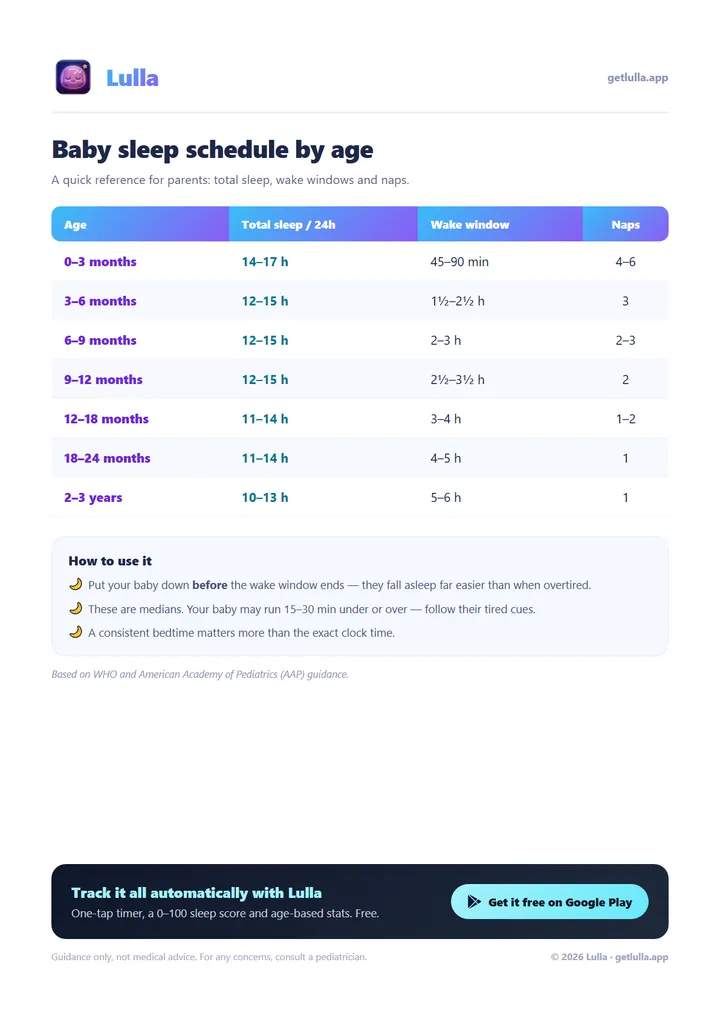
Your baby's sleep schedule, by age
Your baby's sleep schedule, by age
One table with everything that matters: total sleep per 24h, wake windows and number of naps, from newborn to age 3. Total sleep follows the National Sleep Foundation recommendations.
Sources and references
This article draws on official guidelines and peer-reviewed studies. Verify the sources directly:
- World Health Organization. Diarrhoeal disease. Fact sheet; 7 March 2024.
- NHS. How to change your baby's nappy. Page last reviewed 27 August 2024.
- NHS. Jaundice in babies. Page last reviewed 24 March 2026.
- NHS. Constipation in children. Page last reviewed 2 August 2023.
- NHS. Diarrhoea and vomiting. Page last reviewed 21 December 2023.
- NHS. How to make up baby formula. Page last reviewed 31 August 2023.
- NHS. Dehydration. Page last reviewed 1 May 2026.
- NHS. When to get urgent medical help for babies and children under 5. Page last reviewed 6 August 2026.
- National Institute for Health and Care Excellence. Diarrhoea and vomiting caused by gastroenteritis in under 5s: diagnosis and management (CG84). 2009.
- National Institute for Health and Care Excellence. Constipation in children and young people: diagnosis and management (CG99). 2010, updated 2017.
- National Institute for Health and Care Excellence. Jaundice in newborn babies under 28 days (CG98). 2010, updated 2023.
- Jana LA, Shu J; American Academy of Pediatrics. The many colors of baby poop. HealthyChildren.org; last updated 11 July 2024.
- American Academy of Pediatrics. Baby's first days: bowel movements & urination. HealthyChildren.org; last updated 14 November 2024.
- American Academy of Pediatrics. How can I tell if my baby is constipated? HealthyChildren.org; last updated 12 May 2022.
- American Academy of Pediatrics. AAP recommends no fruit juice for children under 1 year. HealthyChildren.org; 2017.
- American Academy of Pediatrics. Diarrhea in babies. HealthyChildren.org; last updated 10 June 2015.
- American Academy of Pediatrics. Signs of dehydration in infants & children. HealthyChildren.org; 2019.
- Schmitt BD. Stools – unusual color. Pediatric Care Advice, HealthyChildren.org symptom checker.
- Valentino PL, Harpavat S; American Academy of Pediatrics. Biliary atresia: when liver disease develops in babies. HealthyChildren.org; last updated 18 February 2025.
- Harpavat S, Aucott SW, Karpen SJ, Shneider BL, Wang K, et al. Guidance for the primary care provider in identifying infants with biliary atresia by 2–4 weeks of life: clinical report. Pediatrics. 2025;155(3):e2024070077.
- National Institute of Diabetes and Digestive and Kidney Diseases. Symptoms & causes of biliary atresia. Last reviewed September 2017.
- Bundesinstitut für Öffentliche Gesundheit (BIÖG). Verdauung des Babys. kindergesundheit-info.de; 30.10.2025.
- Bundesinstitut für Öffentliche Gesundheit (BIÖG). Durchfall bei Babys und Kleinkindern. kindergesundheit-info.de; 28.1.2026.
- Bundesinstitut für Öffentliche Gesundheit (BIÖG). Arztbesuch zwingend. kindergesundheit-info.de; 6.2.2026.
- Gemeinsamer Bundesausschuss. Kinderuntersuchungsheft (Gelbes Heft): Stuhlfarbkarte. Fassung vom 18. Juni 2026.
- Gemeinsamer Bundesausschuss. Gallengangverschluss bei Neugeborenen früher erkennen: Stuhlfarbkarte wird Teil des Kinderuntersuchungsheftes. Pressemitteilung, 12. Mai 2023.
- Asociación Española de Pediatría. Deposiciones (cacas) de los bebés alimentados con pecho o con biberón. ¿Son distintas? En Familia; 2012.
- Storch de Gracia Calvo P; Asociación Española de Pediatría. Cacas de los bebés. Disquecia del lactante. En Familia; 2022.
- Comité de Lactancia Materna, Asociación Española de Pediatría. Características de las deposiciones del bebé amamantado.
- Brasil, Ministério da Saúde. Caderneta da Criança: Passaporte da Cidadania. 6ª edição. Brasília; 2023.
- Brasil, Ministério da Saúde. SAMU 192.
- Istituto Superiore di Sanità. Diarrea. ISSalute; ultimo aggiornamento 26 febbraio 2020.
- Istituto Superiore di Sanità. Stitichezza o stipsi. ISSalute; ultimo aggiornamento 27 dicembre 2021.
- Istituto Superiore di Sanità, Guadagnare Salute. Allattamento al seno: tra arte, scienza e natura. Dossier; 2013.
- Semmelweis Egyetem Gyermekgyógyászati Klinika. Biliaris atresia szűrőprogram; Szülőknek szóló tájékoztató (székletszín-szűrőkártya). 2026.
- Emberi Erőforrások Minisztériuma. Szakmai irányelv az egészséges csecsemő (0–12 hónapos) táplálásáról. Egészségügyi Közlöny 2019/18.
- Ministerstwo Zdrowia, Narodowy Fundusz Zdrowia. Zaparcia u dzieci. pacjent.gov.pl; 4.10.2024.
- こども家庭庁. 母子健康手帳 府令様式(様式第三号): うんちの色に注意しましょう(便色カード). 2026.
- 厚生労働科学研究班(松井陽). 胆道閉鎖症早期発見のための便色カード活用マニュアル. 2012.
- 厚生労働省. 子どもの症状は♯8000.
- T.C. Sağlık Bakanlığı, Halk Sağlığı Genel Müdürlüğü. Bebek, Çocuk, Ergen İzlem Protokolleri. Ankara; 2018.
- T.C. İçişleri Bakanlığı, 112 Acil Çağrı ve Koordinasyon Genel Müdürlüğü.
- Ministerul Sănătății. Ghidul privind abordarea diagnostică și terapeutică a gastroenteritei acute la copil. 2023.
- Institutul Național pentru Sănătatea Mamei și Copilului „Alessandrescu-Rusescu”; Asociația de Neonatologie din România. Ghidul nr. 02: Alimentația cu lapte matern și formule de început a copilului sănătos în primele 6 luni de viață. Revizia 1; 2021.
- Gordon M, de Geus A, Boruta M, Banasiuk M, Benninga M, et al. ESPGHAN/NASPGHAN guidelines for treatment of functional constipation in children aged 0–18 years. Journal of Pediatric Gastroenterology and Nutrition. 2026;83(2):335–366.
- Rome Foundation. Rome IV criteria. Appendix A: Rome IV diagnostic criteria for FGIDs (G5 functional diarrhea, G6 infant dyschezia, G7 functional constipation).
- European Commission. 112: the EU's emergency phone number.
- National 911 Program. Calling 911. 911.gov.
- Benninga MA, Faure C, Hyman PE, St James Roberts I, Schechter NL, Nurko S. Childhood functional gastrointestinal disorders: neonate/toddler. Gastroenterology. 2016;150(6):1443–1455.e2.
- Zeevenhooven J, Koppen IJ, Benninga MA. The new Rome IV criteria for functional gastrointestinal disorders in infants and toddlers. Pediatric Gastroenterology, Hepatology & Nutrition. 2017;20(1):1–13.
- Metaj M, Laroia N, Lawrence RA, Ryan RM. Comparison of breast- and formula-fed normal newborns in time to first stool and urine. Journal of Perinatology. 2003;23(8):624–628.
- Shrago LC, Reifsnider E, Insel K. The Neonatal Bowel Output Study: indicators of adequate breast milk intake in neonates. Pediatric Nursing. 2006;32(3):195–201.
- Çamurdan AD, Beyazova U, Özkan S, Tunç VT. Defecation patterns of the infants mainly breastfed from birth till the 12th month: prospective cohort study. Turkish Journal of Gastroenterology. 2014;25 Suppl 1:1–5.
- Tunc VT, Camurdan AD, Ilhan MN, Sahin F, Beyazova U. Factors associated with defecation patterns in 0–24-month-old children. European Journal of Pediatrics. 2008;167(12):1357–1362.
- Solasaari T, Korpela K, Lommi S, Hyvönen S, Gardemeister S, Merras-Salmio L, Salonen A, de Vos WM, Kolho KL. Bowel function in a prospective cohort of 1052 healthy term infants up to 4 months of age. European Journal of Pediatrics. 2024;183(8):3557–3565.
- Moretti E, Rakza T, Mestdagh B, Labreuche J, Turck D. The bowel movement characteristics of exclusively breastfed and exclusively formula fed infants differ during the first three months of life. Acta Paediatrica. 2019;108(5):877–881.
- den Hertog J, van Leengoed E, Kolk F, van den Broek L, Kramer E, Bakker EJ, Bakker-van Gijssel E, Bulk A, Kneepkens F, Benninga MA. The defecation pattern of healthy term infants up to the age of 3 months. Archives of Disease in Childhood: Fetal and Neonatal Edition. 2012;97(6):F465–F470.
- Weaver LT, Ewing G, Taylor LC. The bowel habit of milk-fed infants. Journal of Pediatric Gastroenterology and Nutrition. 1988;7(4):568–571.
- Steer CD, Emond AM, Golding J, Sandhu B. The variation in stool patterns from 1 to 42 months: a population-based observational study. Archives of Disease in Childhood. 2009;94(3):231–233.
- Courdent M, Beghin L, Akré J, Turck D. Infrequent stools in exclusively breastfed infants. Breastfeeding Medicine. 2014;9(9):442–445.
- Hyams JS, Treem WR, Etienne NL, Weinerman H, MacGilpin D, Hine P, Choy K, Burke G. Effect of infant formula on stool characteristics of young infants. Pediatrics. 1995;95(1):50–54.
- Iron-fortified formulas and gastrointestinal symptoms in infants: a controlled study (with the cooperation of the Syracuse Consortium for Pediatric Clinical Studies). Pediatrics. 1980;66(2):168–170.
- Reeves JD, Yip R. Lack of adverse side effects of oral ferrous sulfate therapy in 1-year-old infants. Pediatrics. 1985;75(2):352–355.
- Lloyd B, Halter RJ, Kuchan MJ, Baggs GE, Ryan AS, Masor ML. Formula tolerance in postbreastfed and exclusively formula-fed infants. Pediatrics. 1999;103(1):E7.
- Otten L, Schelker E, Petersen H, Nomayo A, Conzade R, Günther J, Grieger A, Jochum F; on behalf of the HaSi Study Group. Gastrointestinal tolerance of an infant formula manufactured from extensively hydrolysed protein in healthy term infants. Nutrients. 2023;15(21):4674.
- Typpö L, Solasaari T, Korpela K, de Vos WM, Salonen A, Kolho KL. Green stool predominance in babies and subsequent bowel function at 1–2 years of age. Acta Paediatrica. 2026;115(6):1252–1257.
- Douglas PS. Diagnosing gastro-oesophageal reflux disease or lactose intolerance in babies who cry a lot in the first few months overlooks feeding problems. Journal of Paediatrics and Child Health. 2013;49(4):E252–E256.
- Woolridge MW, Fisher C. Colic, “overfeeding”, and symptoms of lactose malabsorption in the breast-fed baby: a possible artifact of feed management? Lancet. 1988;2(8607):382–384.
- Macknin ML, Piedmonte M, Jacobs J, Skibinski C. Symptoms associated with infant teething: a prospective study. Pediatrics. 2000;105(4 Pt 1):747–752.
- Hsiao CH, Chang MH, Chen HL, Lee HC, Wu TC, Lin CC, et al.; Taiwan Infant Stool Color Card Study Group. Universal screening for biliary atresia using an infant stool color card in Taiwan. Hepatology. 2008;47(4):1233–1240.
- Matsui A. Screening for biliary atresia. Pediatric Surgery International. 2017;33(12):1305–1313.
- Gopal SH, Zebda R, Mohan A, Borovsky K, Takwoingi Y, Scandrett K, Pammi M. Population-based screening strategies for biliary atresia in the newborn: a systematic review and meta-analysis. PLoS One. 2024;19(8):e0307837.
- Arshad A, Gardiner J, Ho C, Rees P, Chadda K, Baker A, Sutcliffe AG. Population-based screening methods in biliary atresia: a systematic review and meta-analysis. Archives of Disease in Childhood. 2023;108(6):468–473.
- Chardot C, Buet C, Serinet MO, Golmard JL, Lachaux A, Roquelaure B, Gottrand F, Broué P, Dabadie A, Gauthier F, Jacquemin E. Improving outcomes of biliary atresia: French national series 1986–2009. Journal of Hepatology. 2013;58(6):1209–1217.
- Livesey E, Cortina Borja M, Sharif K, Alizai N, McClean P, Kelly D, Hadzic N, Davenport M. Epidemiology of biliary atresia in England and Wales (1999–2006). Archives of Disease in Childhood: Fetal and Neonatal Edition. 2009;94(6):F451–F455.
- Wada H, Muraji T, Yokoi A, Okamoto T, Sato S, Takamizawa S, Tsugawa J, Nishijima E. Insignificant seasonal and geographical variation in incidence of biliary atresia in Japan: a regional survey of over 20 years. Journal of Pediatric Surgery. 2007;42(12):2090–2092.
- Lacaille F, Nicastro E, Czubkowski P, Gonçalves CC, Le Thi TG, Koletzko S; ESPGHAN Quality-of-Care Task Force. Awareness, referral and age at Kasai surgery for biliary atresia in Europe: a survey of the Quality-of-Care Task Force of ESPGHAN. Journal of Pediatric Gastroenterology and Nutrition. 2024;78(6):1374–1382.
- Wildhaber BE, Calinescu AM. European strategies in the screening of biliary atresia: a scoping review. World Journal of Pediatric Surgery. 2025;8(2):e001026.
- Nakamura H, Ara M, Koga H, Miyano G, Okawada M, Doi T, Lane GJ, Okazaki T, Urao M, Yamataka A. Duration from the first pale stool to portoenterostomy is prognostic in biliary atresia. Comparison with age at portoenterostomy. Clinics and Research in Hepatology and Gastroenterology. 2021;45(5):101584.
- Kramer EA, den Hertog-Kuijl JH, van den Broek LM, van Leengoed E, Bulk AM, Kneepkens CM, Benninga MA. Defecation patterns in infants: a prospective cohort study. Archives of Disease in Childhood. 2015;100(6):533–536.
- Gatzinsky C, Sillén U, Thornberg S, Sjöström S. Bowel habits in healthy infants and the prevalence of functional constipation, infant colic and infant dyschezia. Acta Paediatrica. 2023;112(6):1341–1350.
- Steutel NF, Zeevenhooven J, Scarpato E, Vandenplas Y, Tabbers MM, Staiano A, Benninga MA. Prevalence of functional gastrointestinal disorders in European infants and toddlers. Journal of Pediatrics. 2020;221:107–114.
- Bloem MN, Baaleman DF, Thapar N, Roberts SE, Koppen IJN, Benninga MA. Prevalence of functional defecation disorders in European children: a systematic review and meta-analysis. Journal of Pediatric Gastroenterology and Nutrition. 2025;80(4):580–597.
- Zhu T, Sun X, Zhu D, You Q, Wan X, Meng X, Feng J. Role of daily anal stimulation for intractable functional constipation in infants. World Journal of Pediatric Surgery. 2020;3(2):e000135.
- Blanchard H, Marton D, Collin PP, Goulet N. [Neonatal pneumoperitoneum caused by perforation by a rectal thermometer. Report of a case and review of the literature]. Journal de l'Association canadienne des radiologistes. 1971;22(4):252–255.
- Senocak N, Ertugrul A, Ozmen S, Bostanci I. Clinical features and clinical course of food protein-induced allergic proctocolitis: 10-year experience of a tertiary medical center. Journal of Allergy and Clinical Immunology: In Practice. 2022;10(6):1608–1613.
- Musto F, Corsello A, Curto S, Logrieco G, Mellos A, Guercio Nuzio S, Romeo AC, Stella G, Bramuzzo M. Gastrointestinal adverse events following rotavirus vaccination in children: a systematic review. Acta Paediatrica. 2026;115:2389–2397.
- Fornelli G, Mondini I, Reschini M, Di Stefano G, Casalechi M, Ferraro C, Fustinoni S, Polledri E, Iurlaro E, Orsi M, Pozzi I, Colombo L, Vigano' P, Vercellini P, Somigliana E, Benaglia L. Challenging the paradigm that neonatal uterine bleeding represents the first menstrual episode. Scientific Reports. 2026;16(1):22374.
- van de Vondervoort S, Kamerbeek A, Harnisch E, Goos M. [Pink-red discoloration in the diaper of a neonate]. Nederlands Tijdschrift voor Geneeskunde. 2026;170:D8720.
📖 Read also:
- Newborn feeding schedule: how often, how much and cluster feeding
- When can newborns have water? From what age, how much and what about tea
- Starting solids: when to start, baby-led weaning and allergens
- Newborn colic: how long it lasts, when it ends, what helps
- How much do newborns sleep? What's normal by age and when it's too much
Or check out the complete baby sleep guide — all 7 articles condensed in one place.