Lulla TeamWe review current pediatric literature and synthesise it into accessible language for parents.
Starting solids: when to start, baby-led weaning and allergens
The first spoonful of zucchini hangs in the air. Your baby looks at it, opens their mouth, then makes a face and pushes everything back out with their tongue. On the table, your phone has three pages open: one says 4 months, another says 6, the third has a chart of which food comes in which week. Starting solids is full of rules. Some have been tested in studies, and the results are more reassuring than you might think; others haven't been tested and get passed from guideline to guideline or from one parent to another.
The short answer on starting solids:
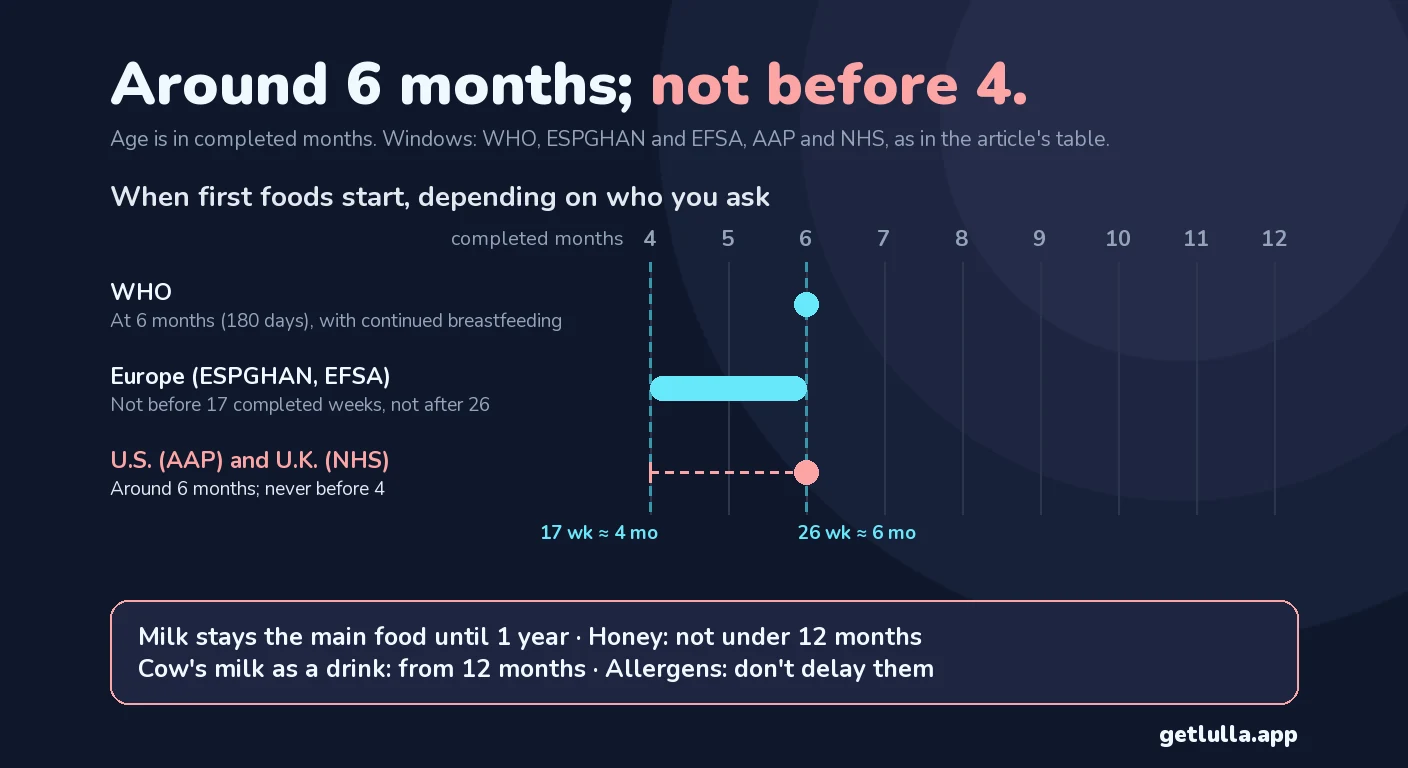
- When: at around 6 months, not before 4 completed months (17 weeks). The World Health Organization says 6 months, European guidelines “between 17 and 26 weeks,” and studies found no growth benefit from starting at 4 months.
- Purees or BLW: both work, with two conditions: an iron-rich food at every meal and food in a safe form. In the study where parents got advice on preventing choking, babies choked just as often on purees as with BLW.
- Iron first: meat, fish, eggs, legumes, iron-fortified cereals. A rejected vegetable is often accepted after 8–10 tries.
- Don't delay allergens: well-cooked egg and peanuts (smooth paste or powder, never whole) alongside the other foods. With severe eczema or an already known allergy, see the doctor first.
- Not before one year: honey, cow's milk as a drink, added salt and sugar, juice, rice drinks, hard and round pieces (whole nuts, not even after one year).
- Milk stays the main food until around one year, and the baby decides how much to eat.
- Swelling of the lips or face, trouble breathing or floppiness after a food means calling 911.
When can infants start eating food: at what age to start solids
The guidelines don't say exactly the same thing. The World Health Organization (WHO) recommends first foods at 6 months, that is, 180 days, with continued breastfeeding; it's a strong recommendation, although the certainty of the evidence is rated low. European pediatric gastroenterologists (ESPGHAN) give a window: not before 17 completed weeks and not after 26. American pediatricians and the NHS say “around 6 months,” never before 4. The dispute is public: in 2024, ESPGHAN and ten other medical societies published a response to the WHO guideline, precisely about age and about cow's milk.
What has been measured explains why. Studies that randomly assigned babies to “from 4 months” or “from 6 months” are few and small. In Iceland, in 119 breastfed babies, foods from 4 months gave a slightly higher ferritin (the body's iron store) at 6 months, but no difference in iron deficiency, anemia or growth. In Honduras, in two studies, first foods from 4 months took the place of part of the breast milk: the babies nursed less, but didn't grow better, not even those born small. The Cochrane review on the length of exclusive breastfeeding found no growth delay with 6 months of breast milk, and fewer digestive infections; in developing countries, where babies may be born with low iron stores, exclusive breastfeeding to 6 months without an iron supplement can affect blood tests.
All these studies were in breastfed babies. For formula-fed babies, Spanish pediatricians give a window between 4 and 6 months. For them, we only have an association, not proof: in an American cohort, among formula-fed babies, solid foods before 4 months went along with more obesity at age 3; among breastfed babies, they didn't. The conclusion that holds: the 4–6 month window is supported, and none of the randomized studies above shows that starting at 4 months is better for growth than starting at 6. For a baby born prematurely, you decide the starting age with the doctor (NHS).
Signs of readiness: when your baby is ready for first foods
The NHS describes three signs that, appearing together at around 6 months, show the baby is ready: they can sit up and hold their head steady; they coordinate eyes, hands and mouth, meaning they look at food, grab it and bring it to their mouth by themselves; they swallow food instead of pushing it back out. The Centers for Disease Control and Prevention (CDC) adds that they open their mouth when the spoon comes and bring objects to their mouth, and the Japanese guideline, that they sit up for more than five seconds and push the spoon out with their tongue less often.
These signs are an agreement among experts, not the result of a test. An American study of 5,475 babies showed that parents really do use them to decide when to start, but no study we found has checked whether they predict a safe meal or better acceptance. Nor has the disappearance of the tongue-thrust reflex been tested as a sign (PubMed and Europe PMC, Nov. 24, 2026: no relevant study). Still, they're the best markers we have, and sitting up steadily matters for swallowing.
The NHS also lists behaviors often mistaken for signs, although they're normal at this age: chewing their fists, waking at night more often than usual, wanting more milk. “They're waking at night, so they want food” is a very widespread idea: in the 2010 British infant feeding survey, cited by the authors of the EAT study, 26% of mothers mentioned night waking as a reason to start solid foods. We didn't find a study linking night waking to readiness for food (Europe PMC, title and abstract, Nov. 24, 2026: zero results).
Purees or baby-led weaning: what was measured on choking, iron and weight
BLW (baby-led weaning, where the baby leads the start of solids) means the baby feeds themselves soft pieces of food from the start, instead of getting purees from a spoon. There have been two independent randomized studies on it, plus a Brazilian one with three groups. The most cited is BLISS, from New Zealand, in 206 babies. Note one detail: BLISS tested a modified version of BLW, in which parents got specific advice, an iron-rich food at every meal, foods in safe shapes and breastfeeding support.
The results, with that detail in mind: between 6 and 8 months, 35% of all babies choked at least once, with no difference between the BLISS babies and the spoon-fed ones (parents recorded the choking, in questionnaires and diaries, knowing which group their child was in). Iron from food and blood tests came out the same, and body mass index was the same at 1 and 2 years. There were downsides too: at 7 months, babies in the BLISS group were eating 35% more sodium, and at 12 months, 94% of all babies, in both groups, had been given a food with a choking risk. BLISS was funded in part by Meat & Livestock Australia, the meat industry organization, and a cereal maker (Heinz Wattie's) supplied the rice cereal; the authors write that the funders had no role.
In Turkey, in 280 breastfed babies, iron came out the same, choking the same, and the BLW babies were somewhat lighter at one year (10.4 vs. 11.1 kg). In Brazil, in 130 babies split into three groups (purees, BLISS and mixed), all with advice on preventing choking, 26% of babies choked at least once, with no difference between groups. The reviews published since then pool these same studies. And BLW without advice, the way many parents do it at home, hasn't been tested in a randomized study.
The guidelines part ways here. The NHS says the risk of choking is no higher when the baby feeds themselves than with a spoon. Germany doesn't recommend BLW as the only method, because proof of its safety is lacking, but accepts it alongside purees. ESPGHAN and Polish pediatricians say the evidence isn't enough for a conclusion. The mixed approach, with purees and soft pieces, is just as accepted. Whichever way you go, the same things matter: iron at every meal, the baby sitting upright, you next to them for the whole meal, and moving on to lumpy food in time; ESPGHAN wants lumpy food by 8–10 months at the latest.
Gagging vs. choking: how to tell them apart
Gagging is very common at first and is part of learning: in the Brazilian study, 80% of babies had it, in all groups. The NHS describes it like this: their eyes water, they push their tongue forward or out, they make a retching movement to bring the food forward, or they may even vomit. It's noisy and passes on its own.
Real choking is something else: the food blocks the airway. If the baby is coughing hard, let them cough and stay with them; don't put your fingers blindly in their mouth, because you can push the piece deeper. If the cough is silent or they can't breathe in, get help right away and call 911. For a baby under one year, the NHS describes first aid like this: you lay them face down along your forearm or thigh, supporting their head, and give up to 5 sharp back blows between the shoulder blades with the heel of your hand. If the piece doesn't come out, you turn them face up along your thighs, with their head lower than their feet, and give up to 5 chest thrusts with two fingers in the middle of the chest, just below the nipple line. Then you alternate back blows and chest thrusts until the piece comes out or help arrives. If they stop responding, you put them on a firm surface and start CPR, with the phone on speaker, as the dispatcher tells you. Even if the piece came out, you take them to the doctor. A short first-aid course before starting solids is worth it.
Foods with a choking risk, from the lists of the CDC, American pediatricians and the NHS: grapes, cherries, cherry tomatoes, large berries and whole melon balls (cut them into quarters); whole nuts, hazelnuts and peanuts; peanut butter eaten off a spoon or in chunks (thin it and mix it into food); raw carrot and apple; hot dogs, chunks of meat or cheese, raisins, whole corn kernels, popcorn, hard candy and gummies. The Italian guideline adds a cutting rule: small round foods in pieces of about 5 mm, long ones lengthwise, never in rounds. Whole nuts stay on the list for years: until at least age 4 for American pediatricians, until 5 for the NHS.
What to start with: iron, vegetables and the 3–5 day rule
Iron. Around the middle of the first year, the iron stores the baby was born with start to run short. In an American study of breastfed babies, ferritin dropped until about 5 and a half months, and iron deficiency began to appear from 4 months and rose until 9, especially in babies born with low stores and in boys. That doesn't mean breastfeeding causes anemia: the risk depends a lot on the stores at birth and on the food that comes after. ESPGHAN puts it simply: from 6 months, all babies need iron-rich foods. On the plate, that means meat, fish, eggs, legumes (lentils, beans, peas) and iron-fortified baby cereals. Iron supplements only if the doctor recommends them.
The order. Many guidelines say outright that there's no required order (the CDC; American, Spanish and Polish pediatricians; the Italian ministry). Germany, by contrast, has a fixed plan, with a vegetable, potato and meat puree first. “Start with rice cereal” isn't a rule backed by studies: the NHS says it isn't needed, and rice brings arsenic. In an American cohort, one-year-olds who ate rice cereal had more than three times as much arsenic in their urine as those who ate no rice at all; the study measured exposure, not an effect on health. On cereal in the bottle, see the guide to newborn feeding.
Vegetables first? The idea is that if you start with fruit, the baby won't want vegetables anymore. In a New Zealand study, babies who got only vegetables for the first 4 weeks ate slightly more broccoli and spinach at 9 months (12 and 10 grams), and liked pear just as much as the others. In two other studies, the benefit didn't last: in the Dutch one, with purees supplied by Danone, the extra vegetables eaten at 12 months were gone by 23 months; in the small British one, in which vegetables were first mixed into milk and rice, with two co-authors from Danone Nutricia, there was no longer any difference between the groups at 6 and 18 months. American pediatricians write that there's no evidence a baby ends up disliking vegetables if fruit comes first. Starting with vegetables is, then, a good choice, not an obligation.
“They spat it out, so they don't like it.” Here the evidence is more solid. A review done for the Dietary Guidelines for Americans, of 21 studies, found that a food offered once a day, for 8–10 days or more, probably increases its acceptance (“moderate” evidence). In a French study, after ten servings of plain artichoke puree, babies ate 63% more and liked it more, an effect that lasted three months; the sweetened version was eaten more, but they didn't like it more. In a French-German follow-up funded by Nestlé, a vegetable rejected at first and then accepted, after being offered at eight meals, was still eaten and liked by 79% of children at 15 months, according to their mothers, and by 57% at age 6, according to the children, although the figure has no comparison group. The NHS says it can take ten tries or more. The face your baby makes at the first spoonful is, most of the time, surprise, not refusal.
One new food every 3–5 days. The rule comes from American recommendations (American pediatricians and the CDC), not from a study that tested it: we found no study comparing waiting a few days with introducing foods without a break (Europe PMC, title and abstract, Nov. 24, 2026: zero results). In a survey published in 2020, among 563 American pediatric practitioners, mostly from Illinois, only 38.6% still recommended a wait of 3 days or more (66.3% for babies at risk of allergy). Guidelines don't agree on the interval either: from “at least a day” to 3–5 days, and the NHS only asks that allergens come one at a time. For the other foods, a specific interval hasn't been shown to be necessary.
Allergens in babies: eggs and peanuts, without delay
Until a few years ago, the advice was to delay eggs, fish and peanuts. Studies turned it around, but exactly who they were done on matters. LEAP, in the U.K., followed 640 babies at high risk: severe eczema, egg allergy or both. Among those who had a negative skin test at the start, peanut allergy at age 5 was 13.7% in those who had avoided peanuts and 1.9% in those who had eaten them regularly, and at age 12, among all participants followed (including those who had a positive test at the start), allergy was 15.4% in the former avoidance group and 4.4% in the eating group. LEAP was funded, among others, by the U.S. allergy institute (NIAID) and by the National Peanut Board, the organization of American peanut growers.
EAT, in England and Wales, was done in the general population: 1,303 exclusively breastfed babies, who were either given six allergenic foods from 3 months or started solids at around 6 months. In the main analysis, the difference wasn't significant (5.6% vs. 7.1% with at least one allergy). Only among those who stuck to the plan was it large (2.4% vs. 7.3%), but only 42% of the families in the early group who could be evaluated stuck to the plan. EAT was funded by the British food agency (FSA), which also commissioned it, and by the British Medical Research Council, and its clinical trials unit was also supported in part by the National Peanut Board. A 2023 meta-analysis of 23 randomized studies and 13,794 babies nonetheless reached a conclusion with high certainty: egg introduced at 3–6 months lowers the risk of egg allergy by about 40%, and peanuts introduced at 3–10 months lower the risk of peanut allergy by about 69%. In real life the effect seems smaller: in Australia, after the guideline called for peanuts early, peanut allergy fell from 3.1% to 2.6%, a nonsignificant difference.
What the guidelines recommend today: well-cooked egg and peanuts as a smooth paste, thinned and mixed into food, or as a powder, alongside the other foods, from the start of solids; never whole peanuts or nuts. Once introduced and tolerated, they stay in the diet regularly, the NHS writes; for high-risk babies, the American guideline recommends a total of 6–7 grams of peanut protein a week, over at least three meals. For a baby with severe eczema or an already known food allergy, talk to the doctor first: the American guideline recommends a test beforehand, and British allergists caution that testing shouldn't delay introduction. Here two British sources part ways: the NHS wants you to talk to the doctor also if there are allergies, eczema or asthma in the family, while British allergists (BSACI) write that a sibling's or parent's allergy doesn't make a baby “high risk.” A few national guidelines still delay some allergens for babies with allergies in the family or in their own history (fish in Mexico; eggs, peanuts and fish in the Turkish ministry's book); you'll find them in the table.
Gluten. Two opposite ideas circulate just as widely: “gluten between 4 and 6 months prevents celiac disease” and “no gluten until one year.” Both were tested in high-risk babies and didn't hold up. In PreventCD, small amounts of gluten between weeks 16 and 24 didn't lower the risk at age 3 (5.9% vs. 4.5%). In CELIPREV, gluten from 12 months instead of 6 only delayed the disease: at age 5, the frequency was the same. In neither study did breastfeeding protect. ESPGHAN says gluten can be introduced anytime between 4 and 12 months; the 2017 position recommended avoiding large amounts in the first weeks after introduction, and the newer summary of the ESPGHAN campaign says that neither the timing nor the amount within this window changes the risk.
What a reaction looks like. Allergic reactions usually appear within a few minutes up to two hours after the new food; with cow's milk, also up to three days later (NHS). A few hives around the mouth, with no other sign, are a mild reaction; swelling of the face, trouble breathing or floppiness means calling 911 (full list below).
What not to give a baby under one year, and when infants can have honey
Honey. It's the only confirmed food source of infant botulism, a rare disease with a median age at onset of 3–4 months, and the authorities say with one voice: not before 12 months. Not in food, not on a pacifier, not “just a little, as a remedy.” Two guidelines put it differently: ESPGHAN and Polish pediatricians allow industrially treated honey, at high pressure and temperature, and the Hungarian guideline says “heat-treated honey can be given,” an ambiguous wording, because boiling at home doesn't destroy the spores.
Cow's milk as a drink. Not as the main drink under 12 months (ESPGHAN, NHS, American pediatricians, Japan, Poland, Italy), because it has little iron; the CDC also mentions the risk of intestinal bleeding. In food, in small amounts, it can be used from around 6 months (NHS, ESPGHAN), and unsweetened yogurt is allowed before one year (CDC). The exception is the WHO, which, at 6–11 months, allows whole animal milk as the main milk if the baby isn't breastfed.
Salt and sugar. No added salt (not even bouillon cubes) and no sugar: salt isn't good for a baby's kidneys, and sugar damages teeth, the NHS writes. It matters most when the baby eats from the family's food: in BLISS, at age 2, two-thirds of all children had too much sodium in their diet. In practice, you take out their portion before salting the pot.
Juice. Under one year there's no need for it, and several guidelines don't want it at all (table below). Whole fruit, mashed or in suitable pieces, is the safer choice. Water comes with the first meals, from a cup, in small amounts; we didn't find a randomized study showing that a breastfed baby needs water when starting solids (Europe PMC, title and abstract, Nov. 24, 2026); an observational study, in a city with a desert climate in Iran, found signs of dehydration in the urine of most of the 4–6-month-old infants who had started solids without water. When and how much water, in the guide to water for babies.
Rice drinks. ESPGHAN excludes them for infants and young children, the NHS until age 5, because of arsenic.
Vegetable purees kept too long. Some vegetables (spinach, Swiss chard, beets, borage) are high in nitrates, which in infants can cause methemoglobinemia, a condition in which the blood carries less oxygen. In Spain, the cases came from purees kept in the fridge from 12 hours to several days, and the risk rose most after 24 hours; and they occurred in babies 7–13 months old, not only in the youngest. Spanish pediatricians don't give Swiss chard, spinach or borage in the first year; the NHS, on the contrary, lists spinach among the first vegetables. The Spanish cases fit the advice of the Spanish food safety agency (AESAN): cooked vegetables, whole or pureed, shouldn't sit at room temperature; you keep them in the fridge only if you serve them the same day, otherwise you freeze them. The Turkish ministry's booklet also asks for food made in single portions that doesn't sit at room temperature for more than two hours.
Raw or runny eggs. European guidelines want eggs well cooked; the NHS allows runny eggs only for British eggs stamped with the red lion, checked for salmonella.
How many meals a day (the WHO pattern) and how much a baby eats
The WHO gives 2–3 meals a day at 6–8 months and 3–4 meals a day from 9 months, plus 1–2 snacks if needed. Polish pediatricians write that toward the end of the first year, formula-fed babies eat 4–5 meals and 1–2 snacks a day.
How much they eat at a meal can't be put in a table in grams: at first, how much they swallow matters less than getting used to tastes and textures, and most of their energy still comes from milk, at the breast or from the bottle (NHS). The WHO recommends responsive feeding, meaning you follow their cues, and Polish pediatricians put it most briefly: the parent decides when and what the child eats, the child decides how much. The NHS describes the “I've had enough” signs: closing their mouth tightly or turning their head away. You wait for them to open their mouth before the spoon and don't force them; if they don't want it today, you try again at the next meal.
A sample day and sleep for the months when solids usually start:
4 months · 5 months · 6 months · 7 months · 8 months
Do solids help a baby sleep better?
Many parents hope that “real” food will bring full nights. An effect was measured, but it's small. In the sleep analysis of the EAT study, babies who had been given solid foods from 3 months slept at 6 months, on average, 16.6 minutes longer per night and woke 1.74 times a night instead of 2.01. Sleep was reported by the parents, who knew which group their child was in, without an objective recording, and the foods started at 3 months, below the European threshold of 4 months. In a French cohort of 8,696 babies, neither baby cereal nor solid foods given early went along with better sleep at one year (sleep again reported by parents).
The NHS says it directly: starting solid foods doesn't make a baby more likely to sleep through the night. How sleep changes in the first year and how much waking is normal, you'll find in the guide to how many hours a baby sleeps and in the guide to the baby who won't sleep; the EAT study, explained in detail, in the guide to newborn feeding.
The studies behind the recommendations
The studies on starting solids cited here, with who was studied and who paid for them. Many are funded, at least in part, by food industry organizations or by public bodies that commissioned the research; where it says “not read,” we didn't see the funding statement.
| Study | Country | How many babies | Who they were | What was compared | What was measured and what was found | Who funded it |
|---|---|---|---|---|---|---|
| Jonsdottir et al., 2012 | Iceland | 119 randomized, 100 completed the study | Healthy, full-term, all breastfed | Other foods from 4 months vs. exclusive breastfeeding to 6 months | At 6 months, higher ferritin (iron store) in those who had started earlier; no difference in iron deficiency, anemia or growth | A U.S. National Institutes of Health grant (NCCIH, in the PubMed record); two authors, Fewtrell and Lucas, had received research funding from infant food manufacturers and had been their consultants; full funding statement, not read |
| Cohen et al., 1994; Dewey et al., 1999 | Honduras | 141 and 119 | Breastfed, from low-income families; in the second study, babies born small (1,500–2,500 g) | Other foods from 4 months vs. exclusive breastfeeding to 6 months | The new foods replaced part of the breast milk (in the first study, up to 103 g a day less), with no better growth, not even in those born small. Total energy: the same in the first study, higher in the second | Second study: UNICEF and Wellstart International, through the U.S. Agency for International Development (USAID); first study: not read |
| Kramer and Kakuma, 2012 (Cochrane review) | Several countries (11 developing, 12 developed) | 23 studies (2 randomized, both from Honduras) | Breastfed (nothing about formula) | Exclusive breastfeeding for 6 months vs. 3–4 months followed by breastfeeding with other foods | No growth delay with 6 months of exclusive breastfeeding; fewer digestive infections; no effect on eczema or asthma; in developing countries, where iron stores at birth may be low, blood tests may suffer without an iron supplement | Canadian Institutes of Health Research; the first author leads one of the included studies |
| BLISS study: Fangupo 2016, Taylor 2017, Daniels 2018, Williams Erickson 2018 | New Zealand (Dunedin) | 206 | General population, mostly families of European descent | Modified BLW (an iron-rich food at every meal, advice on preventing choking, breastfeeding support) vs. usual spoon-feeding | At least one choking episode between 6 and 8 months: 35% of all babies, no difference between groups. Gagging more frequent at 6 months in the BLISS group and less frequent at 8. Iron from food (at 7 and 12 months) and blood tests (at 12 months), the same; body mass index, the same at 1 and 2 years. In the BLISS group, 35% more sodium at 7 months. At 12 months, 94% of all babies had been given a food with a choking risk | Lottery Health Research, Meat & Livestock Australia (meat industry), Karitane Products Society, University of Otago and others; Heinz Wattie's supplied the rice cereal; the funders had no role, the authors write |
| Dogan et al., 2018 | Turkey | 280 enrolled | Breastfed | BLW vs. spoon-feeding | Iron from food and blood tests, the same; at 12 months, the BLW babies lighter (10.4 vs. 11.1 kg); choking, no difference | Not read (not in the PubMed record) |
| de Paiva et al., 2023 | Brazil (Porto Alegre) | 130 followed | Babies 6–12 months old | Three groups: spoon-fed puree, BLISS and mixed; all with advice on preventing choking | At least one choking episode in 26.2% overall (30.2% puree, 22.2% BLISS, 26.2% mixed), nonsignificant difference; gagging in 80% of babies, the same in all groups | Support foundation of the Federal University of Rio Grande do Sul (FAURGS); no conflicts of interest declared |
| Spill et al., 2019 (review for the Dietary Guidelines for Americans) | Several countries | 21 studies | Infants and toddlers, 4–24 months | The same food offered several times vs. fewer times | A food once a day, for 8–10 days or more, probably increases its acceptance (“moderate” evidence); the effect probably extends to foods in the same category, not to others; the studies were mostly on vegetables | U.S. federal project (USDA and HHS); statement, not read |
| Remy et al., 2013 | France | 95 | Babies at the start of solids (on average 6.4 months old) | Plain artichoke puree offered 10 times vs. sweetened or higher-calorie artichoke | Plain version: intake +63%, liking +21%, maintained for 3 months; sweetened version: eaten more (+39%), but not liked more | European Union Framework Programme 7 (HabEat project); no conflicts of interest declared |
| Maier-Nöth et al., 2016 | France and Germany | Children from two earlier studies, followed to age 6 | Breastfed and formula-fed | A vegetable rejected at first, offered at 8 meals in a row | At 15 months, according to the mothers, the vegetable rejected at first and then accepted through repetition was still eaten and liked by 79% of the children; at 6 years, it was liked by 57% (rating given by the child); no comparison group for these figures | Nestlé Nutrition provided the funding; two authors, Nestlé employees |
| Rapson et al., 2022 | New Zealand (Auckland) | 117 | Babies at the start of solids | Only vegetables in the first 4 weeks vs. vegetables and fruit | At 9 months, about 12 g more broccoli and 10 g more spinach eaten; pear, eaten and liked the same; iron, unaffected | A Massey University grant (the protocol also mentions Lottery Health Research); no conflicts declared |
| LEAP study: Du Toit et al., 2015 and 2024 | U.K. | 640 | HIGH RISK: severe eczema, egg allergy or both; entered the study at 4–11 months | Peanuts regularly (about 6 g of peanut protein a week) vs. avoiding them, until age 5 | Peanut allergy at 5 years, in those with a negative skin test at the start: 13.7% with avoidance, 1.9% with eating. At 12 years, in all participants followed (including those with a positive test at the start): 15.4% vs. 4.4% | U.S. allergy institute (NIAID), FARE, MRC and Asthma UK, the U.K. Department of Health, the British food agency (FSA) and the National Peanut Board, the peanut growers' organization; the peanut snack (Bamba) was bought from the manufacturer (Osem) at a discount; the principal investigator held shares in an allergy treatment company |
| EAT study: Perkin et al., 2016 | England and Wales | 1,303 (1,162 in the main analysis) | General population, only babies exclusively breastfed at 3 months | From 3 months, other solid foods first, then six allergenic ones (cow's milk as yogurt, peanuts, egg, sesame, fish, wheat) vs. starting solids at around 6 months | Main analysis: allergy to at least one of the six foods in 5.6% in the early group and 7.1% in the standard group, a statistically nonsignificant difference (p = 0.32). Only among those who stuck to the plan: 2.4% vs. 7.3%, but only 42% of the early group stuck to the plan | British food agency (FSA), which commissioned the study and reviewed its protocol, the British Medical Research Council (MRC) and NIHR; the clinical trials unit, supported in part by the National Peanut Board; the principal investigator had grants from the National Peanut Board and stock options in an allergy treatment company |
| EAT study, sleep analysis: Perkin et al., 2018 | England and Wales | 1,303 | The same babies as in EAT | The same two groups | At 6 months, the early group slept 16.6 minutes longer per night, and waking dropped from 2.01 to 1.74 per night; sleep reported by parents, who knew the group | FSA and MRC; FSA commissioned the paper and reviewed its protocol, statistics and report |
| Scarpone et al., 2023 (meta-analysis) | Several countries | 23 randomized studies, 13,794 babies | From the general population to high risk | Allergens introduced early vs. later | Egg at 3–6 months: risk of egg allergy 40% lower (high certainty, 9 studies). Peanuts at 3–10 months: 69% lower (high certainty, 4 studies) | No funding source declared in the full text; one author leads the EAT study, another declared editorial (Cochrane, Wiley) and expert witness fees |
| PreventCD study: Vriezinga et al., 2014 | Eight European countries and Israel | 944 | High risk: risk genes and a first-degree relative with celiac disease | 100 mg of gluten a day between weeks 16 and 24 vs. placebo | Celiac disease at 3 years: 5.9% vs. 4.5%, nonsignificant difference; breastfeeding didn't change the risk | European Commission, celiac patient foundations, ESPGHAN and others; after 2011, also lab test companies (Thermo Fisher, Eurospital), a bread maker (Fria Bröd) and the Nutricia foundation in Poland; the funders had no role, the authors write |
| CELIPREV study: Lionetti et al., 2014 | Italy | 832 enrolled | High risk: a first-degree relative with celiac disease | Gluten from 6 months vs. 12 months | At 5 years, the same frequency (16% vs. 16%); the later start only delayed the disease; breastfeeding didn't protect | Foundation of the Italian Celiac Association |
| Sanchez-Echaniz et al., 2001; Martinez et al., 2013 | Spain (Bilbao; Pamplona) | 7 cases; 78 cases and 78 controls | Infants with methemoglobinemia after homemade vegetable purees | A case series; then cases compared with healthy babies | The 7 cases in Bilbao were 7–13 months old, with puree kept 12–27 hours in the fridge. In Pamplona (case-control study), puree prepared 24–48 hours ahead had an odds ratio of 17.4, and puree kept more than 48 hours, 24.9, with very wide confidence intervals; the clear link was with borage, the one with Swiss chard uncertain | Not read (not in the PubMed record) |
Almost all are in healthy, full-term babies; many figures come from parents, and several large studies included only breastfed babies.
What the guidelines in each country say
Below, the site's ten countries (for Spanish, Spain and Mexico), alongside the WHO, the European guideline and the U.K. Where it says “doesn't say,” we didn't find the topic in the documents read.
| Who | When to start | Allergens (egg, peanuts) | Honey | Cow's milk as a drink | Juice | Salt and sugar | BLW | Water |
|---|---|---|---|---|---|---|---|---|
| World Health Organization (WHO, 2023 guideline) | At 6 months (180 days), with continued breastfeeding | No formal recommendation; in the text: allergens in the first year lower the risk, but nothing shows a benefit before 6 months, and delaying peanuts may favor allergy | Doesn't say (in the 2023 guideline) | At 6–11 months, if the baby isn't breastfed: formula or whole animal milk (the only one that allows it) | 100% fruit juice, limited | Foods high in sugar, salt and trans fats shouldn't be consumed | Not discussed; recommends responsive feeding | Doesn't say (in the documents read) |
| Europe (European pediatric gastroenterologists, ESPGHAN, and the European Food Safety Authority, EFSA) | Not before 17 completed weeks, not after 26; EFSA: most need other foods at around 6 months | Not delayed; egg well cooked, peanuts as a smooth paste mixed into other foods; at high risk, peanuts between 4 and 11 months, after a specialist's evaluation | Not under 12 months, except industrially treated honey, at high pressure and temperature | Not as the main drink under 12 months; a little in food, yes | To be avoided (2017); in moderation, diluted, once a day (undated ESPGHAN campaign summary) | No added salt or sugar | Insufficient evidence for a conclusion | Water and milk (breast milk or formula) are the main drinks (campaign summary) |
| U.K. (NHS and British allergists, BSACI) | Around 6 months, when the three signs appear together | From ~6 months, one at a time; delaying egg and peanuts beyond 6–12 months may increase the risk. With eczema (BSACI): from 4 months, egg first, then peanuts | Not under 1 year | In food from ~6 months; as the main drink, from 1 year | Not needed under 12 months; if you give it, diluted 1 to 10, only at meals | No salt (not even bouillon cubes) and no sugar | The risk of choking isn't higher than with a spoon | Sips from a cup, with meals, from ~6 months |
| U.S. (American pediatricians, AAP; the Centers for Disease Control and Prevention, CDC; and the NIAID peanut guideline) | Around 6 months; never before 4 | Alongside the other foods; with severe eczema or egg allergy, peanuts as early as 4–6 months, with a doctor's evaluation (NIAID, 2017) | Not under 12 months | Not under 12 months (CDC: risk of intestinal bleeding); unsweetened yogurt, even before 12 months | None under 12 months | No added sugar; no high-salt foods (CDC) | Doesn't say (in the documents read) | No more than one cup (about 240 ml) a day, at 6–12 months |
| Germany (federal public health institute, BIÖG, and the Gesund ins Leben network) | At the earliest from the start of the 5th month, at the latest at the start of the 7th month | Cooked or baked egg and peanuts, in an age-appropriate form, regularly, as solids start, if the family eats them; with moderate or severe atopic dermatitis, the doctor first | Doesn't say (in the 2025 consensus) | In the first year, only in the milk-cereal porridge, no more than 200 ml a day | A tablespoon and a half of fruit juice in the lunch puree, for iron | Doesn't say (in the documents read) | Not BLW alone: proof of safety is lacking; alongside purees, yes | Usually only after the third puree |
| Spain (Spanish pediatricians, AEP) | Breastfed: 6 months. Others: 4–6 months. Not before 4 months (17 weeks), not after 26 weeks | No evidence that delaying beyond 6 months prevents allergy | Doesn't say (in the documents read) | Yogurt or cheese from 9 months; whole cow's milk from 12 months | To be avoided; whole fruit | No salt, sugar or sweeteners | A dedicated page: at around 6 months, when the baby sits almost without support | Doesn't say (in the documents read) |
| Mexico (Ministry of Education, with UNICEF, based on IMSS) | After 6 months | The table: egg, fish, cheese and yogurt from 8 months, fish delayed until after one year if there are allergies in the family; the myths section: egg and dairy, “don't delay them” | Only in the list of sugars to avoid, with no age | Not before 1 year | Doesn't say (in the documents read) | Doesn't say (in the documents read) | Doesn't say (in the documents read) | Doesn't say (in the documents read) |
| Brazil (Ministry of Health, 2019 guide) | After 6 months | Pork, fish and egg white from 6 months; the summary version says they “don't cause allergy,” the full one only that they “do no harm” | No honey and no sugar under 2 years | Doesn't say (in the documents read) | None until 1 year; then no more than 120 ml a day at 1–3 years | No sugar under 2 years | Doesn't say (in the documents read) | Doesn't say (in the documents read) |
| Italy (Ministry of Health) | Usually after the first 6 months | Ordering foods by how allergenic they are has been abandoned | Doesn't say (in the 2016 FAQ) | Not recommended in the first year | Doesn't say (in the documents read) | Doesn't say (in the documents read) | Doesn't say (in the documents read) | Water during the start of solids, no drinks with added sugar |
| Hungary (ministry guideline from 2019, expired in 2022) | From the start of the 5th month to the end of the 6th month | Egg, fish, peanut butter: from 4 completed months | Only “native” honey is banned; “heat-treated honey can be given” (ambiguous: boiled at home isn't safe) | Not as a drink before 2 years; in food, no more than ~100 ml a day from 6 months | 15–20 g in puree | Doesn't say (in the documents read) | Doesn't say (in the documents read) | Only once the baby eats solid foods at least 3 times a day |
| Poland (Polish pediatric gastroenterologists, PTGHiŻDz, 2021) | Usually not before week 17, not after week 26 | Not delayed | Not under 12 months, unless the spores were inactivated industrially | Not as the main drink in the first year | None under 1 year | No more than 0.2 g of salt a day at 7–11 months | No convincing arguments for or against | Doesn't say (in the documents read) |
| Japan (2019 guide of the Ministry of Health, now with the Children and Families Agency) | At around 5–6 months | Delaying doesn't prevent allergy; hard-boiled yolk first, then the whole egg | Not until after 1 year (botulism) | As a drink, preferably after 1 year (because of anemia) | No point before starting solids | Doesn't say (in the documents read) | Eating with the hands starts at around 9 months | Doesn't say (in the documents read) |
| Turkey (Ministry of Health booklet and its 2008/2012 book) | At 6 completed months (180 days) | Booklet: no egg white under 1 year. Book: egg white at 8–9 months; with a history of food allergy, egg, hazelnuts, peanuts, fish and soy not before 12 months | Not under 1 year | Not under 1 year | Booklet: no ready-made juices. Book: fruit and vegetable juice from 6 months | No sugar, salt or additives | Puree mashed with a fork, without a blender | Doesn't say (in the documents read) |
| Romania: we didn't find an official guide for parents; the only source found is a booklet from the NGO Save the Children Romania (2026) | “Usually at 6 months” | Nothing about early introduction of egg or peanuts | “Not earlier than 1 year” (botulism) | “Doesn't replace breast milk or formula in the first year” (whole cow's milk) | Doesn't say (in the documents read) | “To be avoided until at least 3 years” | Doesn't say (in the documents read) | “In small amounts, between meals or at the end” |
The details for your country:
In the U.S., American pediatricians (the AAP, on HealthyChildren.org, in a page updated in June 2026) add doubling of birth weight (at about 13 pounds, around 6 kg) to the signs of readiness and call for one new single-ingredient food every 3–5 days. Water, they also write, is limited to no more than one cup (8 ounces, about 240 ml) a day. Their page on allergens, however, says “at least a day” between new foods, so the same institution gives two intervals. The NIAID-sponsored peanut guideline (2017) divides babies into three groups: with severe eczema, egg allergy or both, peanuts as early as 4–6 months, after a medical evaluation that may include a test; with mild or moderate eczema, at around 6 months, at home, without an evaluation; with no eczema and no allergies, peanuts are introduced freely, along with the other foods. The CDC doesn't recommend foods before 4 months, says that giving only rice cereal raises the risk of arsenic exposure (which is why it also recommends oat, barley or multigrain cereals), and allows unsweetened yogurt before 12 months, but not cow's milk. The 2026 Dietary Guidelines for Americans repeat it: no honey before 12 months. For emergencies, 911.
When to call 911 or see a doctor
911, now (outside the U.S., your local emergency number), if, after eating:
- their lips, face or tongue swell;
- they're breathing with difficulty, wheezing or coughing nonstop;
- they have hives, meaning raised red welts, all over the body;
- they vomit in the first hours after a new food (not gagging during the meal), especially if they vomit more than once or any other sign listed here also appears;
- they turn pale or blue, or suddenly become drowsy and “floppy”;
- they've choked and the cough is silent, they've stopped crying or can't breathe: you call and start back blows, as described above.
Stop the food and talk to the doctor before giving it again if:
- a few hives or a new rash appear around the mouth or on the face, with no other sign;
- in the days after a new food they have diarrhea, vomiting or their eczema gets worse.
Talk to the doctor before starting solids if the baby has severe eczema or an already known food allergy, or was born prematurely.
How Lulla helps
In Lulla you log each meal under “Solid food”, for free. Under “Pick a food” you'll find a list of 25 foods; anything that isn't there, peanuts for example, you write under “Other food”. You can enter “Amount (g)”, answer “Did they like it?” (“Liked it”, “So-so” or “Refused”) and “Any reaction?”: “No reaction”, “Rash”, “Vomiting”, “Diarrhea”, “Gas / colic” or “Constipation”, and under “Notes” you write anything else. A meal with a reaction shows up in the history marked “Reaction noted”. That way you can see how many times you've offered the rejected vegetable, and you have the exact date when you tell the doctor about a rash.
With Premium, Stats shows you “Foods tried” and how many meals had a reaction, and Lulla AI gives you meal ideas. What the app doesn't do: it doesn't tell you which food comes next, it has no calendar and no recommended portions (the grams are for logging, not targets), and it isn't an alarm: it doesn't recognize a serious reaction. With swelling of the face or lips, trouble breathing or floppiness, you call 911; you don't log it.
Keep in mind: this article is informational, not medical advice, and its recommendations come from the guidelines and studies in the source list, each with its own limits. For any concern about your child's meals or allergies, your pediatrician is still the first person to ask: they know your child's history.
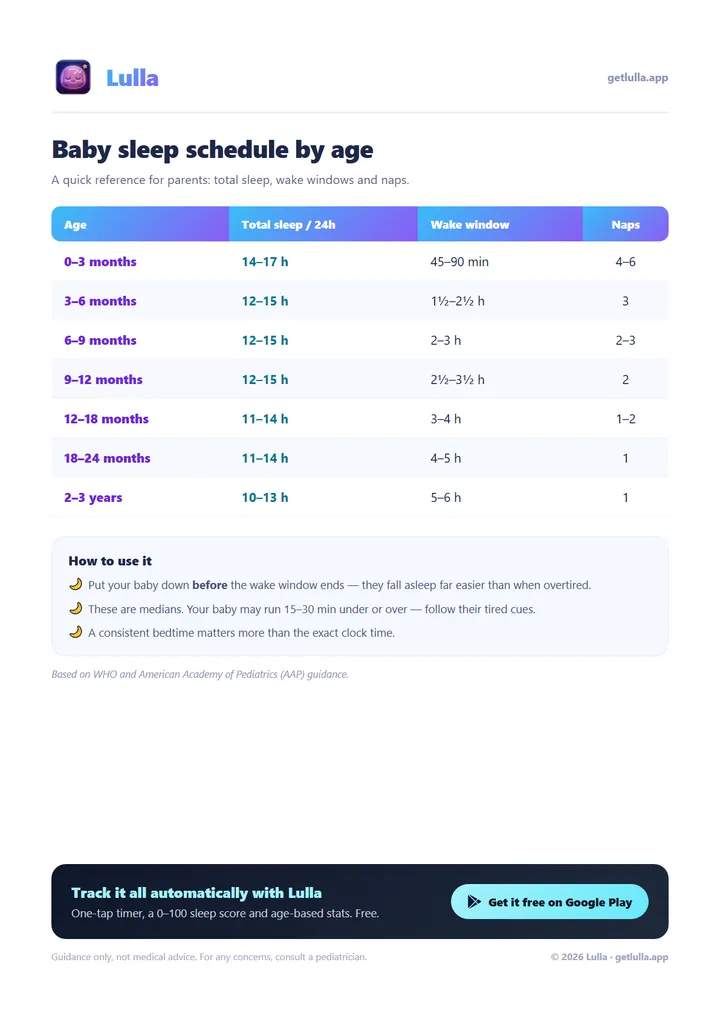
Your baby's sleep schedule, by age
Your baby's sleep schedule, by age
One table with everything that matters: total sleep per 24h, wake windows and number of naps, from newborn to age 3. Total sleep follows the National Sleep Foundation recommendations.
Sources and references
This article draws on official guidelines and peer-reviewed studies. Verify the sources directly:
- World Health Organization. WHO guideline for complementary feeding of infants and young children 6–23 months of age. Geneva; 16 October 2023.
- World Health Organization. Infant and young child feeding. Fact sheet; updated 4 August 2026.
- Fewtrell M, Bronsky J, Campoy C, Domellöf M, Embleton N, Fidler Mis N, Hojsak I, Hulst JM, Indrio F, Lapillonne A, Molgaard C. Complementary feeding: a position paper by the European Society for Paediatric Gastroenterology, Hepatology, and Nutrition (ESPGHAN) Committee on Nutrition. Journal of Pediatric Gastroenterology and Nutrition. 2017;64(1):119–132.
- European Society for Paediatric Gastroenterology, Hepatology and Nutrition. Infant Feeding Campaign: guidance summary.
- European Society for Paediatric Gastroenterology, Hepatology & Nutrition (ESPGHAN), European Academy of Paediatrics, European Society for Paediatric Research, et al. World Health Organization (WHO) guideline on the complementary feeding of infants and young children aged 6–23 months 2023: a multisociety response. Journal of Pediatric Gastroenterology and Nutrition. 2024;79(1):181–188.
- Domellöf M, Braegger C, Campoy C, Colomb V, Decsi T, Fewtrell M, Hojsak I, Mihatsch W, Molgaard C, Shamir R, Turck D, van Goudoever J; ESPGHAN Committee on Nutrition. Iron requirements of infants and toddlers. Journal of Pediatric Gastroenterology and Nutrition. 2014;58(1):119–129.
- Hojsak I, Braegger C, Bronsky J, Campoy C, Colomb V, Decsi T, Domellöf M, Fewtrell M, Mis NF, Mihatsch W, Molgaard C, van Goudoever J; ESPGHAN Committee on Nutrition. Arsenic in rice: a cause for concern. Journal of Pediatric Gastroenterology and Nutrition. 2015;60(1):142–145.
- EFSA Panel on Nutrition, Novel Foods and Food Allergens (NDA), Castenmiller J, de Henauw S, Hirsch-Ernst KI, Kearney J, Knutsen HK, et al. Appropriate age range for introduction of complementary feeding into an infant's diet. EFSA Journal. 2019;17(9):e05780.
- American Academy of Pediatrics. Starting solid foods. HealthyChildren.org; last updated 23 June 2026.
- Cox AL, Pistiner M; American Academy of Pediatrics. When to introduce egg, peanut butter & other common food allergens to a baby. HealthyChildren.org; last updated 12 June 2025.
- Centers for Disease Control and Prevention. When, what, and how to introduce solid foods. 14 April 2026.
- Centers for Disease Control and Prevention. Foods and drinks to avoid or limit. 14 April 2026.
- Centers for Disease Control and Prevention. Choking hazards. 11 March 2026.
- U.S. Department of Agriculture, U.S. Department of Health and Human Services. Dietary Guidelines for Americans: healthy eating for babies & young children. 2026.
- Togias A, Cooper SF, Acebal ML, et al. Addendum guidelines for the prevention of peanut allergy in the United States: report of the National Institute of Allergy and Infectious Diseases-sponsored expert panel. Journal of Allergy and Clinical Immunology. 2017;139(1):29–44.
- NHS. Your baby's first solid foods. Page last reviewed 19 February 2026.
- NHS. Foods to avoid giving babies and young children. Page last reviewed 18 February 2026.
- NHS. Food allergies in babies and young children. Page last reviewed 22 October 2024.
- NHS. Drinks and cups for babies and young children. Page last reviewed 5 October 2022.
- NHS. How to stop a child from choking. Page last reviewed 28 October 2024.
- British Society for Allergy & Clinical Immunology. Early introduction of food allergens. 2026.
- Salvați Copiii România. Diversificarea alimentației bebelușului (broșură, proiectul „Cutia Bebelușului”). 2026.
- Institutul Național pentru Sănătatea Mamei și Copilului „Alessandrescu-Rusescu”; Asociația de Neonatologie din România. Ghidul nr. 02: Alimentația cu lapte matern și formule de început a copilului sănătos în primele 6 luni de viață. Revizia 1; 2021.
- Bundesinstitut für Öffentliche Gesundheit (BIÖG). Beikosteinführung. kindergesundheit-info.de; 30.09.2026.
- Bundesinstitut für Öffentliche Gesundheit (BIÖG). Was ist Baby-led Weaning und ist es für die Ernährung meines Kindes geeignet? kindergesundheit-info.de.
- Bundesinstitut für Öffentliche Gesundheit (BIÖG). Allergierisiko. kindergesundheit-info.de.
- Bundesinstitut für Öffentliche Gesundheit (BIÖG). Getränke. kindergesundheit-info.de; 30.11.2025.
- Abou-Dakn M, Abu-Omar K, Alaze-Hagemann F, Alexy U, et al.; Netzwerk Gesund ins Leben. Ernährung und Bewegung von Säuglingen und stillenden Frauen 2024: teilaktualisierte Handlungsempfehlungen des bundesweiten Netzwerks Gesund ins Leben. Monatsschrift Kinderheilkunde. 2025;173(Suppl 1):69–93.
- Cobo Ruisánchez Á; Asociación Española de Pediatría. Alimentación complementaria. En Familia.
- Asociación Española de Pediatría. Alimentación complementaria dirigida por el bebé. En Familia.
- Asociación Española de Pediatría. Atragantamiento en la infancia: prevención y tratamiento. En Familia.
- Agencia Española de Seguridad Alimentaria y Nutrición (AESAN). Recomendaciones de consumo de hortalizas de hoja para población infantil por la presencia de nitratos (tríptico). Madrid; 2020 (NIPO 069-20-009-9).
- ESPGHAN; Asociación Española de Pediatría (traducción). Guía de bolsillo de alimentación de lactantes para profesionales sanitarios.
- Secretaría de Educación Pública, UNICEF México. Guía para lograr una lactancia materna y alimentación complementaria exitosa. 2024.
- Brasil, Ministério da Saúde. Guia alimentar para crianças brasileiras menores de 2 anos: versão resumida. Brasília; 2019.
- Brasil, Ministério da Saúde. Guia alimentar para crianças brasileiras menores de 2 anos. Brasília; 2019.
- Ministero della Salute. Corretta alimentazione ed educazione nutrizionale nella prima infanzia: FAQ. Roma, 18 luglio 2016 (copia Quotidiano Sanità).
- Ministero della Salute. Linee di indirizzo per la prevenzione del soffocamento da cibo in età pediatrica. 2017.
- Emberi Erőforrások Minisztériuma. Egészségügyi szakmai irányelv: az egészséges csecsemő (0–12 hónapos) táplálásáról (001038). Egészségügyi Közlöny 2019;LXIX(18):2016–2076; hatályos 2022. szeptember 15-ig.
- Szajewska H, Socha P, Horvath A, et al. Zasady żywienia zdrowych niemowląt: zalecenia Polskiego Towarzystwa Gastroenterologii, Hepatologii i Żywienia Dzieci. Standardy Medyczne/Pediatria. 2021;18:7–24.
- 厚生労働省. 授乳・離乳の支援ガイド(2019年改定版). 2019年3月(こども家庭庁).
- 厚生労働省. 子どもの症状は♯8000.
- T.C. Sağlık Bakanlığı, Halk Sağlığı Genel Müdürlüğü. Tamamlayıcı beslenmede önemli noktalar (broşür).
- Köksal G, Gökmen H; T.C. Sağlık Bakanlığı. Bebek Beslenmesi. Yayın No 726. Ankara; 2008 (2. basım 2012).
- T.C. İçişleri Bakanlığı, 112 Acil Çağrı ve Koordinasyon Genel Müdürlüğü.
- Brasil, Ministério da Saúde. SAMU 192.
- European Commission. 112: the EU's emergency phone number.
- National 911 Program. Calling 911. 911.gov.
- Kramer MS, Kakuma R. Optimal duration of exclusive breastfeeding. Cochrane Database of Systematic Reviews. 2012;(8):CD003517.
- Jonsdottir OH, Thorsdottir I, Hibberd PL, Fewtrell MS, Wells JC, Palsson GI, Lucas A, Gunnlaugsson G, Kleinman RE. Timing of the introduction of complementary foods in infancy: a randomized controlled trial. Pediatrics. 2012;130(6):1038–1045.
- Cohen RJ, Brown KH, Canahuati J, Rivera LL, Dewey KG. Effects of age of introduction of complementary foods on infant breast milk intake, total energy intake, and growth: a randomised intervention study in Honduras. Lancet. 1994;344(8918):288–293.
- Dewey KG, Cohen RJ, Brown KH, Rivera LL. Age of introduction of complementary foods and growth of term, low-birth-weight, breast-fed infants: a randomized intervention study in Honduras. American Journal of Clinical Nutrition. 1999;69(4):679–686.
- Huh SY, Rifas-Shiman SL, Taveras EM, Oken E, Gillman MW. Timing of solid food introduction and risk of obesity in preschool-aged children. Pediatrics. 2011;127(3):e544–e551.
- Putnick DL, Ghassabian A, Clayton PK, Sundaram R, Yeung EH. Developmental readiness for complementary feeding: associations with initiation before age 6 months. Journal of Pediatrics. 2025;286:114722.
- Taylor RW, Williams SM, Fangupo LJ, Wheeler BJ, Taylor BJ, Daniels L, Fleming EA, McArthur J, Morison B, Erickson LW, Davies RS, Bacchus S, Cameron SL, Heath AM. Effect of a baby-led approach to complementary feeding on infant growth and overweight: a randomized clinical trial. JAMA Pediatrics. 2017;171(9):838–846.
- Fangupo LJ, Heath AM, Williams SM, Erickson Williams LW, Morison BJ, Fleming EA, Taylor BJ, Wheeler BJ, Taylor RW. A baby-led approach to eating solids and risk of choking. Pediatrics. 2016;138(4):e20160772.
- Daniels L, Taylor RW, Williams SM, Gibson RS, Fleming EA, Wheeler BJ, Taylor BJ, Haszard JJ, Heath AM. Impact of a modified version of baby-led weaning on iron intake and status: a randomised controlled trial. BMJ Open. 2018;8(6):e019036.
- Williams Erickson L, Taylor RW, Haszard JJ, Fleming EA, Daniels L, Morison BJ, Leong C, Fangupo LJ, Wheeler BJ, Taylor BJ, Te Morenga L, McLean RM, Heath AM. Impact of a modified version of baby-led weaning on infant food and nutrient intakes: the BLISS randomized controlled trial. Nutrients. 2018;10(6):740.
- Dogan E, Yilmaz G, Caylan N, Turgut M, Gokcay G, Oguz MM. Baby-led complementary feeding: randomized controlled study. Pediatrics International. 2018;60(12):1073–1080.
- de Paiva CSS, Nunes LM, Bernardi JR, Moreira PR, Mariath AAS, Gomes E. Choking, gagging and complementary feeding methods in the first year of life: a randomized clinical trial. Jornal de Pediatria (Rio de Janeiro). 2023;99(6):574–581.
- Correia L, Sousa AR, Capitão C, Pedro AR. Complementary feeding approaches and risk of choking: a systematic review. Journal of Pediatric Gastroenterology and Nutrition. 2024;79(5):934–942.
- Spill MK, Johns K, Callahan EH, Shapiro MJ, Wong YP, Benjamin-Neelon SE, Birch L, Black MM, Cook JT, Faith MS, Mennella JA, Casavale KO. Repeated exposure to food and food acceptability in infants and toddlers: a systematic review. American Journal of Clinical Nutrition. 2019;109(Suppl 7):978S–989S.
- Remy E, Issanchou S, Chabanet C, Nicklaus S. Repeated exposure of infants at complementary feeding to a vegetable puree increases acceptance as effectively as flavor-flavor learning and more effectively than flavor-nutrient learning. Journal of Nutrition. 2013;143(7):1194–1200.
- Maier-Nöth A, Schaal B, Leathwood P, Issanchou S. The lasting influences of early food-related variety experience: a longitudinal study of vegetable acceptance from 5 months to 6 years in two populations. PLoS One. 2016;11(3):e0151356.
- Rapson JP, von Hurst PR, Hetherington MM, Mazahery H, Conlon CA. Starting complementary feeding with vegetables only increases vegetable acceptance at 9 months: a randomized controlled trial. American Journal of Clinical Nutrition. 2022;116(1):111–121.
- Barends C, de Vries JH, Mojet J, de Graaf C. Effects of starting weaning exclusively with vegetables on vegetable intake at the age of 12 and 23 months. Appetite. 2014;81:193–199.
- Hetherington MM, Schwartz C, Madrelle J, Croden F, Nekitsing C, Vereijken CM, Weenen H. A step-by-step introduction to vegetables at the beginning of complementary feeding: the effects of early and repeated exposure. Appetite. 2015;84:280–290.
- Samady W, Campbell E, Aktas ON, Jiang J, Bozen A, Fierstein JL, Higgins Joyce A, Gupta RS. Recommendations on complementary food introduction among pediatric practitioners. JAMA Network Open. 2020;3(8):e2013070.
- Du Toit G, Roberts G, Sayre PH, Bahnson HT, Radulovic S, Santos AF, Brough HA, Phippard D, Basting M, Feeney M, Turcanu V, Sever ML, Gomez Lorenzo M, Plaut M, Lack G; LEAP Study Team. Randomized trial of peanut consumption in infants at risk for peanut allergy. New England Journal of Medicine. 2015;372(9):803–813.
- Du Toit G, Huffaker MF, Radulovic S, Feeney M, Fisher HR, Byron M, et al. Follow-up to adolescence after early peanut introduction for allergy prevention. NEJM Evidence. 2024;3(6):EVIDoa2300311.
- Perkin MR, Logan K, Tseng A, Raji B, Ayis S, Peacock J, Brough H, Marrs T, Radulovic S, Craven J, Flohr C, Lack G; EAT Study Team. Randomized trial of introduction of allergenic foods in breast-fed infants. New England Journal of Medicine. 2016;374(18):1733–1743.
- Perkin MR, Logan K, Marrs T, Radulovic S, Craven J, Flohr C, Lack G; EAT Study Team. Enquiring About Tolerance (EAT) study: feasibility of an early allergenic food introduction regimen. Journal of Allergy and Clinical Immunology. 2016;137(5):1477–1486.e8.
- Scarpone R, Kimkool P, Ierodiakonou D, Leonardi-Bee J, Garcia-Larsen V, Perkin MR, Boyle RJ. Timing of allergenic food introduction and risk of immunoglobulin E-mediated food allergy: a systematic review and meta-analysis. JAMA Pediatrics. 2023;177(5):489–497.
- Soriano VX, Peters RL, Moreno-Betancur M, Ponsonby AL, Gell G, Odoi A, Perrett KP, Tang MLK, Gurrin LC, Allen KJ, Dharmage SC, Koplin JJ. Association between earlier introduction of peanut and prevalence of peanut allergy in infants in Australia. JAMA. 2022;328(1):48–56.
- Vriezinga SL, Auricchio R, Bravi E, Castillejo G, Chmielewska A, Crespo Escobar P, et al. Randomized feeding intervention in infants at high risk for celiac disease. New England Journal of Medicine. 2014;371(14):1304–1315.
- Lionetti E, Castellaneta S, Francavilla R, Pulvirenti A, Tonutti E, Amarri S, et al. Introduction of gluten, HLA status, and the risk of celiac disease in children. New England Journal of Medicine. 2014;371(14):1295–1303.
- Perkin MR, Bahnson HT, Logan K, Marrs T, Radulovic S, Craven J, Flohr C, Lack G. Association of early introduction of solids with infant sleep: a secondary analysis of a randomized clinical trial. JAMA Pediatrics. 2018;172(8):e180739.
- Messayke S, Davisse-Paturet C, Nicklaus S, Dufourg MN, Charles MA, de Lauzon-Guillain B, Plancoulaine S. Infant feeding practices and sleep at 1 year of age in the nationwide ELFE cohort. Maternal & Child Nutrition. 2021;17(1):e13072.
- Ziegler EE, Nelson SE, Jeter JM. Iron stores of breastfed infants during the first year of life. Nutrients. 2014;6(5):2023–2034.
- Karagas MR, Punshon T, Sayarath V, Jackson BP, Folt CL, Cottingham KL. Association of rice and rice-product consumption with arsenic exposure early in life. JAMA Pediatrics. 2016;170(6):609–616.
- Greer FR, Shannon M; American Academy of Pediatrics Committee on Nutrition; Committee on Environmental Health. Infant methemoglobinemia: the role of dietary nitrate in food and water. Pediatrics. 2005;116(3):784–786.
- Martinez A, Sanchez-Valverde F, Gil F, Clerigué N, Aznal E, Etayo V, Vitoria I, Oscoz M. Methemoglobinemia induced by vegetable intake in infants in northern Spain. Journal of Pediatric Gastroenterology and Nutrition. 2013;56(5):573–577.
- Sanchez-Echaniz J, Benito-Fernández J, Mintegui-Raso S. Methemoglobinemia and consumption of vegetables in infants. Pediatrics. 2001;107(5):1024–1028.
- Aricò MO, Caselli D, Stefanizzi P, Tafuri S, Aricò M. Infant botulism and honey exposure: global epidemiology, prevention policies, and communication strategies. Acta Paediatrica. 2026;115:1429–1433.
- Shakiba M, Montehaee T, Nafei Z, Falahzade MH. Water status of breastfed infants during weaning in Yazd, Iran. Saudi Medical Journal. 2008;29(12):1752–1756.
📖 Read also:
- When can newborns have water? From what age, how much and what about tea
- Newborn feeding schedule: how often, how much and cluster feeding
- Newborn poop: colors, green poop, how often and when to worry
- When to drop to one nap: signs and the 2 to 1 nap transition
Or check out the complete baby sleep guide — all 7 articles condensed in one place.