Lulla TeamWe review current pediatric literature and synthesise it into accessible language for parents. All recommendations follow WHO and AAP guidelines.
Why bedtime stories help babies sleep better

Bedtime stories aren't just a beautiful tradition — they're a scientifically proven tool for better sleep.
What science says
A 2023 study (Pediatrics Journal) showed that babies who listen to stories before bed fall asleep 30% faster and have sleep cycles that are 20% longer. Why? The parent's voice activates the parasympathetic system (calming) and reduces cortisol (stress).
Why Lulla stories work
Personalization: Every story includes your baby's name. "Emma's Little Star" creates an emotional connection impossible to replicate with a generic book.
Magic structure: All 120 stories follow the same structure: soothing setup → short adventure → relaxation → falling asleep. Your baby's body learns the pattern.
6 different themes: Stars, forest, ocean, animals, moon, clouds. Each theme has its own sonic universe in your child's imagination.
How to read a bedtime story
- Low voice, slow pace — slower than you normally speak
- Long pauses between sentences — let imagination do the work
- Lower the volume gradually toward the end
- Don't stop abruptly — let the last sentence melt into silence
Lulla generates 8 new stories each session out of the 120 available. The same story never repeats two nights in a row. For maximum effect, fold them into a consistent bedtime routine — predictability amplifies the calming effect of stories.
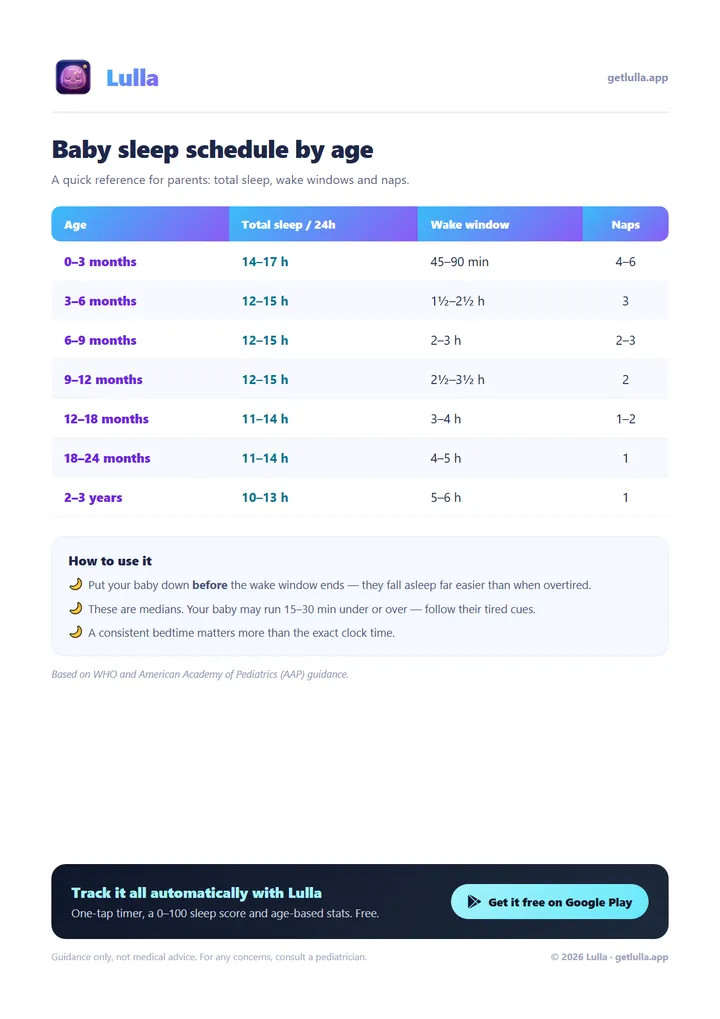
Your baby's sleep schedule, by age
Your baby's sleep schedule, by age
One chart with everything that matters: total sleep per 24h, wake windows and number of naps, from newborn to age 3. Based on WHO and AAP guidance.
Sources and references
This article draws on official guidelines and peer-reviewed studies. Verify the sources directly:
- High PC, Klass P, Council on Early Childhood (2014). Literacy Promotion: An Essential Component of Primary Care Pediatric Practice. Pediatrics, 134(2), 404–409. (AAP policy)
- Mindell JA, Telofski LS, Wiegand B, Kurtz ES (2009). A nightly bedtime routine: Impact on sleep in young children and maternal mood. Sleep, 32(5), 599–606.
- National Sleep Foundation — Bedtime Routines for Children
- American Academy of Pediatrics — Reading to Your Baby Before Bedtime (HealthyChildren.org)
📖 Read also:
- How to build the perfect sleep routine for your baby
- White noise vs. natural sounds: which works better?
- The 4-month sleep regression: what it is and how to get through it
Or check out the complete baby sleep guide — all 7 articles condensed in one place.