Toddler refuses to brush teeth? 12 ideas to try (ages 1–6)
The Lulla Kids team · Updated: · 9 min read
In short
- Refusing to brush is common: Raising Children Network (2025) notes that toddlers often don't want to keep still for toothbrushing. Possible causes include a need for control, unpleasant sensations (the mint taste, the foam), bad timing or toothache.
- The basics: the NHS (2025) recommends brushing at least twice a day for about 2 minutes with fluoride toothpaste, once last thing at night before bed; afterwards, your child spits the toothpaste out and doesn't rinse.
- How much toothpaste: the EAPD (2019), AAPD (2023) and NHS (2025) recommend a smear or a rice-grain-sized amount of fluoride toothpaste for little ones and a pea-sized amount at 3–6. Between 2 and 3 they differ: the EAPD moves to the pea-sized amount from age 2, the AAPD and NHS from 3.
- Help until at least age 7: the EAPD (2019) and NHS (2025) recommend that parents help with or supervise brushing until at least 7. Until then, Raising Children Network (2025) suggests splitting the job: first your child, then you.
- First dentist visit: the NHS (2025) recommends one when the first milk teeth appear or before 12 months, and the AAPD (2025) recommends that by 12 months a child already has a regular dentist.
Why does my toddler refuse to brush their teeth?
If your toddler refuses to brush their teeth, you're not alone: Raising Children Network (2025), the Australian parenting website, notes that toddlers often don't want to keep still for toothbrushing. Possible reasons include a need for control, unpleasant sensations such as a mint taste or lots of foam, bad timing at the end of the day, and toothache.
In more detail, without claiming to diagnose anything:
- A need for control. On HealthyChildren.org (2017), the American Academy of Pediatrics' website for parents, a paediatric dentist writes that it's very typical for a preschooler to challenge you to a “test of wills”, and that this is actually normal: at this age, children are learning to be independent.
- Sensations. An advice sheet from the children's occupational therapy service of North Cheshire and Mersey NHS Foundation Trust (UK) explains that some children are extra aware of the sensations in their mouth. Some don't like the taste of peppermint and describe it as “painful” or “like a burning sensation”, and toothpaste that foams a lot can bother them.
- Timing. The HealthyChildren.org article describes the typical evening: after a long day, parents are exhausted, and the preschooler is tired and cranky.
- Pain. The NHS (2025), the UK's public health service, lists toothache and sharp pain when eating or drinking hot, cold or sweet things among the symptoms of tooth decay.
How should you brush a toddler's teeth?
The NHS (2025) recommends brushing a toddler's teeth at least twice a day for about 2 minutes with fluoride toothpaste, once last thing at night, starting as soon as the first milk tooth comes through. Afterwards, your child should spit the toothpaste out and not rinse: the NHS explains that rinsing stops the fluoride working as well.
- Longer than a minute. The European Academy of Paediatric Dentistry (EAPD, 2019) adds that brushing should last longer than one minute, including for preschoolers.
- From the first tooth. The first milk tooth usually comes through at around 6 months, says the NHS (2025), which recommends a small, soft toothbrush and small circular movements, gently brushing the gums and behind the teeth too.
- Little or no rinsing. The American Academy of Pediatric Dentistry (AAPD, 2023) agrees: minimal rinsing, or none at all.
How much toothpaste should toddlers use at each age?
For toddlers, the European Academy of Paediatric Dentistry (EAPD, 2019), the American Academy of Pediatric Dentistry (AAPD, 2023) and the NHS (2025) recommend a smear or rice-grain-sized amount of fluoride toothpaste from the first tooth, and a pea-sized amount at 3–6. Between 2 and 3 they differ: the EAPD moves to pea-sized at 2, the AAPD and NHS at 3.
| Age | Amount of toothpaste | Recommended by |
|---|---|---|
| From the first tooth to age 2 | A smear or a rice-grain-sized amount (EAPD: 0.125 g) | EAPD (2019), AAPD (2023), NHS (2025) |
| Between 2 and 3 | NHS: a smear; AAPD: no more than a grain of rice; EAPD: pea-sized (0.25 g) | The guidelines differ: ask your child's dentist |
| 3–6 | Pea-sized (EAPD: 0.25 g) | EAPD (2019), AAPD (2023), NHS (2025) |
The fluoride concentration on the packaging matters too. The EAPD (2019) recommends 1,000 ppm from the first tooth to age 6; between 2 and 6, a higher concentration may be considered depending on the child's risk of tooth decay. The NHS (2025) recommends at least 1,000 ppm under 3, and 1,000–1,500 ppm between 3 and 6.
- You put the toothpaste on the brush. The AAPD (2023) points out that under 3, toothpaste dispensed by a parent helps avoid it being swallowed by accident, and the HealthyChildren.org article (2017) recommends doing this until about age 6.
- Keep the tube away from your child. The NHS recommends making sure children don't eat or lick toothpaste from the tube.
- There's a reason for the small amount. According to the AAPD (2023), no more than a smear or a grain of rice under 3 can lower the risk of dental fluorosis. It can occur when a child repeatedly swallows too much fluoride while their tooth enamel is forming; in mild forms it looks like whitish spots, which are generally not considered an aesthetic concern.
When can kids brush their own teeth?
Parents should help with or supervise toothbrushing until at least age 7, recommend the European Academy of Paediatric Dentistry (EAPD, 2019) and the NHS (2025). Children can start helping at around age 2 by holding the toothbrush with you, says Raising Children Network (2025); at 3–6, the NHS says to encourage them to brush while you supervise.
| Age | Who brushes | Source |
|---|---|---|
| Under 3 | Parents do the brushing; from around 2, your child can help by holding the toothbrush with you. | NHS (2025); Raising Children Network (2025) |
| 3–6 | Encourage your child to brush their own teeth while you supervise. | NHS (2025) |
| Around 7–8 | Parents help with or supervise brushing until at least 7; the HealthyChildren.org article mentions 7–8. | EAPD (2019), NHS (2025); HealthyChildren.org (2017) |
How can I get my toddler to brush their teeth? 12 ideas
To get a toddler to brush their teeth, keep the same time and order every evening, offer small choices, brush together, make it playful with a song or a teddy, and hold your child in a stable position. These ideas come from the NHS (2025), HealthyChildren.org (2017), Raising Children Network (2025) and an NHS occupational therapy sheet.
No method works for every child: pick two or three ideas and give them a few days.
- Same time, same order. The HealthyChildren.org article describes the author's family routine, “bath, book, brush, bed”, and explains that a child who knows what to expect tends to respond better and may be less inclined to assert their will.
- Small choices, within the rules. Not “Shall we brush your teeth?” but “The green toothbrush or the blue one?”
- Your child first, then you. Raising Children Network suggests this split: your child feels they're “doing it themselves”, and you know the brush has reached everywhere. The HealthyChildren.org article suggests the reverse also works.
- Brush your teeth together. The NHS suggests brushing your own teeth at the same time and then helping your child finish.
- Teddy goes first. Brush the teddy's teeth together, then it's your child's turn. Or, as Raising Children Network suggests, let them play with their favourite toy while you brush.
- A song or a timer. The NHS (2025) suggests an egg timer for the roughly 2 minutes, and the occupational therapy sheet a sand timer or a short song your child knows: when the song is over, brushing is over.
- A mirror. The NHS recommends one so your child can see where the brush is cleaning, and the occupational therapy sheet adds that it can help them feel more in control.
- A stable position. With a wriggling child, how you're positioned matters:
- For babies, the NHS's easiest option: your baby on your knee, with their head resting against your chest.
- Raising Children Network recommends standing behind your child, so they feel secure, with their head resting against you and their chin cupped in your hands. The Canadian Dental Hygienists Association (CDHA) also suggests standing behind, with their head against your shoulder or upper arm, chin up, looking at the sky.
- For very young or uncooperative children, the CDHA describes the “knee-to-knee” position: two adults sit facing each other with their knees touching; your child lies back on your lap with their head towards the other adult, who brushes, while you hold their hands and talk to them.
- A different toothpaste or toothbrush. If the refusal seems linked to taste or sensation, the occupational therapy sheet suggests a different flavour, a toothpaste that foams less or a softer brush, chosen with your dentist's advice. Change the taste, not the fluoride.
- Tell them what's coming. “Now the top teeth… now the back ones… done!” The same sheet recommends making sure your child knows the steps, for example with a visual schedule.
- Stay calm, even when it doesn't work. Raising Children Network points out that even a short brush is better than none, and that this way your child learns brushing is part of every day.
- Praise the effort, not perfection. “You kept your mouth open right to the end!” says more than “Well done”. For children over 3, the HealthyChildren.org article (2017) suggests a brushing chart, which gives your child a visual cue and a sense of control.
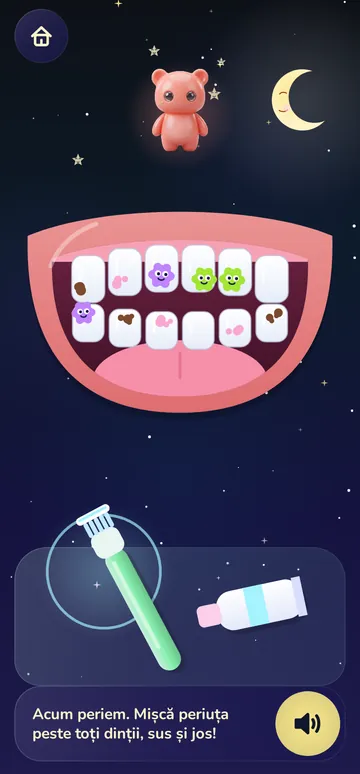
Outside the bathroom, the occupational therapy sheet suggests reading books about toothbrushing together; a calm game with no ads is another option (see what to check before choosing an app).
What should I avoid when my toddler won't brush?
Not all children like having their teeth brushed, says the NHS (2025), so you may have to keep trying. On tough evenings, avoid four traps: using the dentist as a threat, letting your child run around with a toothbrush in their mouth, putting a cartoon on in the bathroom and blaming anyone when an evening goes wrong.
- Don't use the dentist as a threat. The NHS recommends being positive about dental visits, so your child doesn't dread them.
- Don't let them run around with a toothbrush in their mouth. The NHS warns that they could hurt themselves.
- A cartoon in the bathroom is still screen time. See how many minutes suit each age in our article on screen time for toddlers.
- No blame. Start again the next day, with the same routine.
When should I talk to a dentist or paediatrician?
The NHS (2025) recommends a first dentist visit when the first milk teeth appear or before 12 months, and seeing a dentist as soon as possible if your child's teeth seem to hurt or you see spots on them. If a very strong refusal comes with intense reactions in other situations too, talk to your paediatrician.
- You haven't been to the dentist yet. The AAPD (2025) recommends that by 12 months a child should already have a regular dentist. If your child is older than that, book an appointment.
- Brushing seems to hurt, or you see spots. The signs the NHS (2025) lists are complaints about the teeth, flinching at something cold, hot or sweet, and white, brown or black spots on the teeth. It also says to see a dentist if gums are painful, swollen or bleed when brushing.
- The refusal is very strong and doesn't go away. The occupational therapy sheet notes that some children who are very sensitive to sensations in the mouth also have problems with food textures, and recommends asking the dentist for advice if problems with brushing continue.
- You're not sure which toothpaste to choose. Your dentist can tell you which fluoride concentration suits your child's risk of tooth decay (see the EAPD advice above) and when to move to the pea-sized amount, where the guidelines differ.
Frequently asked questions
At what age can a child brush their own teeth?
Parents should help with or supervise toothbrushing until at least age 7, according to the EAPD (2019) and the NHS (2025). Your child can start helping at around 2, by holding the toothbrush with you (Raising Children Network, 2025). Even after 7, the NHS says it's still a good idea to watch them brush.
When should toddlers start using fluoride toothpaste?
From the first tooth: the NHS (2025) recommends brushing with a smear of fluoride toothpaste as soon as the first milk tooth comes through. The EAPD (2019) recommends toothpaste with 1,000 ppm fluoride from the first tooth, in an amount the size of a grain of rice. The amount then goes up to the size of a pea: from age 2 according to the EAPD, from age 3 according to the AAPD (2023) and NHS.
What if my toddler swallows toothpaste?
The EAPD (2019) notes that young children swallow some of the toothpaste, which is why parents should use an amount suited to their age. The AAPD (2023) points out that spitting after brushing and an amount controlled by the parent help avoid swallowing too much. Keep the tube away from your child: the NHS (2025) recommends making sure children don't eat or lick toothpaste from the tube.
What should I do if my toddler won't brush their teeth at all?
Keep trying calmly: the NHS (2025) says not all children like having their teeth brushed, and Raising Children Network (2025) says even a short brush is better than none. Keep the same time and the same order, offer small choices (the toothbrush, the flavour of a fluoride toothpaste) and let your child start, then you finish. If it seems to hurt, see a dentist, as the NHS recommends.
When should my child first see a dentist?
The NHS (2025) recommends a first dentist visit when the first milk teeth appear or before 12 months, so your child gets familiar with the surroundings and the dentist. The AAPD (2025) recommends that by 12 months a child should already have a regular dentist. Be positive when you go: the NHS says that way your child won't worry about future visits.
Sources
- NHS (2025). Children's teeth
- NHS (2025). Looking after your baby's teeth
- NHS (2025). Tooth decay
- European Academy of Paediatric Dentistry (EAPD), European Archives of Paediatric Dentistry (2019). Guidelines on the use of fluoride for caries prevention in children: an updated EAPD policy document
- American Academy of Pediatric Dentistry (AAPD) (2023). Fluoride Therapy (Best Practices)
- American Academy of Pediatric Dentistry (AAPD) (2025). Perinatal and Infant Oral Health Care (Best Practices)
- American Academy of Pediatrics, HealthyChildren.org (2017). How do I get my preschooler to let me brush her teeth?
- Raising Children Network (Australia) (2025). Toddler teeth development, dental health and dental care
- Canadian Dental Hygienists Association (CDHA). Brushing Your Child's Teeth
- North Cheshire and Mersey NHS Foundation Trust, Occupational Therapy Service for Children and Young People. Tooth Brushing – Sensory Advice
General information for parents. It does not replace advice from your paediatrician or dentist.
Everyday routines, practised through play
Handwashing with Pepe, toothbrushing with Bubu, a bedtime routine with Somi. Games with no ads that work without internet, with a daily limit you choose.
18 free games · Premium by subscription or one-time payment · Android app in development